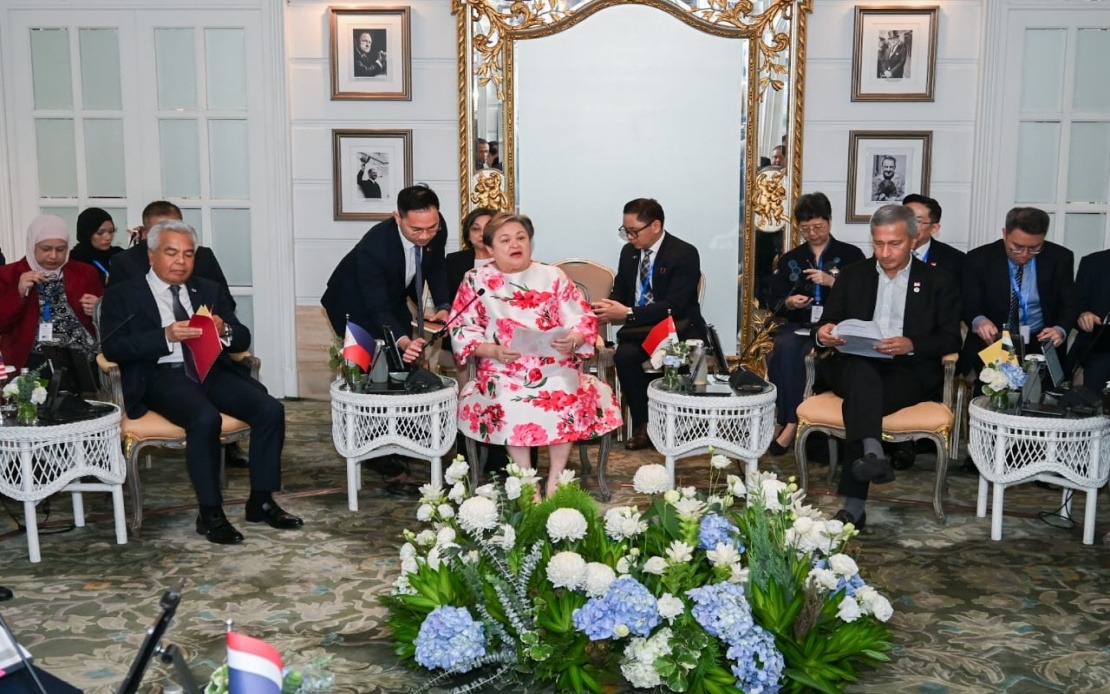
ASEAN's regional approach to the Myanmar crisis remains anchored in the Five-Point Consensus, the diplomatic framework adopted in April 2021 that continues to define the bloc's engagement strategy despite mounting challenges from Naypyidaw. At a gathering of foreign ministers in Bangkok on Sunday, the ten-member regional organisation reaffirmed this foundational document and signalled determination to move from endorsement toward concrete implementation across three critical dimensions: expanding humanitarian relief, curtailing violence against civilians, and facilitating broader political reconciliation among Myanmar's fractured stakeholders.
Philippine Foreign Secretary Maria Theresa Lazaro, serving as the ASEAN Chair's Special Envoy on Myanmar, articulated the bloc's unwavering position with particular directness. Speaking alongside Thailand's Foreign Minister Sihasak Phuangketkeow, Lazaro underscored that the Five-Point Consensus functions as the foundational basis for all ASEAN interactions with Myanmar's government and opposition elements alike. Her remarks carried notable weight given that Myanmar's parliament had rejected the peace framework just days earlier, a decision that some observers interpreted as a signal of hardening positions from the military junta. Nevertheless, Lazaro's statement—that ASEAN "stands behind the Five-Point Consensus"—reflected the bloc's apparent determination not to abandon diplomatic engagement despite this setback.
The Bangkok meeting itself assumed considerable symbolic importance, representing the first in-person gathering between ASEAN's foreign ministers and Myanmar's Foreign Minister since the February 2021 military coup upended the country's democratic trajectory. This diplomatic resumption came after an Informal Meeting of ASEAN Foreign Ministers and an Extended Informal Consultation specifically dedicated to Myanmar affairs, indicating that the crisis retained top billing on the regional agenda. Malaysia's representation through Foreign Ministry Secretary-General Tan Sri Amran Mohamed Zin underscored Kuala Lumpur's continued engagement, though notably Cambodia's absence from the proceedings raised questions about consensus-building fractures within ASEAN itself.
The humanitarian dimension featured prominently in ASEAN's revised expectations for Myanmar's cooperation. The Philippines, in its capacity as current ASEAN Chair, signalled plans to dispatch a humanitarian mission aimed at identifying pathways to increase aid delivery to vulnerable populations within Myanmar. This initiative addresses escalating international concern about civilian suffering amid ongoing conflict, particularly in regions controlled by armed resistance groups and ethnic armed organisations challenging the junta's authority. For Malaysia and other regional economies with significant humanitarian obligations, the expansion of assistance channels represents both a moral imperative and a practical necessity given the flow of displacement across ASEAN borders.
Beyond humanitarian concerns, ASEAN explicitly demanded deceleration in violence directed at Myanmar's civilian population. The second pillar of the regional consensus calls for Myanmar's military authorities to demonstrably reduce combat operations in populated areas and cease extrajudicial actions against non-combatants. This demand carries particular resonance for Southeast Asian nations that have witnessed escalating reports of atrocities and indiscriminate violence affecting ethnic minorities and civilian communities. Thailand's hosting of the meeting reflected Bangkok's geopolitical stakes, sharing a 2,400-kilometre border with Myanmar and managing refugee populations fleeing the conflict.
The third expectation—fostering inclusive political dialogue—strikes at the heart of ASEAN's strategic objective: achieving national reconciliation that could eventually restore Myanmar's democratic institutions. ASEAN's call for creating a politically conducive environment encompasses the contentious issue of political prisoner releases, a humanitarian and political metric that international observers increasingly view as a barometer of good faith engagement. The diplomatic language about advancing "national reconciliation" essentially signals ASEAN's vision of Myanmar eventually returning to civilian democratic governance rather than perpetual military rule, though the timeline and pathway remain nebulous.
Thailand's Foreign Minister injected a crucial caveat into the regional consensus: framing ASEAN's engagement with Myanmar as a "two-way street" requiring reciprocal efforts from Naypyidaw. Sihasak's emphasis on "calibrated engagement"—meaning measured diplomatic pressure coupled with ongoing dialogue—reflects the tension within ASEAN's approach. The bloc has resisted both isolation strategies advocated by Western governments and unconditional acceptance of junta governance favoured by some regional voices, instead pursuing a middle path designed to incentivise cooperation through selective engagement while maintaining communication channels. However, Sihasak's observation that "the key issue is the strategy for implementing" the Five-Point Consensus acknowledged an uncomfortable reality: ASEAN possesses diplomatic tools but limited enforcement mechanisms.
The absence of a firm timeline for assessing Myanmar's progress toward these three objectives revealed the constraints inherent in ASEAN's consensus-based diplomacy. When queried about specific deadlines, Sihasak deferred to the ASEAN Summit scheduled for later in the year, suggesting that comprehensive evaluation of Myanmar's compliance would occur at this higher-level gathering. This deferral, while maintaining ASEAN unity, also provided Myanmar's government with extended discretion in implementing the requested measures. For Malaysian policymakers observing from Bangkok, the lack of binding timelines underscored an enduring tension: ASEAN's commitment to principled engagement versus its limited capacity to enforce standards through concrete consequences.
Myanmar's recent parliamentary rejection of the Five-Point Consensus complicated the diplomatic landscape considerably. The junta's explicit repudiation signalled either confidence in its military dominance or dismissal of ASEAN's regional influence—perhaps both. Yet ASEAN's recommitment to the framework, articulated forcefully by Lazaro and other ministers, suggested the bloc viewed rejection not as dialogue termination but as negotiating posturing. This interpretation reflects ASEAN's institutional preference for sustained engagement regardless of setbacks, a philosophy rooted in the association's founding principle of non-interference coupled with pragmatic recognition that regional stability depends on preventing Myanmar's complete international isolation.
For Malaysia and other ASEAN members, the Bangkok conclave underscored the bloc's continuing struggle to balance competing interests: the need for principled stands against military authoritarianism versus the imperative to maintain regional stability and prevent humanitarian catastrophe. Myanmar's geographic centrality to Southeast Asian geopolitics, its resource endowments, and the presence of ethnic minorities straddling ASEAN borders mean that regional stability directly affects Malaysian interests. The renewal of commitment to the Five-Point Consensus, despite Myanmar's rejection, reflects ASEAN's calculated judgment that continued diplomatic engagement—imperfect and frustratingly slow though it may be—remains preferable to alternatives that could further destabilise Myanmar and consequently the broader region.
Looking ahead, the ASEAN Summit scheduled for later in 2024 will provide the venue for evaluating Myanmar's responsiveness to the three key expectations articulated in Bangkok. The humanitarian mission from the ASEAN Chair will generate empirical data on ground realities regarding violence and civilian conditions, potentially informing subsequent diplomatic pressure. For Malaysian observers and policymakers, the trajectory of ASEAN's Myanmar engagement illustrates both the association's diplomatic strengths—maintaining dialogue amid polarisation—and structural limitations in compelling behavioural change from determined military governments.

