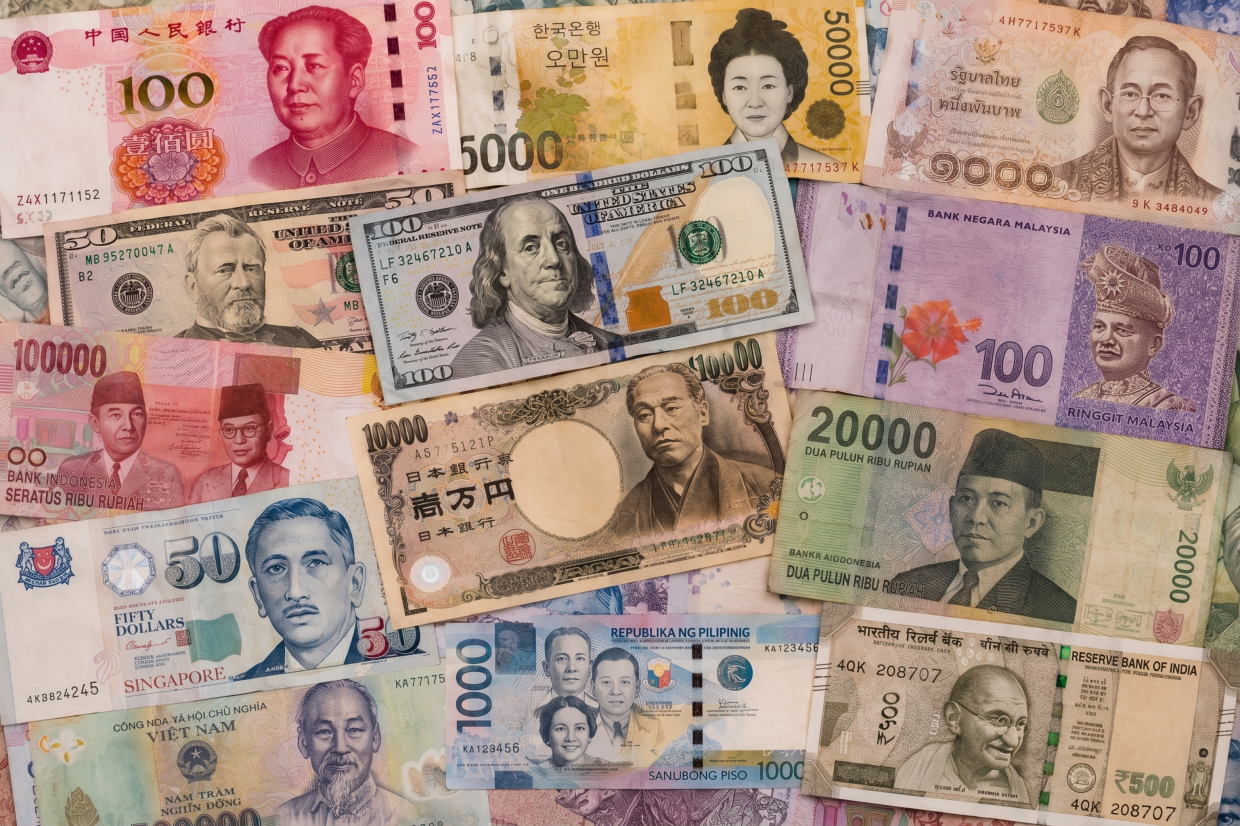
Renewed conflict in the Middle East sent shockwaves through Asian financial markets on Monday, with currencies across the region sliding against the strengthening U.S. dollar as investors fretted over surging oil prices and the spectre of persistent inflation. The geopolitical flare-up, which pushed crude futures up 4%, revived concerns that central banks globally might maintain elevated interest rate settings for longer than previously anticipated, dampening appetite for riskier emerging-market assets and strengthening the dollar's appeal as a safe haven.
The ripple effects were particularly acute in currency markets, where the Indonesian rupiah deteriorated to 18,140 per dollar—its weakest level in over a month—while South Korea's won fell to 1,507.9. These moves reflect a broader retreat from emerging-market currencies as investors reassess the balance between opportunity and risk in a landscape suddenly marked by heightened geopolitical uncertainty and inflationary pressure. The rupiah's weakness is particularly noteworthy given Indonesia's reliance on commodity exports; oil price volatility directly affects both government revenues and the current account balance, making currency stability crucial for managing capital flows and inflation expectations.
The regional equity selloff proved even more dramatic. South Korea's KOSPI benchmark index plummeted 7.96% to a 10-week low, triggering automatic circuit breakers as losses mounted throughout the trading session. The decline was spearheaded by a devastating 13% collapse in SK Hynix, the world's dominant producer of advanced AI memory chips, as investors rushed to lock in profits following the company's robust U.S. market debut on Friday. The chipmaker's sharp reversal underscores the fragility of sentiment in semiconductor stocks, which have been buoyed by explosive demand for high-bandwidth memory solutions powering artificial intelligence applications.
Underlying the KOSPI's volatility are deeper structural concerns that extend beyond SK Hynix's single-day performance. Market participants have grown increasingly wary about whether the extraordinary earnings growth in memory chip production can be sustained, particularly as major artificial intelligence hyperscalers adopt more disciplined capital allocation strategies. The question of demand durability—whether the current wave of AI infrastructure investment will continue at present intensity—has begun to weigh on valuations. Adding fuel to this uncertainty are highly leveraged single-stock exchange-traded funds, which amplify price swings and can trigger cascading sell orders during periods of weakness, creating a feedback loop that exacerbates volatility independent of fundamental developments.
Despite Monday's losses, South Korea's equity market has maintained an impressive trajectory for 2024, still posting a 63% gain since January. The KOSPI has surrendered roughly 25% from its record close on June 22, however, suggesting that the sector's extraordinary run has begun to face natural headwinds. For Malaysia, the currency and equity picture proved more nuanced. The ringgit weakened to 4.0780 per dollar in line with regional trends, yet Malaysian equities actually advanced to three-week highs, suggesting that local investors maintained a relatively more positive outlook despite broader regional headwinds.
This apparent contradiction in Malaysia's market action stems from a unique domestic political development that deserves careful examination for its implications on investor sentiment and policy continuity. Prime Minister Anwar Ibrahim's coalition suffered a decisive defeat in Saturday's Johor state election to a key political partner, an outcome that has triggered serious questions about the strength of the federal ruling alliance. The electoral setback has sparked speculation about the stability of the federal government and raised the possibility of an early general election, introducing political risk at a moment when consistent economic stewardship is particularly valuable given regional uncertainties.
Goldman Sachs analysts weighed in on Malaysia's situation, noting that while the country's macroeconomic fundamentals remain sound, renewed uncertainty regarding coalition cohesion could potentially erode some of the policy-stability premium that has supported Malaysian assets. This distinction is important: the bank's assessment suggests that Malaysia's underlying economic strength—solid growth trajectory, inflation management, and structural reforms—provides a protective floor. However, political risk that threatens continuity of the government's reform agenda represents a separate valuation consideration that could pressure assets if questions about governance durability persist.
The central bank's measures implemented in June to encourage foreign exchange inflows appear to be providing a stabilizing influence on the ringgit, according to Goldman's note. These policy interventions should help prevent excessive currency depreciation and volatility even as the domestic political risk premium persists. This suggests that Bank Negara Malaysia's toolkit remains sufficiently robust to manage near-term currency pressures, though the effectiveness of such measures depends on market confidence in underlying political stability—a factor only the political system can ultimately determine.
Cross the broader region, reactions to the Middle East-driven turmoil were mixed. Philippine equities edged slightly higher while Indonesian stocks gained 0.5%, suggesting that some investors were selectively deploying capital despite overall risk-off sentiment. Taiwan's market inched lower, while Singapore's benchmark index declined 0.7%, ending a remarkable streak of seven consecutive record closes. This varied regional performance indicates that market participants are distinguishing between economies based on energy dependencies, supply-chain exposures, and policy robustness—suggesting that country-specific factors remain decisive even amid broad external shocks.
Looking ahead, the week promises a busy calendar of economic data releases and policy decisions that will help clarify the trajectory of growth and inflation across the region. Singapore's advance second-quarter gross domestic product figures will provide a barometer of economic momentum in the broader region, while the United States' inflation print will give investors crucial insight into whether the oil price surge threatens to persist as an inflationary force. Bank of Korea's interest rate decision holds particular significance for regional monetary policy tightening cycles, and Malaysia's inflation and output data will prove essential for assessing whether the ringgit weakness poses risks to price stability.

