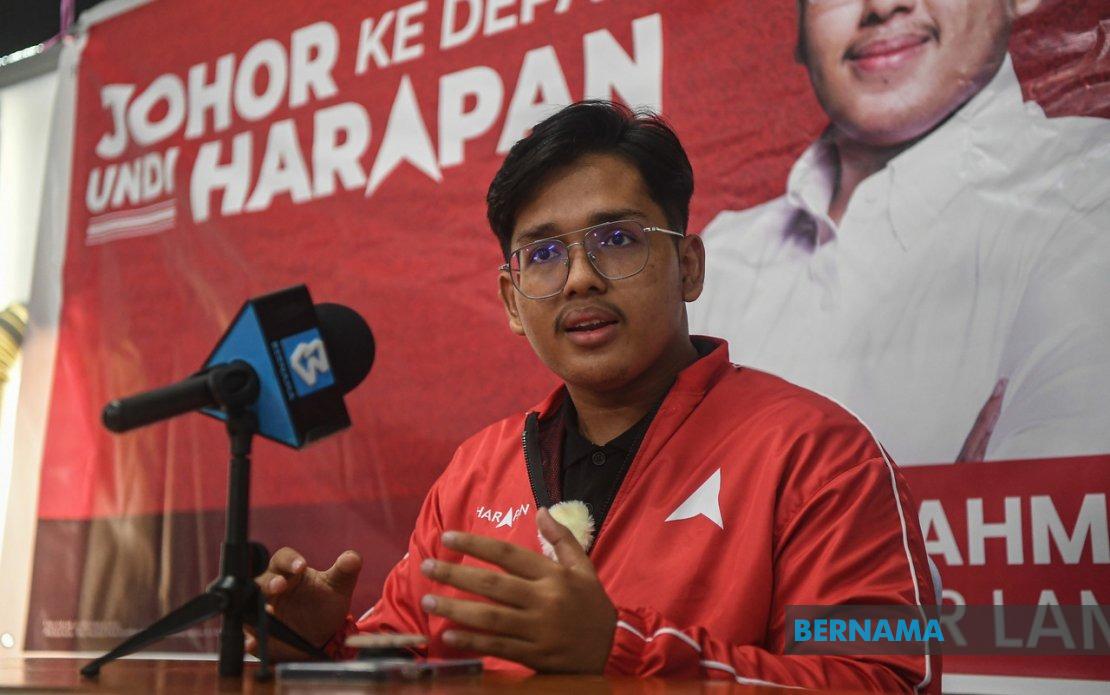
Danish Hossman Abd Rahman, at just 23 years old, represents a generational shift in Malaysian electoral politics. Running as the Pakatan Harapan candidate in the closely watched Johor Lama state constituency, the Master of Information Technology student from Universiti Tun Hussein Onn Malaysia has crystallised his campaign around the theme of dynamic renewal. Speaking ahead of polling day in the 16th Johor state election, he framed the groundswell of support he has encountered across the constituency as a powerful vote of confidence—not merely in his candidacy, but in a fundamentally different approach to addressing persistent local grievances.
What makes Hossman's candidacy particularly noteworthy is the unexpected reception he has received from older voters and veteran groups, a demographic typically sceptical of young, first-time candidates. Rather than dismissing his age as a liability, seasoned residents have instead embraced it as a potential asset. Hossman attributes this shift to his unrelenting presence in the field: consistent engagement with residents at village forums, coffee shops, and community gatherings has helped establish credibility where proximity to power might otherwise be absent. This grassroots stratagem has exposed him to the everyday challenges confronting Johor Lama residents—challenges that, he argues, long-serving leaders have largely ignored.
Voters, particularly those of advanced years, have expressed frustration with incumbent representatives who maintain considerable distance from their constituents. Hossman has positioned himself as the antidote to this remoteness, presenting a case built on accessibility and genuine dialogue. The younger generation, he argues, brings not arrogance but humility—a willingness to listen before prescribing solutions. Older voters appear to have validated this pitch, viewing his youthful energy as compatible with, rather than opposed to, institutional wisdom and experience.
Central to Hossman's platform is his refusal to frame leadership through the prism of age alone. Instead, he has adopted what he terms a "strategic bridge" approach, consciously synthesising the accumulated insights of established political figures with the aspirational momentum of younger Malaysians. This articulation reflects a broader demographic reality: Malaysia's generational divide on substantive policy matters—employment, housing affordability, infrastructure—transcends the traditional boundaries of party politics. By positioning himself as a conduit between these constituencies, Hossman has created rhetorical space for a coalition spanning voters typically separated by generational grievance.
The constituency contest itself unfolds within a three-cornered battle. Hossman faces Norlizah Noh, the incumbent from Barisan Nasional, and Aisah Esa representing Perikatan Nasional. The triangular dynamics introduce complexity: voters must weigh competing claims not simply between government and opposition, but among three distinct visions for the constituency's future. In such a configuration, a candidate's ability to mobilise specific demographic blocs becomes paramount. Hossman's particular strength lies in his appeal across generational lines—neither purely a youth candidate nor solely an anti-establishment figure, but something more nuanced.
Economic stagnation forms the substantive backbone of Hossman's campaign narrative. Johor Lama, despite its agricultural potential and proximity to industrial zones, has witnessed steady out-migration of young people seeking employment elsewhere. This brain drain reflects a structural problem: the local economy lacks sufficient, adequately remunerated opportunities to retain talent. Hossman has diagnosed this malaise with precision, identifying affordable housing scarcity and limited career pathways as the principal drivers of youth exodus. These are not abstract grievances but lived experiences for young families contemplating whether to remain in their hometowns.
Hossman's proposed remedies centre on attracting downstream industries and diversifying the agricultural base to encompass value-added production. Rather than advocating for subsidy-dependent schemes or symbolic interventions, he frames economic revitalisation through the language of investment and industrial positioning. Crop cultivation and livestock development, properly integrated with processing and export infrastructure, could theoretically convert raw agricultural advantage into employment for multiple skill levels. This framework acknowledges that young Malaysians require not merely jobs, but careers with genuine progression.
The campaign's final phase has seen Hossman intensify engagement with constituencies he identifies as pivotal: youth, women, and small business operators. Each segment faces distinct pressures within Johor Lama's economic landscape. Young people confront limited local opportunities; women often navigate structural disadvantages in accessing capital and market access; small entrepreneurs struggle against larger competitors and bureaucratic friction. By directly addressing these constituencies' concrete needs rather than resort to generic political messaging, Hossman has attempted to transcend the polarised discourse characterising contemporary Malaysian politics. His repeated visits to towns, villages, and Federal Land Development Authority settlements underscore commitment to granular, repeated engagement rather than episodic campaigning.
Hossman's insistence on capability-based assessment rather than identity politics or personal attacks reflects a broader frustration among younger voters with the tone of contemporary Malaysian electoral contests. While established parties deploy familiar frameworks—ethnic representation, religious sentiment, historical grievance—segments of the electorate, particularly younger urban and semi-rural voters, increasingly demand discussion of competence, track record, and specific policy solutions. This generational preference does not indicate apathy towards identity questions, but rather impatience with their dominance over material concerns affecting daily life.
The broader context of the 16th Johor state election—encompassing 172 candidates contesting 56 seats—suggests voters will deliver a complex verdict reflecting multiple anxieties and aspirations. Economic underperformance in state constituencies beyond the Klang Valley and Selangor precincts has become a recurring theme in Malaysia's political discourse. Johor, despite its reputation as an industrial and commercial centre, contains pockets of relative stagnation where traditional industries have contracted without adequate replacement activity. This structural weakness creates openings for candidates offering distinctive visions of economic repositioning.
Hossman's emergence as the youngest candidate in this election cycle carries symbolic weight extending beyond Johor Lama. It signals that Malaysian voters, at least in segments beyond the most entrenched party bases, remain open to candidates willing to invest sustained effort in understanding local conditions and articulating coherent responses. The reception accorded to a 23-year-old political novice suggests that age, far from being disqualifying, may increasingly represent an advantage for candidates demonstrating seriousness, accessibility, and genuine engagement with constituent concerns. Whether this broader trend will crystallise into electoral success for Hossman personally remains contingent on polling day outcomes, but the very fact of his competitive positioning indicates significant shifts in how Malaysian voters evaluate leadership potential.

