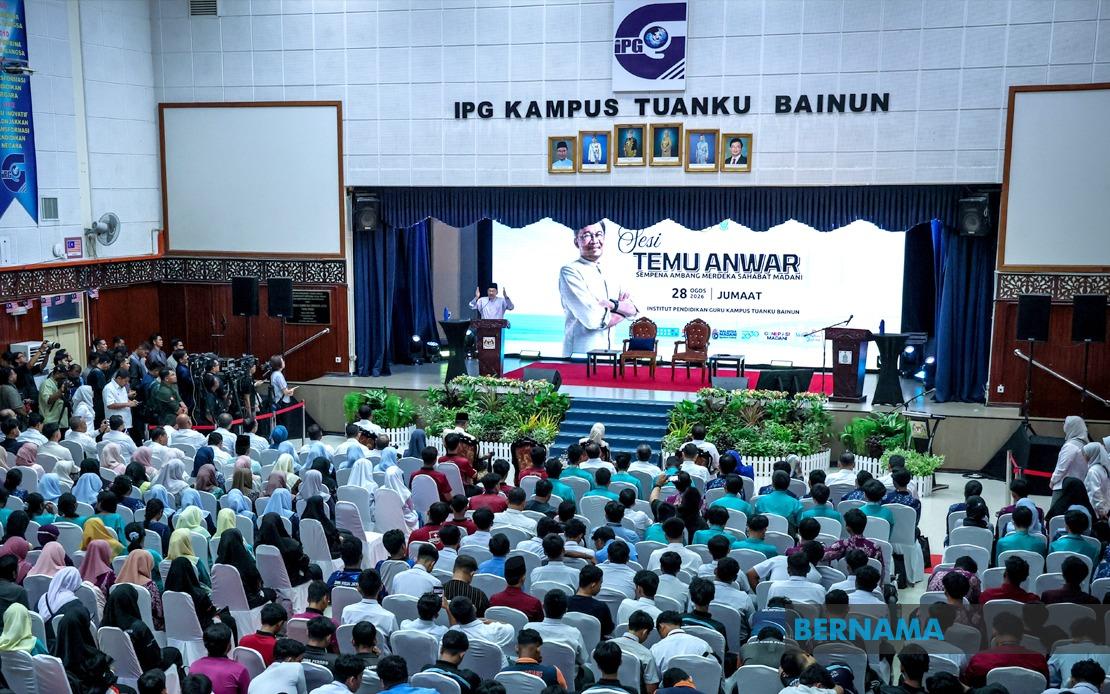
Prime Minister Datuk Seri Anwar Ibrahim has defended the government's decision to completely repeal the Universities and University Colleges Act 1971 (AUKU), positioning the move as essential to enabling students to exercise fundamental freedoms of expression and develop their intellectual capabilities. Speaking during a Temu Anwar session held in Bukit Mertajam, Anwar contended that the decades-old legislation, which had severely restricted student activism and political participation on campus, no longer reflects the maturity and democratic rights of young Malaysians.
Central to Anwar's argument is the premise that students who have attained voting age—18 years old—should logically possess the corresponding right to engage in public discourse without institutional constraints. By this reasoning, maintaining strict prohibitions on student speech and assembly became increasingly difficult to justify in a democratic context. The Prime Minister framed the AUKU repeal not merely as a removal of restrictions, but as an affirmative step to unlock the creative and intellectual potential of the nation's student population.
According to Anwar, the original imposition of AUKU restrictions in 1971 reflected a particular government philosophy that prioritised institutional control over student autonomy. However, he suggested that this paternalistic approach has become outmoded in contemporary Malaysia. The announcement of the AUKU's complete abolition, he explained, responds directly to a recognition that young people require intellectual space to develop judgment, creativity, and the capacity for rigorous critical thinking—competencies increasingly viewed as essential for navigating complex social and economic challenges.
The Prime Minister acknowledged that student expression would not always prove correct or uncontroversial. Rather than viewing this as justification for suppression, he reframed it as an inherent feature of intellectual development. Students should be actively encouraged to voice their perspectives and engage in substantive debate on matters of public concern, Anwar contended, with the understanding that the iterative process of articulating, defending, and sometimes revising positions constitutes crucial learning. This philosophy positions universities not as spaces of ideological conformity but as laboratories for developing sophisticated analytical skills.
Education Minister Datuk Seri Fadhlina Sidek's presence at the session underscored the government's unified messaging on the AUKU repeal, suggesting broad cabinet-level consensus on the direction of higher education policy. The joint appearance by both the Prime Minister and Education Minister conveyed that the abolition represents deliberate, coordinated policy rather than isolated commentary.
For Malaysian higher education, the AUKU repeal carries substantial implications. Universities have historically operated under severe constraints on student political organisation, with prohibitions extending to participation in political parties, public demonstrations, and union activities. The removal of these statutory restrictions potentially transforms the campus environment fundamentally, allowing student bodies to organise independently and engage with civic issues that traditionally remained off-limits.
The timing and framing of Anwar's remarks reflect ongoing efforts by his administration to distance itself from the restrictive governance approaches of previous eras. The AUKU, enacted more than five decades ago during a period of significant political turbulence, embodied assumptions about the relationship between state authority and student autonomy that contemporary democratic governance increasingly questions. By characterising the repeal as consistent with democratic principles and individual development, rather than merely as administrative reform, Anwar positioned the change within a broader narrative of institutional modernisation.
For Southeast Asia more broadly, Malaysia's AUKU repeal represents a notable shift in higher education policy within the region. While many neighbouring countries have moved incrementally toward greater campus freedoms over recent decades, few have undertaken such comprehensive statutory abolition of student restrictions. The development invites regional comparison regarding the relationship between political liberalisation and educational governance, with implications for how other governments approach balancing institutional order with student rights.
The practical effects of AUKU's abolition will likely emerge gradually. Student unions, which had operated under significant legal constraints, now possess substantially expanded scope to organise, advocate, and mobilise. Universities themselves face the challenge of developing new regulatory frameworks to govern student conduct in the absence of AUKU's prescriptive restrictions. These institutional adaptations will prove crucial in determining whether the legislative repeal translates into meaningfully expanded student freedoms or whether universities establish alternative mechanisms to constrain student activism.
Anwar's justification for the repeal—that students merit the freedom to develop independent judgment—fundamentally reframes the purpose of higher education within Malaysian policy discourse. Rather than viewing universities primarily as credentialing institutions subject to state control, this framing emphasises their role in cultivating citizens capable of sophisticated reasoning about complex issues. Whether Malaysian universities successfully embrace this philosophy, and whether the broader society accepts significantly more vocal and visible student activism, will determine the repeal's ultimate significance for the nation's democratic development.

