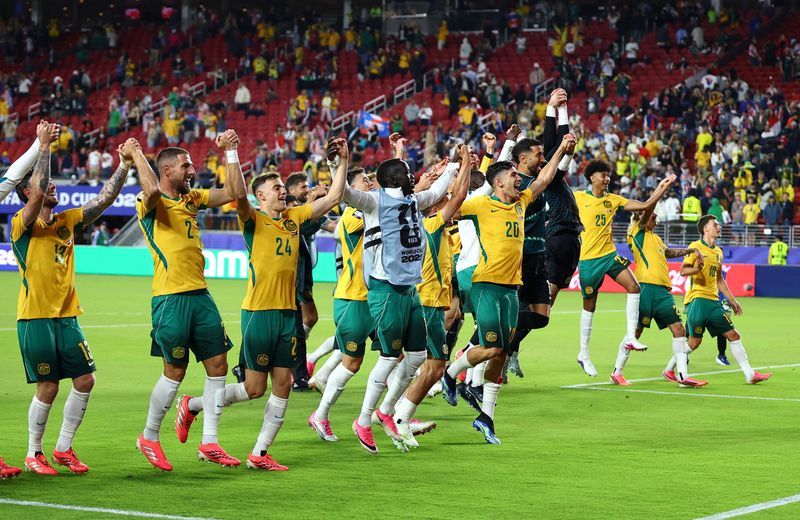
Australia has booked a berth in the World Cup's round of 16 after a tightly contested stalemate with Paraguay on Thursday, providing the Socceroos with passage to the knockout stage for the third occasion. The match at San Francisco Bay Area Stadium in California's Santa Clara region proved to be a defensive affair, with both teams content to cancel each other out in a display that prioritised caution over creativity. Tony Popovic's squad sealed second position in Group D, trailing only the United States, and will now face the runner-up from Group G—a cluster that remains decidedly open heading into Friday's final round of matches involving Egypt against Iran and Belgium facing New Zealand.
Paraguay's situation remains considerably more precarious. The South American side accumulated four points from their group campaign and may have accumulated sufficient tally to advance as one of eight best-performing third-place finishers, yet they cannot confirm their progression until the remaining fixtures conclude. The 2010 quarter-finalists must now endure an anxious waiting period as other outcomes determine whether their points total proves adequate for advancement. This uncertainty underscores the importance of final group matches in determining the tournament's broader bracket, a dynamic that has repeatedly produced dramatic shifts and unexpected eliminations in recent World Cups.
Popovic signalled attacking ambitions by implementing six alterations to his starting lineup, a substantial tactical refresh that reflected his determination to secure victory or at minimum break the deadlock. The reintroduction of the energetic Nestory Irankunda and the inclusion of Cristian Volpato in the forward configuration demonstrated the coach's willingness to chase goals. However, Australia's attacking enterprise encountered consistent frustration throughout the ninety minutes, with promising moments repeatedly squandered through poor final execution rather than defensive resistance from Paraguay's goalkeeper Orlando Gill.
Australia dominated possession during the opening period, with Jordan Bos's repositioning from left-back to right-back—necessitated by Jacob Italiano's injury—facilitating sustained pressure down the flank. The Socceroos manufactured several dangerous crossing opportunities and penetrating runs, yet lacked the precision required to convert territorial advantage into scoring chances. Jackson Irvine's early opportunity epitomised this wastefulness; positioned favourably on the penalty area's right side after Volpato's setup, he struck an angled attempt directly at the goalkeeper rather than capitalising on the space available to him.
Paraguay's coach Gustavo Alfaro recognised the necessity for tactical adjustment at the interval, introducing the Brazilian-born Mauricio to inject greater attacking impetus. This substitution reinvigorated the Paraguayan approach considerably, with the team progressively gaining territorial control and creating genuine opportunities as the second period progressed. Julio Enciso emerged as the primary threat, his directness and movement through Australia's defensive lines repeatedly creating dangerous situations. Eight minutes from fulltime, Enciso squandered Paraguay's clearest opportunity, launching a low drive that sailed well wide of the left post when accuracy might have altered the match's trajectory entirely.
The contest's latter stages descended into an end-to-end affair characterised by fast transitions and escalating intensity. Bos provided a moment of encouragement for the Australian contingent when, in the 89th minute, he surged through Paraguay's defensive formation, carrying the ball into the penalty area from the right flank before sending a shot narrowly past the far post. Mauricio responded with an effort of his own moments later, but his tepid attempt from the area's edge proved insufficient to trouble Australia's goalkeeper Matthew Ryan.
For Malaysian and broader Southeast Asian observers, Australia's qualification carries significance beyond the immediate sporting achievement. The Socceroos' progression demonstrates the quality established within the AFC confederation, positioning the confederation favourably heading into the tournament's later stages. Australia's presence in the knockout phase represents continuity following their last-16 appearance in Qatar four years prior, suggesting sustained competitive development within regional football. The manner of the victory—through defensive solidity and astute match management rather than scintillating attacking displays—reflects the pragmatism increasingly required at modern tournament football's highest levels.
The significance of Paraguay's position cannot be understated within the South American context. As a smaller confederation member struggling to compete with continental heavyweights, the opportunity to advance from their group remains within reach, contingent upon other results. Should they progress, they would represent a considerable achievement for Alfaro's programme. Conversely, elimination would constitute a significant disappointment, particularly given their early-stage prospects. The waiting period ahead will prove torturous for supporters and officials alike, as the tournament's final group matches reshape the knockout configuration.
Australia's advancement, achieved through controlled pragmatism rather than aesthetic brilliance, underscores an important tournament principle: goals often matter more than possession statistics or attacking poetry. Popovic's tactical adjustments and defensive discipline ultimately proved decisive, enabling the Socceroos to navigate a genuinely challenging opponent without conceding. The coach's willingness to make substantial lineup changes, combined with his team's ability to execute instructions, suggests Australia should advance further than many pre-tournament assessments suggested. The group stage's completion will provide greater clarity regarding Australia's knockout opposition and realistic progression prospects.
Looking beyond the immediate encounter, Australia's consistent participation in World Cup knockout phases elevates their standing within Asian football. The consecutive qualification achievements over recent tournaments indicate an emerging powerhouse, challenging traditional regional hierarchies. For Malaysian football, Australia's sustained success serves as both inspiration and competitive benchmark, illustrating the standards required for consistent tournament participation. The Socceroos' journey continues, their fate now determined by Group G's outcomes, yet their place in the knockout phase represents a noteworthy achievement that consolidates their position as a tournament regulars and serious Continental competitors.

