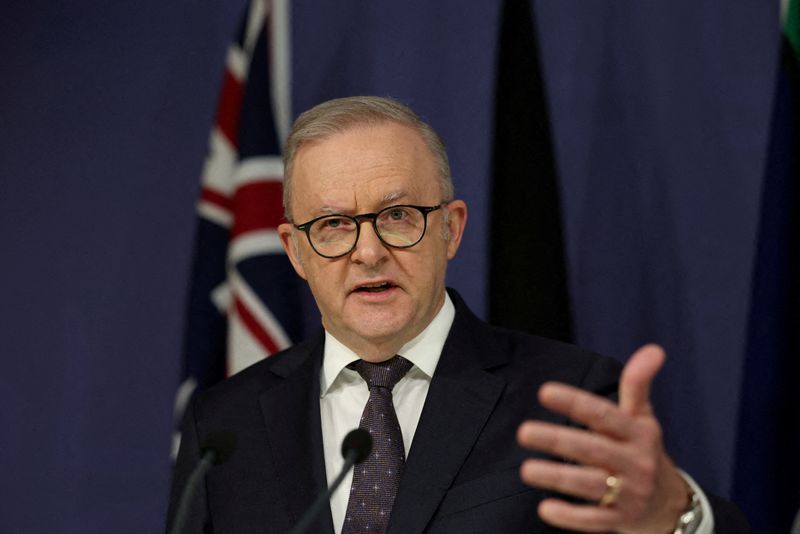
Australia is moving to establish a centralized government office dedicated to artificial intelligence, marking what officials describe as a world-first approach to managing the technology at the highest levels of state administration. The Office of AI will operate from within the Department of the Prime Minister and Cabinet, positioning it to influence policy across all government departments and agencies. Prime Minister Anthony Albanese announced the initiative during a major address in Sydney on Wednesday, framing the creation of this office as essential to Australia's competitive positioning in the global AI economy.
The establishment of this new office reflects a deliberate shift in how Canberra approaches technological governance. Rather than responding to challenges on a case-by-case or sector-specific basis, the government is seeking to develop comprehensive, whole-of-government strategies similar to those deployed for previous transformative technologies. Albanese drew historical parallels with Australia's regulatory responses to civil aviation in the 1920s and genetics in the 1990s, suggesting that such coordinated approaches have proven effective in the past and should now be applied to artificial intelligence.
Government officials argue that this centralized framework will enhance Australia's attractiveness as a destination for global AI investment and development. By establishing clear approval pathways and streamlining compliance requirements, the office aims to reduce regulatory uncertainty that might otherwise discourage companies from establishing operations or data centres within Australian jurisdiction. This strategic positioning is particularly important as nations compete intensely to become regional AI hubs, with countries across Asia and beyond investing heavily in supporting infrastructure and talent development.
The announcement arrives at a critical juncture for Australia's technology strategy. The country aspires to position itself not only as a leader in AI research and deployment but also as a major centre for data infrastructure. These dual ambitions require careful management, as they create tension between attracting investment and addressing legitimate public concerns. The government's institutional approach suggests recognition that ad hoc responses cannot adequately govern a technology that touches nearly every sector of the modern economy.
Yet Australia faces mounting pressure to tighten its regulatory stance on artificial intelligence. Concerns have intensified regarding potential job displacement across professional and service sectors, with anxiety running particularly high in communities dependent on routine cognitive work. Beyond employment, observers point to the massive energy and water requirements of data centre expansion, raising questions about environmental sustainability at a time when Australia is attempting to reduce its carbon footprint and manage water scarcity in several regions. These infrastructure demands could create tensions between the government's investment attraction goals and its environmental commitments.
The current regulatory landscape offers only fragmented protections. Australia lacks dedicated AI legislation, instead relying on existing privacy laws, consumer protection statutes, and an optional ethical framework. This patchwork approach has proven increasingly inadequate as AI systems become more autonomous and consequential. Companies operating in sectors ranging from finance to healthcare to government services deploy these systems with minimal sector-specific oversight, creating gaps that could expose consumers and citizens to unfair treatment, bias, or privacy violations. The voluntary ethics framework, while well-intentioned, lacks enforcement mechanisms and has not prevented controversial deployments.
Safety and security considerations add another layer of complexity to the regulatory challenge. AI systems can malfunction in ways that are difficult to predict or trace, potentially affecting critical infrastructure or sensitive data. Intellectual property concerns also loom large, particularly as generative AI systems trained on large datasets raise questions about fair compensation for creators and original copyright holders. These issues cross traditional regulatory boundaries, requiring coordination between departments handling security, justice, commerce, and culture—precisely the kind of cross-government coherence that the new office is designed to facilitate.
International context matters significantly here. Other developed nations and regional powers have already begun establishing AI governance frameworks. The United States, European Union, and China have all announced regulatory initiatives or strategic investments in AI oversight. For Australia, creating this dedicated office signals commitment to competing in an increasingly crowded landscape while maintaining standards that align with democratic values and rule of law principles. The office's position within the Prime Minister's department ensures it carries political weight and access to executive authority necessary for implementation.
The success of this initiative will depend heavily on how effectively the office coordinates across government silos. Different departments have divergent interests: Industry and Innovation may prioritize growth and investment, while Treasury focuses on fiscal impacts, Human Services worries about job displacement, and Environment and Water targets sustainability. Creating genuine coordination rather than mere consultation among these interests requires both institutional design and political commitment. The office will need adequate resourcing, clear mandate, and protection from being captured by any single departmental agenda.
For Southeast Asian observers, Australia's approach offers both lessons and competitive implications. Governments across the region are themselves grappling with how to regulate AI, and Australia's framework could serve as a model—or a cautionary tale, depending on its effectiveness. The region faces similar tensions between attracting technology investment and protecting citizens from emerging harms. However, Southeast Asian nations often face additional complications including varied regulatory capacities, cross-border data flow issues, and diverse national interests, making centralized AI governance more challenging than in Australia's more unified federal system.
The announcement also reflects Australia's recognition that AI governance cannot be left entirely to market forces or individual companies' ethical commitments. This positions Australia somewhat at odds with the hands-off approach preferred by some technology companies and some policymakers who fear that overregulation will stifle innovation. The government appears to be betting that clear, transparent regulatory frameworks will ultimately prove more conducive to investment than uncertainty or reactive crisis management. Whether that calculation proves correct will become apparent as the office develops specific policies and standards over the coming years.

