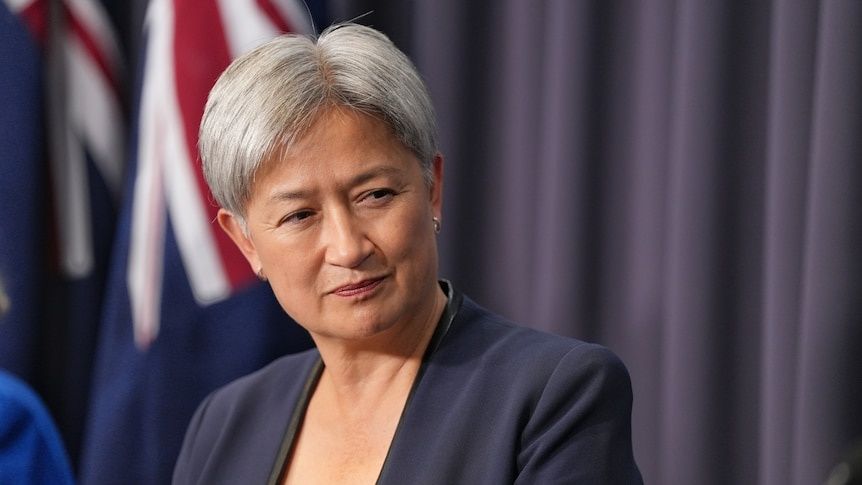
Foreign Minister Penny Wong will use a major speech this week to mount a vigorous defence of Australia's multicultural character, directly confronting the political momentum of One Nation, the far-right party that has emerged as the country's most popular political force according to recent polling. Wong, herself born in Malaysia and the first Asian-Australian to hold federal ministerial office, plans to articulate at the Lowy Institute in Sydney that cultural diversity represents not a recent experiment but the authentic foundation upon which modern Australia has been built and prospered.
The timing of Wong's intervention reflects deepening anxiety within the Labor government about One Nation's trajectory. Under the leadership of Pauline Hanson, a figure frequently likened to Donald Trump or Marine Le Pen, the party has captured significant public attention by advocating for what it explicitly describes as a "monoculture"—a marked rejection of the pluralistic model that has defined Australian society for decades. Polling suggests One Nation could position itself as a kingmaker in federal elections scheduled for 2028, giving the fringe movement potential leverage over mainstream political outcomes and policy direction.
Wong's prepared remarks centre on a counterintuitive but historically grounded argument: that Australia has never possessed a monoculture and that attempts to impose one would fundamentally weaken the nation. Census data substantiates this claim with striking clarity—approximately half of all Australians were either born overseas or have at least one parent born outside the country. This demographic reality underscores that multiculturalism is not an imported ideology but rather a demographic and historical fact that Wong intends to reframe as Australia's greatest strategic asset rather than a liability to be managed.
Hanson and One Nation have increasingly weaponised nostalgia for what they characterise as a more homogeneous Australia, with Hanson herself invoking the "White Australia" policy that operated through much of the twentieth century to restrict non-white immigration. Such rhetoric has generated considerable public backlash, yet the party's polling numbers have continued climbing, suggesting that economic anxieties and concerns about housing affordability are creating receptiveness to anti-immigration messaging among sections of the electorate. The party has also called for Australia to fundamentally reassess its commitments to international organisations and to dramatically curtail foreign aid spending.
Wong's speech will position multiculturalism as integral to Australia's geopolitical interests and capacity to navigate an increasingly contested global order. She plans to argue that the international security architecture and trade relationships upon which Australian prosperity depends would be jeopardised by the "melancholic fantasy of a monoculture" that One Nation advocates. This framing attempts to elevate the debate beyond cultural arguments about national identity into the realm of hard national interest—suggesting that those who champion cultural uniformity are inadvertently weakening Australia's standing and strategic options at a moment when middle powers face mounting pressure from larger actors wielding military force, economic coercion, and control of critical technologies and materials.
For Malaysian and broader Southeast Asian audiences, Wong's intervention carries particular significance. Australia's approach to multiculturalism and immigration directly shapes its regional relationships and capacity to serve as a trusted partner in Southeast Asia. A shift toward the monoculturalism that Hanson advocates would likely diminish Australia's soft power in the region and complicate diplomatic relationships grounded in cultural understanding and people-to-people connections. Malaysia itself represents one of the largest sources of both migrants to Australia and investment in Australian enterprises, making the political climate surrounding immigration questions of mutual concern.
Prime Minister Anthony Albanese has signalled that the government recognises legitimate public anxieties about housing affordability and economic pressures, even as it opposes the divisive rhetoric that One Nation employs. The Labor administration is preparing to announce adjustments to immigration policy, attempting to navigate between addressing voter concerns and maintaining the multicultural character that Wong defends. Albanese himself underscored this position by referencing his own Italian surname, implicitly demonstrating that Australian identity encompasses diverse heritage and that this diversity strengthens rather than diminishes national cohesion.
Wong's emphasis on the achievements of refugee communities in business and sport represents an attempt to reframe the immigration debate by highlighting tangible contributions and integration success stories. This counter-narrative strategy acknowledges that public discussion has become dominated by anxieties about social strain and resource competition, and seeks to reintroduce evidence of positive outcomes and mutual benefit. The approach recognises that polling data showing One Nation's rise reflects real voter concerns, not mere bigotry, and that addressing these concerns requires more than rhetorical defence of diversity.
The rising support for One Nation appears partly attributable to a perception that mainstream parties have failed to adequately address legitimate concerns about housing costs, wage stagnation, and infrastructure capacity. By coupling her defence of multiculturalism with acknowledgment that immigration settings require periodic adjustment, Wong and Albanese attempt to reclaim middle ground that One Nation has occupied by appearing to take voter anxieties seriously. This strategy faces challenges, however, given that One Nation's appeal extends beyond policy disagreements into deeper currents of cultural anxiety about national identity and rates of demographic change.
The confrontation between Wong's vision and Hanson's represents a fundamental debate about Australia's future orientation and identity. Wong's argument that external and internal forces seek to exploit division for political gain implicitly casts One Nation's rhetoric as strategically corrosive regardless of its electoral appeal. Her speech essentially contends that accepting the monoculture framework would involve Australia voluntarily curtailing its choices and severing connections at precisely the moment when middle powers require maximum flexibility and maximum international engagement to navigate geopolitical complexity.
For the Labor government, the stakes extend beyond this particular political cycle. The trajectory of One Nation will partly determine whether Australian multiculturalism continues to evolve as a lived reality and governing principle, or whether the country enters a period of sustained debate about the legitimacy of cultural diversity itself. Wong's intervention represents an attempt to establish clear terms of debate before One Nation's political ascendancy potentially translates into legislative influence that could reshape immigration and integration policies.

