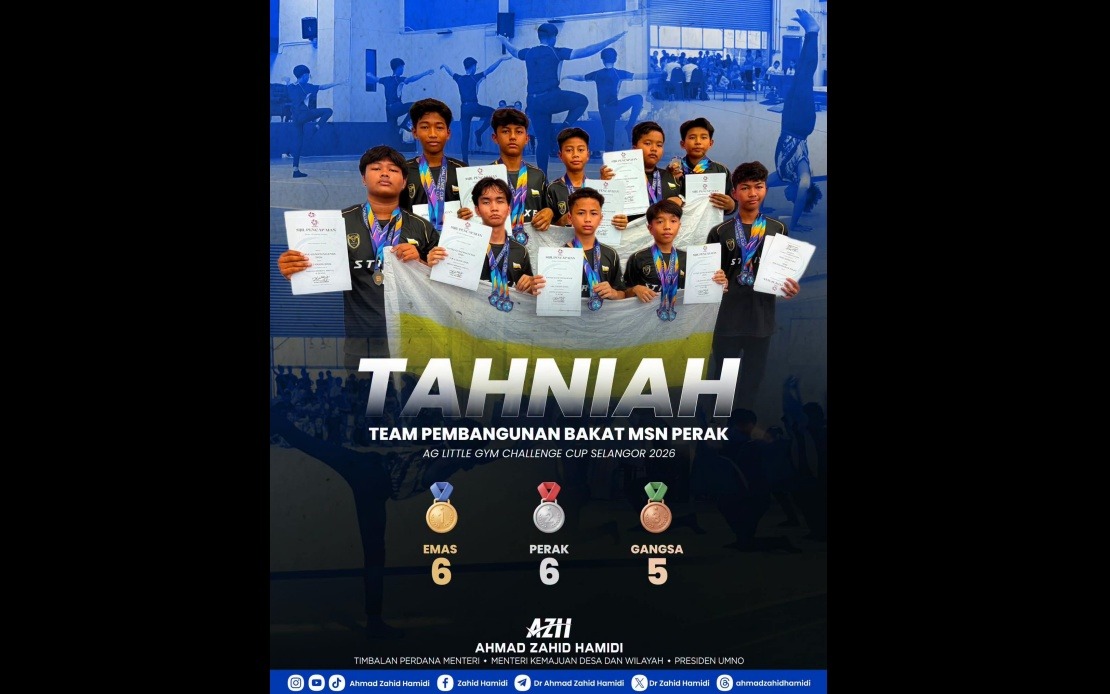
A young gymnastics contingent from the Perak district of Bagan Datuk has etched its name into sporting history by securing an impressive haul of six gold medals at the AG Little Gym Challenge Cup Selangor 2026, held in Kajang on August 1. The team's stellar performance extended across the medal standings, adding six silver and five bronze medals to their tally—a result that underscores the growing strength of grassroots gymnastics development in smaller Malaysian districts beyond the traditional sporting hubs.
Deputy Prime Minister Datuk Seri Dr Ahmad Zahid Hamidi, who represents Bagan Datuk as Member of Parliament, publicly celebrated the achievement through social media, highlighting the broader significance of the medal haul for his constituency. His endorsement of the gymnasts' success reflects a recognition among national political leadership that sporting excellence at the grassroots level serves as an indicator of holistic community development and youthful potential extending well beyond academic pursuits.
In his statement, Ahmad Zahid emphasised that the performance demonstrated the multifaceted capabilities of Bagan Datuk's younger generation. The Deputy Prime Minister noted that the achievement shattered any lingering perception that excellence in the district was confined to the classroom, instead showcasing that with proper infrastructure, coaching, and parental support, young athletes could compete effectively on regional platforms. This observation carries weight given that Bagan Datuk is a constituency more commonly associated with political discourse than sporting accolades, making the gymnastics breakthrough particularly noteworthy for local identity and pride.
The Bagan Datuk Generasi Muda Gymnastics Club, the organisation behind this young talent, independently amplified the achievement through their own social channels, framing the medals as validation of years of dedicated training and disciplined preparation. The club's narrative went beyond mere celebration, positioning the medals as a waypoint rather than a destination—a strategic messaging approach that acknowledges present success while maintaining aspirational momentum for future competitions.
The club's statement underscored the rigorous regimen underlying these results, pointing to the countless training hours, physical conditioning, and mental fortitude required to achieve competitive success in gymnastics. This emphasis on process over outcome reflects a maturity in coaching philosophy, one that prioritises building sustainable athletic development pathways rather than chasing isolated medal moments. For Malaysian gymnastics, which has historically struggled to produce consistent medal performers at regional events, this grassroots-level intensity is precisely what national development programmes seek to replicate.
The geographic context of Bagan Datuk's success holds significance for Malaysian sports policy. As a smaller district in Perak, the presence of a functional, competitive gymnastics club suggests that talent identification and development need not be concentrated exclusively in major urban centres. The club's ability to produce athletes capable of medalling at a regional challenge cup indicates that with targeted investment and coaching expertise, districts outside the Klang Valley and major cities can contribute meaningfully to the national sports pipeline.
Parental involvement emerged as a critical enabling factor in the Bagan Datuk gymnasts' success, according to statements from both the Deputy Prime Minister and the club itself. Malaysian sports development increasingly recognises that parental commitment—in transportation, financial support, and emotional encouragement—often determines whether young talent translates into competitive achievement. The explicit acknowledgment of parents' contributions serves as an implicit call for greater community engagement in youth sports development across the nation.
The August 1 competition in Kajang, as part of the established AG Little Gym Challenge Cup circuit, operates within Malaysia's growing ecosystem of developmental sporting events. These challenge cups serve as crucial stepping stones for young athletes, providing competitive experience, medal opportunities, and exposure without the stakes of national or international championships. For Bagan Datuk's gymnasts, success at this level validates their training investments and provides psychological confidence for progression to higher levels.
Looking at the broader implications, the Bagan Datuk achievement highlights an understated reality in Malaysian sports: many districts possess untapped talent and infrastructure that remains invisible without strategic showcasing and political backing. The Deputy Prime Minister's public endorsement of the gymnasts effectively transforms a sports accomplishment into a political narrative about inclusive development and distributed opportunity—a messaging strategy increasingly common among Malaysian leaders keen to demonstrate governance beyond urban centres.
For the Bagan Datuk Generasi Muda Gymnastics Club, the critical task ahead involves sustaining this momentum and preventing the typical pattern where early success fades due to lack of ongoing funding, coaching upgrades, or competition opportunities. Malaysian sports history contains numerous examples of young athletes who peaked early, only to disappear from competitive circuits due to infrastructure collapse or resource constraints post-victory. Translating six gold medals into long-term competitive relevance will require continued parental investment, government support, and strategic planning by club leadership.
The performance also carries implications for gender representation in Malaysian gymnastics, though the source material does not specify the demographic composition of the medal-winning team. Gymnastics globally has developed as one of the more gender-balanced sports, and grassroots success in this discipline across a district like Bagan Datuk suggests evolving community attitudes toward girls' participation in sporting activities—a trend that Malaysian policymakers have sought to encourage through various initiatives.
As the AG Little Gym Challenge Cup circuit continues and other regional competitions approach, the Bagan Datuk gymnasts will face the challenge of replicating their Kajang performance while addressing increasingly competitive fields. The six gold medals represent not just current achievement but a baseline expectation that will grow with each subsequent competition. This elevated standard, while demanding, also presents an opportunity for the young athletes to establish Bagan Datuk as a consistent gymnastics presence on Malaysia's regional sporting map.

