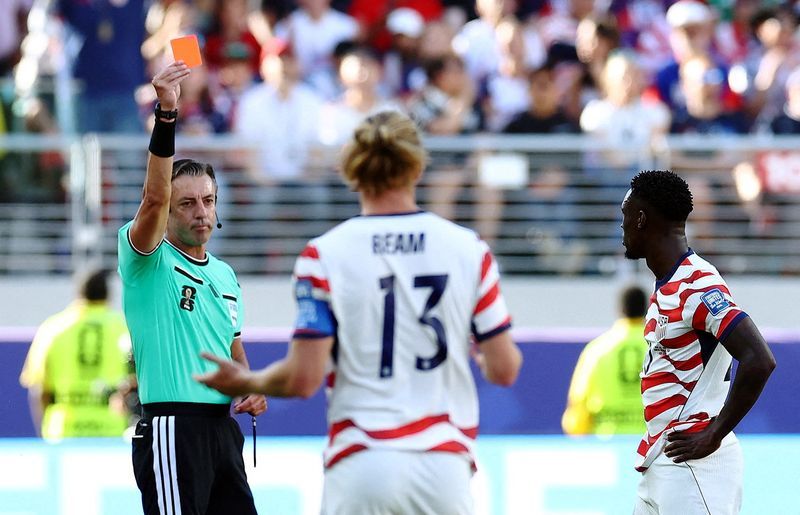
Football's regulatory integrity faces a credibility crisis following FIFA's decision to overturn the World Cup suspension of United States forward Folarin Balogun, according to warnings from senior Premier League figures Howard Webb and Richard Masters. The handling of Balogun's red card dismissal, which drew direct intervention from U.S. President Donald Trump, has sparked fears that the fallout will extend far beyond the international tournament and contaminate domestic competition as the new English football season begins.
Webb, who leads Premier League refereeing operations through Pro Ref (formerly Professional Game Match Officials Limited), articulated profound unease about the affair rather than the original on-field decision itself. The refereeing chief, who oversaw the 2010 World Cup final, highlighted the corrosive effect of FIFA's subsequent actions: the initial suspension was lifted through a process that appeared to materialise specifically to address this case, creating the impression that rulebook flexibility could be manufactured on demand. The public acknowledgment that political pressure directly influenced FIFA's position represented the most troubling aspect of the incident.
The timing of this controversy coincides with an environment where social media has become a platform for questioning officials' motives and integrity. Webb expressed alarm at how readily unsubstantiated allegations of corruption circulate online, with individuals lacking factual basis attributing sinister motivations to contentious calls. The Balogun episode, by demonstrating that external political influence could apparently reshape FIFA's disciplinary framework, provides ammunition to those already predisposed to view officiating decisions through a lens of suspicion rather than professional judgment. Webb's perspective, drawn from extensive professional experience, suggests this perception could prove far more damaging than any individual controversial decision.
The psychological impact on upcoming Premier League matches looms large. As the season commences with unprecedented scrutiny likely to greet every marginal VAR decision and referee judgment, the Balogun precedent offers skeptics a concrete example to reference when questioning whether decisions reflect honest sporting judgment or hidden external pressures. Webb acknowledged directly that the affair "doesn't help," recognising that separating legitimate debate about officiating from baseless conspiracy theories becomes exponentially harder once tangible evidence of political intervention exists.
Richard Masters, the Premier League's chief executive, approached the controversy from a different angle, lamenting the dominance of off-field narratives at the expense of actual football. The tournament should have been remembered for Spain's compelling performance and England's heartbreaking semi-final elimination, yet instead the conversation centres on regulatory dysfunction and political interference. This displacement of sporting narrative by administrative controversy represents a "huge shame" in Masters' assessment, suggesting that football's fundamental appeal becomes obscured when governance questions overwhelm discussion.
Masters specifically identified structural deficiencies in FIFA's regulatory architecture that enabled the Balogun situation. Unlike domestic competitions, FIFA's disciplinary framework contains no mechanism for reviewing or overturning red card decisions. This absence created the necessity for FIFA to invent an extraordinary process to address the suspension, thereby manufacturing the very appearance of impropriety and inconsistency that Webb warned about. The absence of transparent established procedures for addressing potential red card injustices becomes glaringly apparent precisely when such situations arise, forcing ad-hoc solutions that invite scrutiny.
The contrast between FIFA's limitations and domestic league procedures highlights why Malaysian and broader Southeast Asian football governance structures must establish clear, predetermined mechanisms for addressing disciplinary controversies. When rules contain no provision for overturning decisions, administrators either rigidly apply regulations regardless of circumstances or create unpublished exceptions that damage credibility. Neither alternative serves the sport's interests, yet FIFA's structure permitted no middle ground. Domestic leagues operating within Asia would do well to examine their own rulebooks for similar gaps that might force comparable choices between inflexibility and questionable workarounds.
The new Premier League season arrives with an additional layer of complexity: Webb announced that referees will apply new laws of the game more stringently than previously, with reduced tolerance for time-wasting and greater emphasis on penalising contact and technical offences. The implementation of these modified regulations during a season when officiating faces heightened suspicion creates genuine challenges. If referees penalise offences more frequently as intended, every marginal decision becomes potential ammunition for those inclined to view the sport through the Balogun lens, interpreting changed enforcement patterns as evidence of manipulation rather than legitimate law application.
Webb's perspective on the new laws reflects sophistication about how rule changes function: when officiating penalises previously-tolerated behaviour, players must adjust tactics, and the situations in question naturally diminish over time. However, this adjustment period creates transitional phases where marginal decisions proliferate, and each judgment becomes subject to heightened scrutiny in the current environment. The combination of heightened sensitivity to officiating integrity and the implementation of stricter enforcement creates a perfect storm of controversy risk.
For Malaysian readers and Southeast Asian football observers, the Balogun situation offers instructive lessons about how international football governance operates and the vulnerability of the sport's regulatory systems to external pressure. Political intervention in sporting matters, while sometimes obvious at the highest levels, can also occur through subtler channels that undermine confidence across entire systems. The Premier League's concerns about domestic impacts from international regulatory decisions suggest that regional competitions must insulate themselves through clear, transparent, and consistently applied rules that resist external pressure.
The broader implication extends beyond officiating mechanics into fundamental questions about sporting authority and legitimacy. When FIFA can be shown to have altered its procedures in response to political pressure, the entire edifice of independent sporting governance becomes suspect. This psychological shift matters more than any individual decision's correctness. Webb's professional experience and Masters' administrative perspective converge on this point: the problem lies not in whether the original red card was justified, but in whether the sport's governing structures can maintain independence from political influence and whether the public can trust that decisions reflect sporting logic rather than external agendas.
As the Premier League season unfolds and officials navigate complex implementation of new laws amid heightened scrutiny, the shadow of FIFA's compromised process will linger. Webb warned that unless clear steps demonstrate that football's governance structures remain genuinely independent and consistent, the damage to public trust could prove lasting. The challenge now involves referees making decisions based purely on sporting criteria while an audience primed by recent controversy scrutinises their work for evidence of hidden motives. Restoring confidence will require time, consistency, and transparent governance at all levels.

