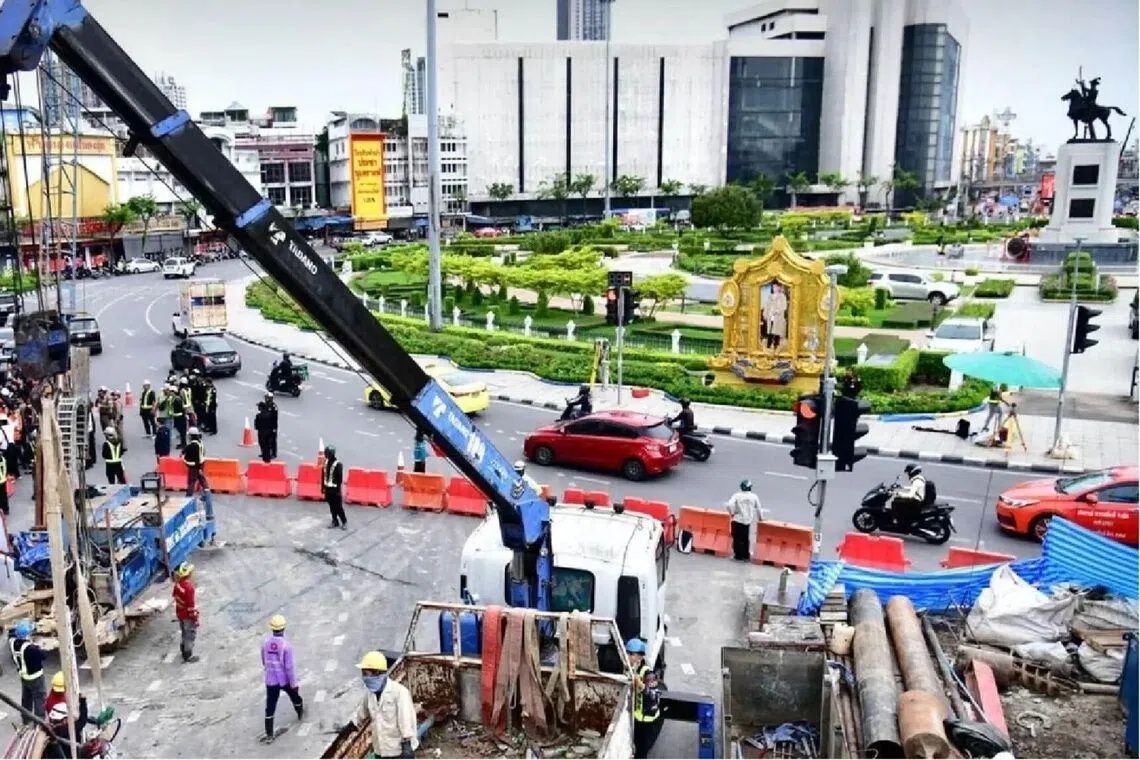
Bangkok authorities have forced the evacuation of around 60 residents from three commercial buildings following a subsidence incident linked to subway construction work near Wongwian Yai. The emergency measures mark the latest complication in Bangkok's ongoing Purple Line expansion project, which has already encountered significant structural problems during earlier phases of development.
The crisis originated from water seepage detected within a drainage sump at the lowest point of the southern Purple Line construction tunnel. This water intrusion set off a chain reaction in which soil surrounding the underground structure gradually flowed inward, destabilising the ground and road surface above. The resulting subsidence created immediate risks to the structural integrity of neighbouring buildings, triggering swift action from city authorities.
Governor Chadchart Sittipunt personally assessed the damage on July 9, accompanied by deputy governor Wisanu Subsompon and deputy permanent secretary Kanokwan Iamlim. Their inspection confirmed that water levels and the pace of ground movement had stabilised, though officials cautioned that continuous round-the-clock observation would persist until the situation reached full resolution.
Prajadhipok Road between Ban Khaek intersection and Wongwian Yai now sits closed for roughly 200 metres as a protective measure. All outbound lanes have been sealed to prevent traffic vibration from further weakening destabilised soil and nearby structures. Temporary alternatives direct outbound vehicles through converted inbound lanes, while motorists from Memorial Bridge or Phra Pok Klao Bridge have been advised to reroute through Ban Khaek intersection and use Itsaraphap, Lat Ya or Somdet Chao Phraya roads instead.
Residents displaced from the affected commercial buildings have been relocated to temporary hotel accommodation, with the Mass Rapid Transit Authority of Thailand's contractor assuming full financial responsibility for housing, compensation and related expenses. Officials anticipate this temporary arrangement will last approximately one week, contingent on structural assessments confirming that buildings and surrounding infrastructure meet safety standards.
The Bangkok Metropolitan Administration and the Department of Disaster Prevention and Mitigation have deployed sophisticated monitoring infrastructure to track any further movement. Two Rescue Guardian units now continuously measure tilting and structural shifts in real time, automatically alerting authorities to any abnormal activity. These sensors, positioned within 30 metres of visible road cracks, transmit data to a central monitoring system designed to catch emerging problems before they escalate into emergencies.
Engineers from Thailand's national Urban Search and Rescue team have joined the operation to evaluate neighbouring structures and validate that responses meet engineering and public safety standards. A forward command centre positioned near the subsidence point coordinates efforts among the Bangkok Metropolitan Administration, the Mass Rapid Transit Authority, the project contractor, district authorities, police and emergency teams. The Department of Disaster Prevention and Mitigation has supplied generators, lighting and specialised machinery to support overnight operations, while rescue foundations and volunteers remain on standby for potential medical assistance.
Immediate efforts concentrate on sealing the water leak and preventing further soil erosion into the tunnel. Continuous monitoring tracks road surface conditions, soil movement, water leakage rates and the structural status of adjacent buildings. This incident represents the second significant setback for the southern Purple Line alignment; an earlier collapse occurred near Vajira Hospital, though that section involved a different contractor, raising questions about consistency in project management across the entire line.
The closure carries substantial implications for traffic flow through this congested corridor, particularly given the proximity to major educational institutions including Suankularb Wittayalai School and Suksanari School. Governor Chadchart suggested that Bangkok may implement measures previously deployed following the Vajira Hospital subsidence, potentially including additional school shuttle services to reduce parent vehicle traffic in the affected area. Such interventions would require coordination with educational authorities and represent a significant operational adjustment for the broader metropolitan region.
The timing and severity of these repeated construction incidents have intensified scrutiny of project oversight mechanisms and contractor accountability across Bangkok's mass transit expansion programme. The Purple Line's phased development has already consumed substantial time and resources, and each complication adds to overall completion timelines and budgetary pressures. For commuters depending on alternative routes during the Prajadhipok Road closure, the disruption underscores the cascading effects that infrastructure development can impose on urban mobility during construction phases.
Authorities have committed to maintaining restrictions until engineers formally certify that buildings, roads and surrounding infrastructure satisfy safety requirements. The pace of repairs and soil stabilisation will determine how quickly normal traffic patterns can resume through this critical zone. Meanwhile, officials are assessing the possibility of longer-term traffic management strategies, with announcements about extended arrangements expected once engineers determine the necessary duration of the road closure and can chart a pathway for safe restoration of normal operations.

