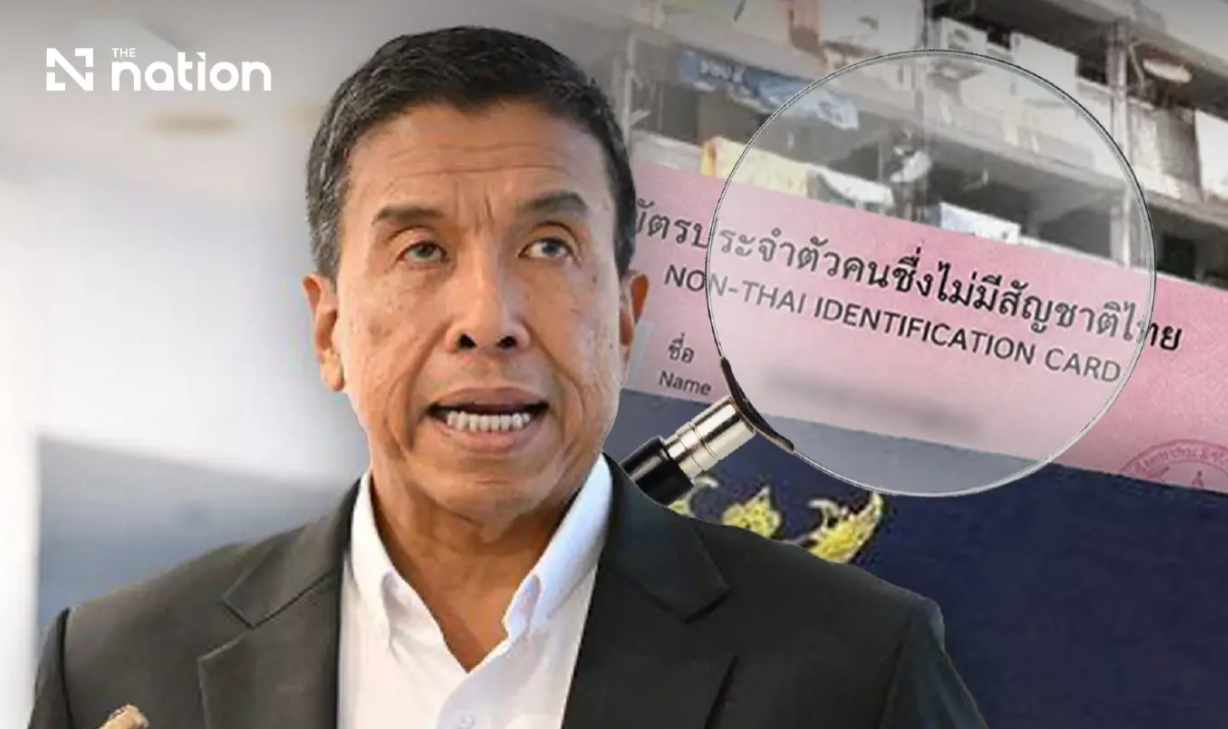
Bangkok Governor Chadchart Sittipunt has ordered a sweeping examination of household-registration records spanning the past decade across all 50 district offices in the capital, responding to evidence of systematic irregularities in the issuance of identification cards for foreign nationals, colloquially referred to as pink cards. The probe follows the discovery of suspicious patterns that suggest organised exploitation of weaknesses embedded within Thailand's civil-registration framework, representing a significant vulnerability in how the kingdom verifies and documents the status of non-Thai residents.
The scope of this audit is both extensive and detailed, requiring each district office to submit preliminary findings by August 21 following the governor's directive. The investigation targets documents dating back to 2017, meaning officials must now sift through more than a decade of records to identify instances where individuals without Thai nationality were improperly inserted into household registrations—a critical step in the process of obtaining pink cards and supporting documentation. This backward-looking investigation acknowledges that fraudulent patterns may have operated undetected for years, potentially affecting thousands of registrations across the metropolitan area.
The suspected schemes reveal disturbing creativity in circumventing administrative safeguards. One prominent method exploited birth certificates belonging to foreign-born children of non-Thai parents who subsequently returned to their home countries. The physical certificates remained in Bangkok, where they were allegedly repurposed to transfer unrelated individuals into household registrations under these children's identities, effectively creating phantom family members. This technique exemplifies how fraudsters weaponised legitimate documents by severing them from their original purpose and context.
Additional schemes uncovered by investigators involved the manipulation of household structures themselves. Some cases showed evidence of names being transferred from central household registers into ordinary household registrations, while others relied on fabricated relationships—arrangements officials have termed "phantom child" and "phantom father" constructions. These fraudulent family configurations appeared legitimate on paper while serving no authentic purpose beyond facilitating access to identity documentation. The sophistication of these methods suggests involvement of experienced operatives familiar with administrative procedures.
The initial discovery emerged clearly in Din Daeng district, where auditors identified a property spanning merely 40 square metres that somehow carried 40 to 45 registered residents. This absurd density immediately triggered suspicion and prompted deeper examination of registrations throughout the district. Subsequent reviews of 2024 records in Din Daeng alone identified over 2,000 suspicious address transfers, suggesting the problem extends far beyond a few isolated cases. The sheer scale of irregularities in a single district implies that Bangkok-wide figures could reach into the tens of thousands.
Four Bangkok Metropolitan Administration employees linked to the Din Daeng irregularities have been temporarily suspended pending disciplinary inquiries, with a fourth employee recently added to this list as the investigation expanded. The BMA emphasised that these administrative actions do not constitute findings of guilt but rather precautionary measures while separate police investigations proceed in parallel. The involvement of government staff raises troubling questions about whether officials knowingly facilitated fraud or were manipulated by sophisticated operators who exploited administrative loopholes and trust relationships.
Investigators now focus on tracing financial connections between suspected brokers orchestrating the fraud and government employees who may have enabled registration approvals. Governor Chadchart acknowledged that the BMA lacks independent authority to compel information from outside parties or examine private financial records, necessitating police assistance to map money flows and establish direct links between suspected payments and specific officials. This financial investigation component could prove decisive in distinguishing between system failures and deliberate corruption.
The investigation committee will examine not merely the registrations themselves but also the conduct of individuals involved, with Chadchart making clear that inquiry will follow evidence regardless of whether it leads to senior administrators or retired officials. Any subsequent action will depend on findings and applicable legal frameworks, suggesting the Bangkok administration is prepared to pursue accountability at all levels should the evidence warrant such action. This willingness to investigate regardless of seniority is essential for public confidence in the review's integrity.
Chadchart cautioned against premature estimates, noting that approximately 3,000 suspicious registrations remain unconfirmed and may be distributed across numerous properties rather than concentrated in single locations. The initial screening phase will focus on homes with at least 15 registered occupants, a threshold that may subsequently be lowered to permit more comprehensive random sampling of individual properties. This graduated approach balances the need for thorough examination with practical constraints on administrative resources.
Beyond immediate investigation, the BMA is implementing structural reforms designed to prevent recurrence. Approval authority for registrations will no longer rest with individual employees; instead, district directors and section heads must now share responsibility for these decisions, distributing power and reducing opportunities for abuse. Officials working in sensitive registration positions face potential periodic rotation to prevent the entrenchment of corrupt relationships and the accumulation of discretionary power within individual officers.
Expanded anti-corruption policies will emphasise administrative and civil-registration functions, incorporating measures to improve transparency without creating barriers for legitimate applicants attempting to navigate the system legitimately. These procedural improvements acknowledge that effective administration requires both robust oversight and functional processes capable of serving the public efficiently. The challenge lies in simultaneously closing loopholes that facilitated fraud while maintaining systems that remain accessible to genuine claimants seeking valid documentation.
For Malaysia and Southeast Asian nations observing this situation, the Bangkok case illustrates how civil-registration systems—essential infrastructure for state capacity and social services—remain vulnerable to organised exploitation unless constantly monitored and regularly reformed. Thailand's discovery of systematic fraud spanning a decade highlights that administrative weaknesses can persist and proliferate undetected until unusual patterns trigger investigation. The sophistication of the schemes uncovered suggests that identity fraud of this nature may plague other regional neighbours similarly, warranting proactive review of registration procedures before large-scale fraud becomes entrenched in administrative structures.

