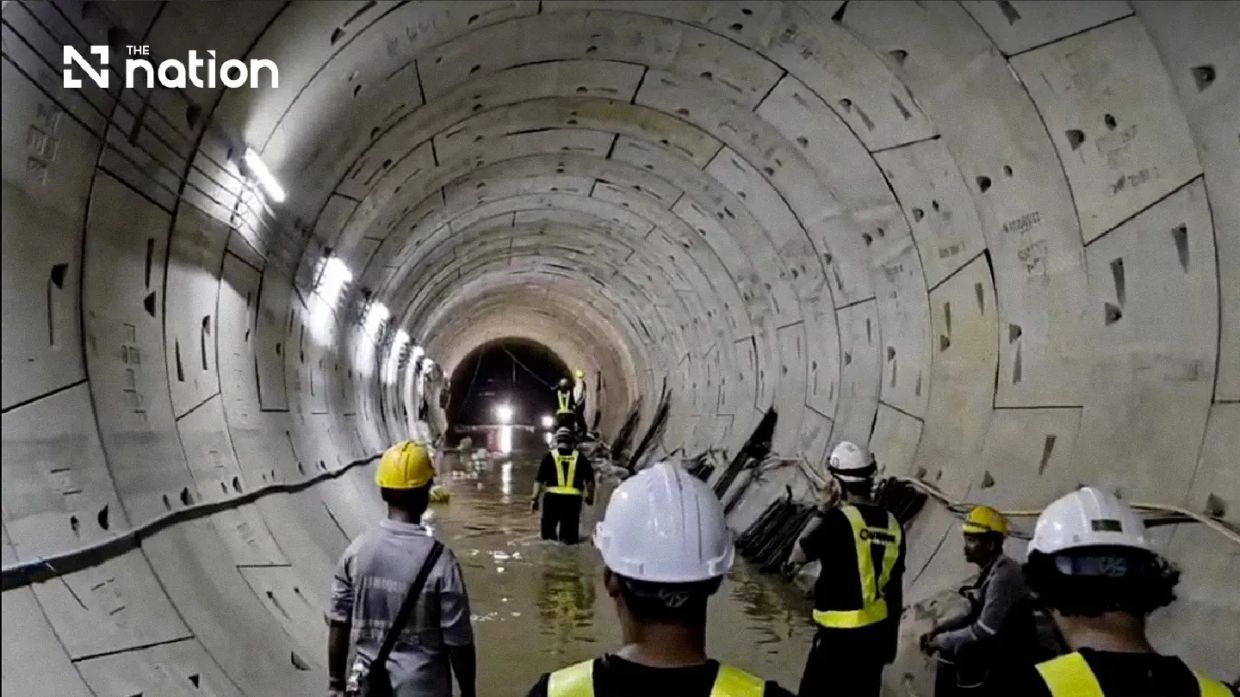
Prime Minister Anutin Charnvirakul made an unscheduled late-night visit to the Purple Line construction site in Wongwian Yai on Wednesday after water breached an underground tunnel section during heavy Bangkok rainfall, triggering immediate safety assessments by transport authorities and engineering teams overseeing the major transit infrastructure project.
The incident occurred within a construction shaft located beneath the Tao Poon–Rat Burana section of the Purple Line extension, which follows the Kanchanaphisek Ring Road corridor. As monsoon downpours inundated the capital on July 8, water levels rose steadily throughout the day at the active worksite, eventually entering the tunnel excavation area and prompting authorities to declare an emergency inspection. The unexpected incursion of groundwater into this critical structural zone raised immediate concerns about the integrity of ongoing construction and potential impacts on the broader project timeline.
Anutin's arrival near midnight followed mobilization of Thailand's top transport leadership. Deputy Prime Minister and Transport Minister Phiphat Ratchakitprakarn, alongside Deputy Transport Ministers Siripong Angsakulkiat, Phattharaphong Phatraprasit, and Sanphet Boonyamanee, had already established themselves at the location to monitor developments. Interior Ministry officials also dispatched Deputy Interior Minister Worasit Liangprasit. The high-level convergence underscored government anxieties surrounding Bangkok's expanding metro network, where construction-related accidents have previously caused serious public safety incidents and significant reputational damage to successive administrations.
The troubled section forms part of Contract 4 under the southern Purple Line expansion, extending from Saphan Phut to Dao Khanong. Contractor Unique Engineering and Construction Public Company Limited (UNIQ) holds the 14.982 billion baht (US$447.3 million) contract, currently engaged in tunnel boring and retaining wall installation. Mass Rapid Transit Authority of Thailand Governor Gardphajon Udomdhammabhakdi and UNIQ's executive leadership joined government representatives in analyzing the developing situation and reviewing immediate containment protocols.
Deputy Transport Minister Phattharaphong provided initial assessments suggesting the water intrusion remained manageable. However, he ordered the MRTA and UNIQ to intensify monitoring operations, execute comprehensive technical evaluations, and rapidly identify the precise breach mechanism. Critical directives mandated urgent corrective actions to safeguard tunnel structural integrity, eliminate public safety hazards, and preserve the construction program's viability. Both organizations received instructions to maintain regular ministry progress reporting and ensure all interventions adhered strictly to established engineering and safety protocols.
Anutin characterized the official response as fundamentally engineering-focused, balancing immediate repair efforts with longer-term preventive measures. He indicated that water accumulation had not yet reached thresholds necessitating surface road closures or widespread public disruptions. The prime minister notably distinguished this incident from September 2025's catastrophic Vajira Hospital tunnel collapse, where structural failure had caused ground subsidence affecting surface infrastructure. In contrast, officials had detected the Wongwian Yai leak early and were working continuously since morning to seal the breach while preventing further water level escalation.
Authorities had successfully maintained internal water levels throughout the response period without evidence of continuing rises, according to Anutin's account. The MRTA simultaneously deployed specialized monitoring equipment to track any subsurface movement in nearby structures, with initial assessments detecting no abnormal deformation or displacement patterns. Nonetheless, the authority committed to sustained surveillance of surrounding buildings and infrastructure as a precautionary measure. The prime minister suggested that comprehensive inspections would conclude relatively expeditiously given the controlled situation.
When questioned about the urgency motivating his personal midnight site visit, Anutin referenced the profound lessons derived from the Vajira Hospital catastrophe. That incident had fundamentally altered official preparedness protocols and heightened sensitivity toward early detection, rapid public communication, and coordinated emergency response mechanisms. He emphasized that public safety constituted the paramount consideration driving all decision-making throughout the crisis management process.
Following consultations with MRTA leadership, independent engineering consultants, and UNIQ management, Anutin reported consensus that the situation remained controllable despite the breach. All stakeholders had committed to accelerating repair schedules to restore normal operational conditions expeditiously. When media observers noted the substantial minister participation at the site, Anutin characterized this as organic coordination emerging from routine inter-agency communications rather than hierarchical emergency protocols, though he emphasized his personal commitment to ensuring proper situation management before escalation could occur.
The Purple Line incident reflects ongoing structural vulnerabilities within Bangkok's rapidly expanding metro construction program, where aggressive timelines, complex urban geology, and monsoon-season groundwater dynamics create persistent engineering challenges. For Malaysian observers monitoring Southeast Asia's transport development, the episode illustrates how even well-resourced economies struggle managing underground infrastructure projects in tropical urban environments. The incident also demonstrates the political dimensions of infrastructure failures, where ministerial visibility and rapid response become essential components of crisis containment and public confidence maintenance, particularly following previous catastrophic failures that eroded institutional credibility.

