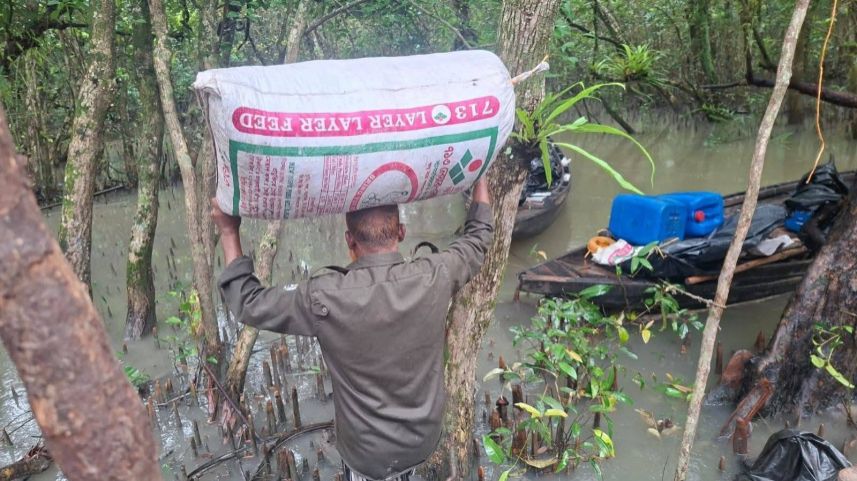
Bangladeshi forest officials have uncovered what appears to be a coordinated network of illegal shrimp processing camps operating within the Sundarbans, executing a full-day enforcement operation that resulted in the destruction of three facilities suspected of using poison to accelerate production. The July 30 raid, conducted by the Chandpai Range authorities and overseen by Divisional Forest Officer Rezaul Karim Chowdhury, targeted operations concealed along waterways in the Charaputia area, demonstrating the scale of unauthorised activity taking place within this internationally protected ecosystem.
The enforcement action uncovered a troubling picture of how food products destined for consumer markets in Bangladesh are being manufactured through environmentally destructive methods. When officials arrived at three distinct locations—positioned at the mouths of Kaga Khal, Indurkani Khal and Chhoto Hormal Khal—they found that the first two camps had already been hastily abandoned, suggesting operators maintain surveillance systems to detect approaching authorities. The third location proved more revealing, containing substantial quantities of processed and semi-processed shrimp alongside equipment suggesting this was not merely a small-scale operation but part of a larger commercial enterprise.
The material seized during the twelve-hour operation painted a stark picture of the processing methods employed. Officials recovered two sacks of finished dried shrimp alongside approximately five maunds of fresh shrimp arranged for drying, two litres of unidentified chemical substances identified as suspected poison, two boats equipped for harvesting, multiple nets designed for shrimp collection, and three sacks of rice used in processing. The fresh shrimp exhibited an overwhelmingly strong chemical odour, prompting officials to make the precautionary decision to destroy the entire stockpile immediately rather than risk contaminated product entering the food supply chain. In a separate seizure during the same enforcement drive, authorities also apprehended a vessel carrying ninety-five crab traps after its operators fled into the forest mangroves.
The operation represents an escalation in environmental enforcement efforts within the Sundarbans, though conservationists argue such measures remain inadequate to stem the tide of illegal activity. The Sundarbans, which spans across both Bangladesh and India and encompasses the world's largest continuous mangrove forest, has been designated a UNESCO World Heritage Site precisely because of its irreplaceable ecological significance and biodiversity. Yet the discovery of this poison-based shrimp processing network illustrates how such international designations offer limited practical protection against determined commercial operators willing to exploit the remoteness and vastness of the territory.
Environmental advocates stress that the use of toxic chemicals in shrimp processing represents a particularly insidious threat to the region's delicate ecological balance. Noor Alam, coordinator of the community environmental organization Sundarban Rokkhay Amra, underscores how poison-based processing practices silently degrade the entire ecosystem by contaminating waterways, decimating aquatic organisms that form the foundation of the food chain, and rendering the environment increasingly inhospitable for wildlife. The chemicals do not remain contained within processing sites but instead seep into the intricate network of channels that constitute the lifeblood of the Sundarbans, spreading ecological damage far beyond the immediate vicinity of illegal operations.
The raid has simultaneously exposed serious gaps in food safety mechanisms protecting ordinary consumers across Bangladesh. In communities surrounding the Sundarbans, including areas like Kachua upazila, dried shrimp has begun appearing with increasing frequency in local markets despite never previously being a common commodity in these regions. This sudden emergence of supply has generated considerable alarm among residents and public health advocates who question the origins and safety status of the product. A student from the region, Mehadi Hasan Khan, articulated the dilemma facing consumers who encounter dried shrimp at local bazaars like Badal Bazar without any reliable means of determining whether the product has been processed through legitimate methods or through the toxic techniques exposed by this enforcement operation.
The broader context demonstrates that the Sundarbans faces an escalating array of threats that compound one another in ways that single enforcement operations struggle to address. Beyond the newly exposed problem of poison-based shrimp production, the ecosystem already endures sustained pressure from illegal timber extraction, wildlife poaching networks, unregulated fishing operations that deplete fish stocks, accelerating climate change impacts including rising sea levels and increased salinity, and progressive habitat degradation. Forest officials acknowledge they will intensify enforcement drives targeting illegal activities, yet the persistence of such operations despite existing regulations suggests that enforcement capacity and resource allocation remain insufficient to match the scale and sophistication of illegal commercial networks operating within the protected area.
For Malaysia and other Southeast Asian nations with comparable coastal ecosystems and mangrove forests, the Bangladesh case study carries important implications regarding how transnational seafood supply chains operate and how illegal processing practices can become embedded within legitimate distribution networks. The discovery that poison-processed shrimp has penetrated local markets without detection mechanisms raises questions about food safety oversight throughout the region. Bangladesh's experience suggests that without coordinated international approaches to enforcement, supply chain transparency, and investment in alternative livelihood opportunities for communities dependent on marine resource extraction, individual nation-states will struggle to contain environmentally destructive practices that operate across porous borders and exploit enforcement gaps.
The demolition of the three camps and seizure of equipment represents a temporary disruption rather than a definitive solution to the underlying economic incentives driving illegal operations. The low cost of poison-based acceleration compared to traditional drying methods, combined with rising international demand for dried shrimp products, creates powerful motivation for operators to continue such practices despite legal prohibitions. Forest officials have committed to expanded surveillance and more frequent enforcement operations, yet sustainability will require simultaneously addressing the economic marginalization of local communities and developing commercially viable alternatives to exploitative extraction methods that currently offer the quickest path to income generation.

