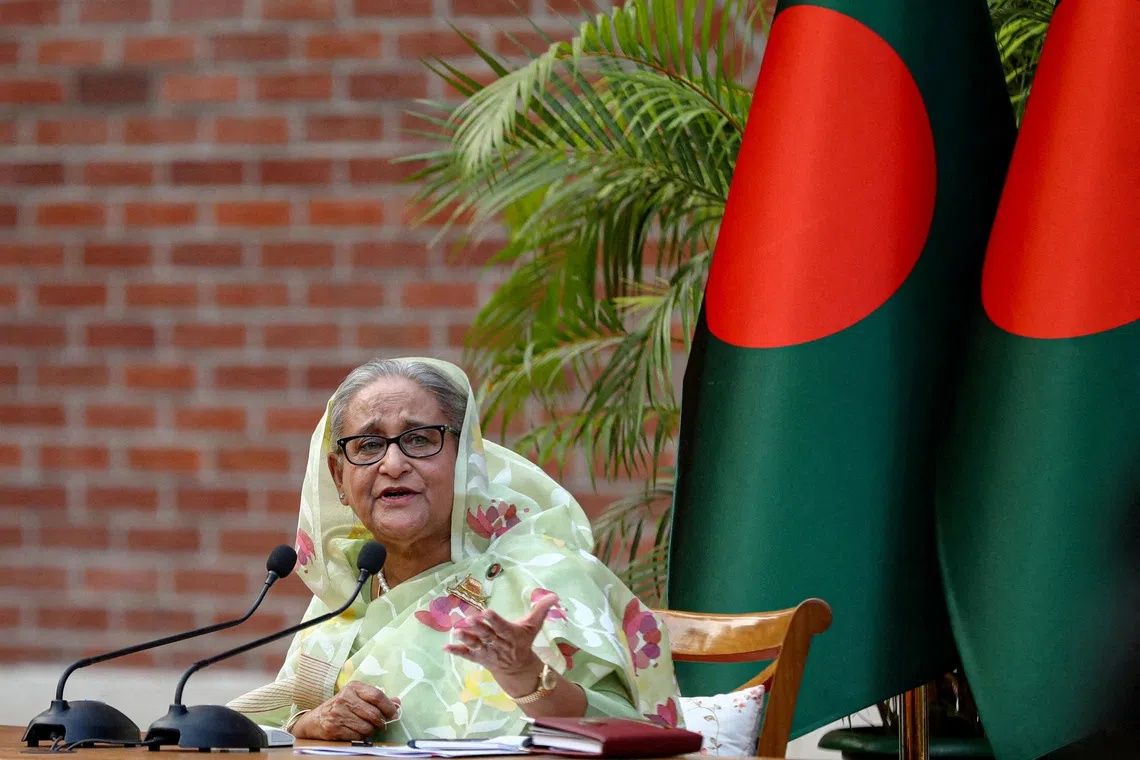
Bangladesh has formally requested clarification from India regarding its position on an upcoming virtual address by exiled former prime minister Sheikh Hasina from New Delhi, raising concerns that tolerating such political activity by a fugitive could undermine the recent momentum toward reconciliation between the two South Asian neighbours. The diplomatic complaint marks the first official response from Dhaka to the planned appearance by Hasina at an August 5 event organised by the Foreign Correspondents' Club of South Asia, which will commemorate the second anniversary of the student-driven movement that toppled her government last year.
The timing of this dispute is delicate. Bangladesh has consistently sought Hasina's extradition since she fled to India in August 2024, following weeks of civil unrest that claimed hundreds of lives. Yet simultaneous efforts by the newly elected government under Prime Minister Tarique Rahman to rebuild relations with New Delhi have shown promise in recent months. State Minister for Foreign Affairs Shama Obaed Islam conveyed Dhaka's position to reporters on Monday, emphasising that Bangladesh wants bilateral progress to continue unimpeded. "We are moving forward with India with a forward-looking approach. We don't want that progress to be affected," she stated, before pointedly adding that "India has to be clear about its stance."
The planned speech itself is relatively modest in format. Hasina, now 78 years old, is expected to participate by video link from Indian territory, appearing alongside her son Sajeeb Wazed Joy and other speakers at the commemoration event. The Foreign Correspondents' Club of South Asia has not yet responded to requests for comment regarding Bangladesh's concerns, leaving the event's status somewhat uncertain. While the club operates independently and the gathering is not a state-sponsored affair, the location—New Delhi—gives it significant diplomatic weight in the eyes of Dhaka officials, who view the venue as implying tacit government endorsement or at minimum, governmental permission.
Bangladesh's objections rest on a principle it claims India has previously endorsed: that countries should not permit fugitives accused of serious crimes to conduct political activities from their territory. Islam reiterated that Dhaka has raised this concern with New Delhi multiple times, specifically regarding Hasina and other Awami League leaders who have made political statements whilst residing in India. The government has not ruled out escalating the matter through formal diplomatic channels if India does not provide a satisfactory response, signalling that this is more than a routine administrative complaint.
The underlying legal and political context gives weight to Bangladesh's position. In 2025, Hasina was sentenced to death in absentia for crimes against humanity stemming from a 2024 military crackdown on protests. International observers, including the United Nations, estimated that operation resulted in up to 1,400 deaths. Hasina has rejected the verdict as legally invalid, claiming the proceedings lack legitimacy. Despite facing multiple criminal cases at home, she told Reuters in a recent interview that she intends to return to Bangladesh in December, a statement that seems to assume either a change in her legal circumstances or a political shift in Dhaka that would make her return safe.
India's response to this developing situation remains unclear. The Indian foreign ministry has not yet commented publicly on the matter. This silence is noteworthy because New Delhi has long maintained a delicate balancing act regarding Hasina's presence on its soil. Harbouring a regional political figure wanted by a neighbouring state creates obvious diplomatic friction, yet expelling her or openly restricting her activities could be seen as undue interference in her personal freedoms and might generate criticism from her supporters within India and internationally.
The relationship between Bangladesh and India has deteriorated notably since Hasina's departure from power. Both countries share a complicated history marked by periods of tension and cooperation. Recent developments suggest a tentative thaw, with officials from the new Bangladeshi administration signalling willingness to engage constructively with New Delhi and explore avenues for enhanced bilateral cooperation. The Hasina question, however, threatens to complicate this warming trend at a crucial moment when both governments are attempting to reset their engagement.
For Malaysia and other Southeast Asian nations, this dispute carries indirect significance. Bangladesh's position as a large Muslim-majority democracy and significant ASEAN dialogue partner means that regional stability depends partly on smooth relations between Dhaka and New Delhi. Any deterioration in Indo-Bangladesh ties could ripple across South Asia and the wider region, affecting trade, security cooperation, and regional initiatives. Additionally, the precedent set by how India handles the Hasina question—whether it prioritises individual freedoms, diplomatic relations, or extradition obligations—could influence how other South Asian governments approach similar situations involving political fugitives.
The episode also reflects broader tensions within South Asian politics regarding exile and accountability. As governments become more sophisticated in pursuing political opponents across borders through legal mechanisms, questions about where accountability ends and political persecution begins grow increasingly contentious. Hasina's supporters argue that the charges against her are politically motivated, while her opponents contend that accountability for deaths during her administration is essential. India's handling of this situation will inevitably be interpreted as taking a side in that dispute, regardless of what position New Delhi actually adopts.
Looking ahead, several outcomes are possible. India could quietly discourage Hasina from participating in the August 5 event, effectively supporting Bangladesh's position without making a public statement. It could allow the event to proceed without comment, signalling that it views such activities as beyond government control. Or it could formally clarify its stance, as Dhaka has requested, providing legal and diplomatic reasoning for whatever decision it makes. Each option carries different implications for bilateral relations and regional perceptions of Indian foreign policy.

