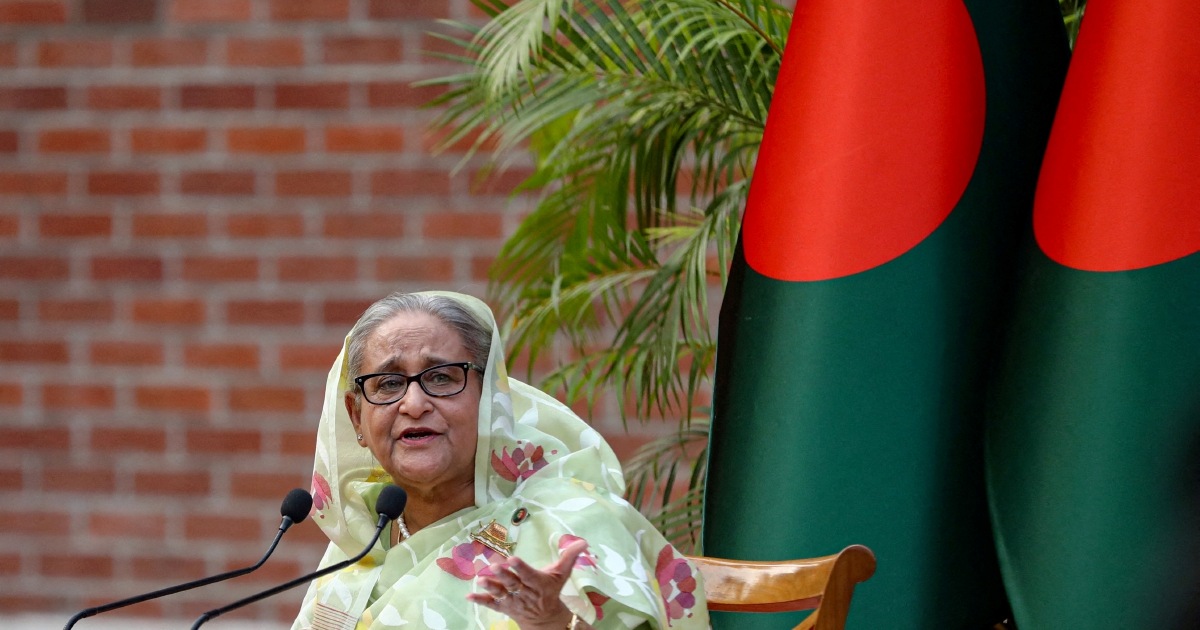
Bangladesh's interim government has moved decisively to confiscate 760 billion taka—equivalent to roughly $6.2 billion—in assets belonging to ousted Prime Minister Sheikh Hasina, her relatives, and a network of ten prominent business groups, according to an announcement made by state authorities on Wednesday. The sweeping asset seizure represents one of the most substantial financial actions taken since Hasina's departure from office and underscores the transitional administration's commitment to investigating the former premier's tenure and its alleged financial irregularities.
The confiscation order encompasses not only personal wealth held by Hasina and members of her immediate household but extends to vast commercial holdings controlled by major entrepreneurs and conglomerates with reported connections to the ousted leader. This multi-layered approach targeting both political figures and their business associates reflects a broader accountability effort that extends beyond simple removal from power to examining networks of alleged influence and financial misconduct. The action signals that investigators believe substantial assets were accumulated through mechanisms that warrant state recovery and further scrutiny.
For Malaysian and Southeast Asian observers, this development carries particular relevance given the region's shared concerns about governance, corruption, and the transition of power. Bangladesh's population of 170 million makes it a significant regional economy, and the stability of its institutions affects broader South Asian trade and diplomatic relations. The seizure announcement comes amid international attention to how transitional governments in the region manage accountability measures while maintaining economic confidence and avoiding excessive destabilisation.
The identification of ten specific business groups as having assets subject to confiscation suggests a coordinated investigation into patronage networks rather than isolated cases of individual wrongdoing. Such networks—where political power translates into preferential market access, monopolistic positions, or state contracts—represent a recurrent challenge across South Asia. Bangladesh's action, if transparently implemented with legal due process, could provide valuable lessons for how post-transition administrations can balance retribution with institutional legitimacy.
The financial quantum involved demands attention to both domestic and international dimensions. A $6.2 billion seizure represents a substantial injection of resources into state coffers or, alternatively, into frozen accounts pending legal determination. For Bangladesh's development agenda, the disposition of these assets—whether returned to the state treasury, distributed as reparations, or held pending trials—will influence fiscal capacity and public confidence in institutional reform. International banking systems and regulatory bodies will be monitoring how these assets are managed to ensure compliance with anti-money laundering standards and cross-border financial transparency requirements.
Hasina's departure from office came amid significant political turbulence that drew regional and international concern. Her administration, which had governed Bangladesh for most of the period since 2009 with a brief interruption, faced accusations spanning from alleged election irregularities to restrictions on press freedom and opposition activity. The asset seizure constitutes legal follow-up to her exit, though the mechanisms of investigation, standards of evidence, and opportunities for due process will be critical to determining whether these measures strengthen or undermine Bangladesh's long-term institutional development.
The involvement of business groups in the confiscation suggests that investigators are examining allegations that Hasina's political authority was leveraged to create or protect commercial monopolies, extract favourable regulatory treatment, or facilitate illicit financial flows. This pattern—where political power generates private commercial advantage—is not unique to Bangladesh but remains a persistent governance challenge throughout the region. How thoroughly and fairly the investigation proceeds will affect perceptions of whether Bangladesh is undertaking genuine institutional reform or merely executing political vengeance dressed in legal language.
International observers and Bangladesh's own civil society organisations will be monitoring whether the confiscation process adheres to established legal procedures, permits affected parties meaningful opportunity to contest claims, and demonstrates transparent accounting of seized assets. The credibility of anti-corruption efforts depends not merely on the scale of assets recovered but on the rigor and fairness of investigative and judicial processes. Bangladesh's courts and investigative agencies face the challenge of conducting thorough accountability while maintaining public confidence that the transition serves institutional reform rather than serving narrow political interests.
The timing and scale of the asset seizure announcement also reflects broader questions about Bangladesh's international engagement. The country's relationships with major trading partners, development partners, and regional neighbours will be shaped partly by perceptions of how transitional justice unfolds. Excessive or apparently arbitrary asset confiscation could trigger international concerns about property rights and rule of law, while inadequate accountability could suggest that institutional capture persists under new leadership. Bangladesh's authorities will need to calibrate their approach carefully.
Looking forward, the disposition of these seized assets will carry implications for Bangladesh's economic recovery and institutional credibility. Whether funds are productively redeployed through transparent mechanisms or disappear into bureaucratic channels will signal whether the transition represents genuine systemic change. For regional observers in Malaysia and neighbouring countries, Bangladesh's experience offers cautionary lessons about managing post-crisis governance and the centrality of transparent, accountable institutions to sustainable development and public trust.

