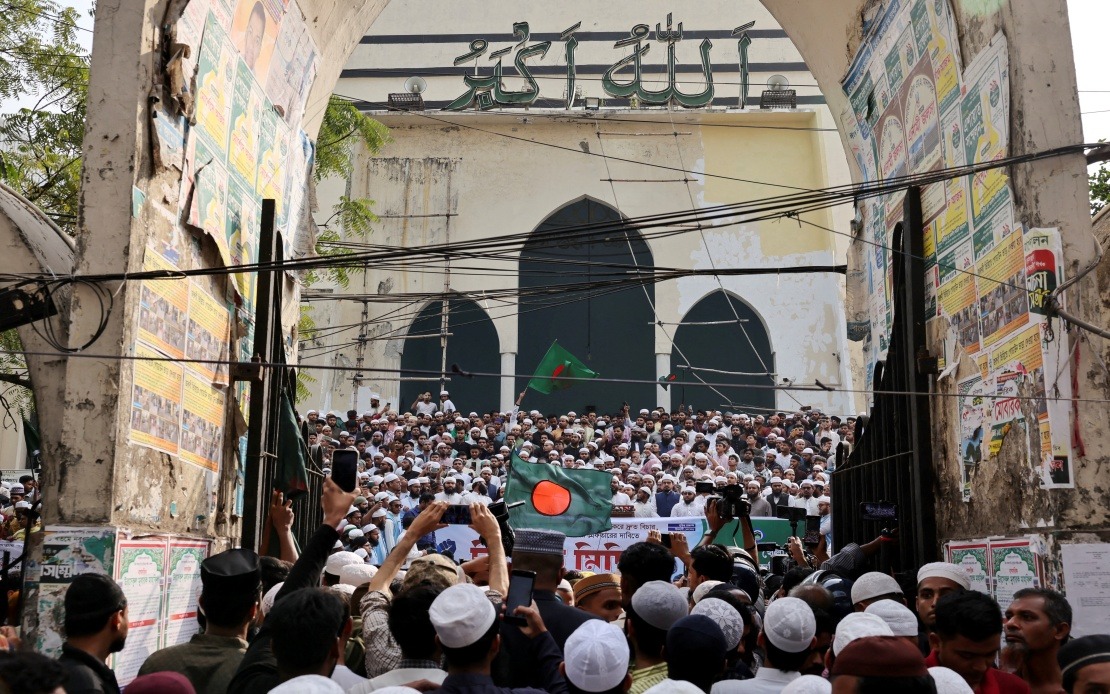
Bangladesh's International Crimes Tribunal delivered death sentences on Sunday to three police officers found guilty of crimes against humanity for their involvement in the fatal shooting of protesters during the tumultuous July 2024 uprising. The three-member tribunal, chaired by Justice Md Golam Mortuza Mozumder, issued the verdict in absentia against the senior law enforcement officials, marking a significant moment in the country's reckoning with the violence that destabilized the nation.
The convicted officers occupy prominent positions within Bangladesh's police hierarchy. Habibur Rahman, who served as commissioner of the Dhaka Metropolitan Police, received the capital sentence alongside Md Rashedul Islam, a former additional deputy commissioner of the same force, and Md Mashiur Rahman, who previously headed the Rampura Police Station. All three remain fugitives from the authorities. Rahman has already faced a separate death sentence in another case, suggesting a pattern of serious allegations against the former police establishment.
Two additional officers received lengthy prison sentences in connection with the same incidents. Tariqul Islam Bhuiyan, a former sub-inspector at Rampura Police Station, was sentenced to life imprisonment plus an additional twenty years. The tribunal's graduated approach to sentencing reflects the varying degrees of culpability established during the proceedings, with the sentences corresponding to documented roles in specific killings during the uprising.
The particular cases examined by the tribunal gained international attention through viral social media footage. One conviction involved the shooting of a young man as he hung from a building in Dhaka—an image that circulated widely online and galvanized public outrage. Two additional deaths occurred elsewhere in the capital during the same period of civil unrest. These high-profile incidents became catalysts for broader demonstrations demanding accountability and governmental reform.
The 2024 uprising represented a watershed moment in Bangladesh's recent political history, culminating in the downfall of Prime Minister Sheikh Hasina's administration after more than fifteen years in power. The demonstrations, which erupted amid escalating tensions over various governance issues, encountered a violent police response that left an estimated 1,400 dead according to United Nations documentation. The overwhelming majority of fatalities resulted from gunfire discharged by law enforcement officers, many of whom were members of the Awami League party apparatus. Hasina fled the country in August 2024 and has remained in exile since then.
The tribunal's actions form part of broader efforts to prosecute those responsible for deaths during the uprising. In November of the previous year, the same court convicted Hasina herself on crimes against humanity charges, sentencing her to death in her absence. The former prime minister's conviction established that accountability mechanisms were being applied across the political hierarchy, from the highest governmental levels to operational police personnel.
For Malaysia and other Southeast Asian nations, the Bangladesh proceedings offer a significant case study in post-conflict accountability and transitional justice. The International Crimes Tribunal represents an institutional commitment to investigating and prosecuting alleged abuses, though the challenge of locating and apprehending the convicted fugitives remains substantial. The tribunal's independence and authority become critical considerations for regional observers monitoring judicial responses to mass-casualty events.
The conviction of senior police officers carries implications for institutional reform within Bangladesh's security forces. When high-ranking officials face accountability for command-level decisions and operational directives, it potentially influences internal police culture and chain-of-custody protocols. However, the absence of the convicted officers—still at large—underscores the difficulty of enforcing such sentences without robust international cooperation or domestic law enforcement capacity.
The case also highlights the role of social media and visual documentation in mobilizing public demand for justice. The viral spread of footage showing specific acts of violence created incontestable evidence that supported prosecutorial efforts and public pressure for convictions. In the context of Southeast Asian governance, where security forces sometimes operate with relative impunity, the Bangladesh tribunal's willingness to prosecute high-ranking officers regardless of their political connections represents a notable precedent.
Regional governments and civil society observers are closely monitoring Bangladesh's accountability processes as they unfold. The tribunal's work continues beyond these three officers, with investigations potentially extending to additional participants in the 2024 violence. The broader question of institutional accountability versus individual culpability—distinguishing between orders given and orders followed—will likely shape future discourse around protest management and police conduct across the region.
Looking forward, Bangladesh faces the complex task of rebuilding public confidence in law enforcement institutions while pursuing accountability for established wrongdoing. The trials demonstrate a commitment to investigating credible allegations, yet the practical challenges of prosecuting fugitives and maintaining judicial momentum over extended periods remain formidable. For Malaysian and other Southeast Asian observers, the case illustrates both the possibilities and limitations of transitional justice mechanisms in emerging democracies navigating post-crisis recovery.

