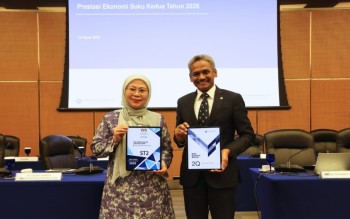
Malaysia's central bank has signalled continued confidence in the economy's expansion trajectory, maintaining its 2026 gross domestic product growth forecast of 5.0 per cent despite headwinds from global uncertainties and geopolitical tensions. Bank Negara Malaysia Governor Datuk Seri Abdul Rasheed Ghaffour indicated that no revision to the growth projection is warranted at the current juncture, with any adjustments likely to occur only during the annual Budget announcement when fresh data becomes available. This stance reflects the resilience demonstrated across the economy in recent quarters, suggesting that Malaysia's growth engines remain adequately powered despite external challenges.
The central bank's confidence is grounded in concrete economic performance. Malaysia's economy expanded by 6.0 per cent in the second quarter of 2026, exceeding the Department of Statistics Malaysia's preliminary estimate of 5.8 per cent. This outperformance marks the third consecutive quarter in which actual growth has surpassed initial expectations, signalling both the robustness of underlying economic activity and the conservative nature of official forecasting. For Malaysian policymakers and investors alike, this track record of upside surprises provides reassurance that growth momentum remains intact despite concerns about external developments.
The Governor attributed this positive trajectory primarily to the strength of domestic demand, which continues to serve as the economy's ballast even as global trade patterns remain volatile. Malaysia has benefited substantially from external sector support, particularly in the preceding quarter, indicating that the export-oriented segments of the economy retain competitiveness despite international trade uncertainties. This diversified support base matters crucially for the Southeast Asian economy, as it suggests that growth is not dependent on any single source, reducing vulnerability to sector-specific shocks. The combination of robust internal consumption and external demand creates a more stable foundation for sustained expansion.
Within the export sector specifically, growth has manifested itself across multiple industries rather than concentrating in traditional areas. Both electrical and electronics products and non-E&E exports have recorded positive growth, demonstrating that Malaysia's manufacturing base extends well beyond its historical strength in semiconductor-related goods. Additionally, the information and communications technology services sector has shown expansion, reflecting the economy's ongoing diversification towards higher-value activities. This breadth of export performance contrasts with scenarios where growth might depend excessively on a handful of product categories vulnerable to price fluctuations or demand shocks.
Household consumption has emerged as particularly resilient, expanding at 4.8 per cent during the second quarter despite moderate wage growth across many sectors. The Governor identified income growth, accumulated savings, and government policy support as the primary underpinnings of consumption resilience, with household borrowing playing only a marginal role. This composition of demand drivers is significant for Malaysia, as it indicates that consumer spending rests on relatively sustainable foundations rather than debt accumulation. The reliance on savings suggests that households retain buffers for potential economic downturns, and the contribution of government policies points to the effectiveness of fiscal measures in supporting purchasing power.
Yet the central bank remains cognisant of emerging risks that could materially alter Malaysia's growth trajectory. Global economic uncertainties and geopolitical conflicts present genuine threats to export momentum and investor confidence. The Governor explicitly acknowledged that adjustments to growth drivers may become necessary as these external pressures potentially intensify. For Malaysian businesses and investors, this cautious but not alarmist tone suggests that while the current outlook remains favourable, flexibility and contingency planning remain prudent. The central bank's reluctance to revise forecasts downward despite acknowledging these risks reflects a belief that the Malaysian economy possesses sufficient resilience to absorb moderate shocks.
One specific concern highlighted by the Governor relates to El Niño's potential economic impacts, though he characterised these as likely to materialise gradually and remain concentrated within the agricultural sector. However, he urged businesses and households to commence preparation strategies should climatic conditions deteriorate further. This forward-looking guidance proves particularly relevant for Malaysia, given the agricultural sector's role in rural livelihoods and the interconnections between agricultural productivity and broader economic activity. Small and medium enterprises operating in agriculture-dependent supply chains should take note of the central bank's implicit warning to strengthen their resilience.
The timing of Bank Negara's forecast confirmation carries additional significance in the regional context. As other Southeast Asian economies grapple with varying degrees of growth deceleration and inflation persistence, Malaysia's ability to expand above five per cent while maintaining price stability represents a comparative advantage. The central bank's maintenance of existing growth projections rather than downward revisions sends a signal to regional and international investors that Malaysia's macroeconomic fundamentals remain sound. This positioning could influence capital flows within the region, potentially benefiting the Malaysian ringgit and attracting investors seeking emerging market exposure with lower-than-average volatility.
For policymakers in Putrajaya, the central bank's assessment provides some flexibility in budget planning. The Governor's indication that revisions typically accompany Budget announcements suggests that Parliament should anticipate detailed growth assumptions when the Finance Minister presents the fiscal framework. If growth continues to exceed five per cent, the government may find additional fiscal room to either reduce deficits or channel resources towards priority areas such as infrastructure or human capital development. Conversely, should external conditions deteriorate materially in coming quarters, the central bank would likely signal downward revisions at that juncture, necessitating budget adjustments.
The broad-based nature of growth across consumption, investment, and exports also indicates that Malaysia's economic expansion reflects genuine economic activity rather than statistical artefacts or temporary distortions. This fundamental soundness matters for long-term planning by both private sector enterprises and government agencies. Companies considering capacity expansions can take some comfort that demand growth appears structural rather than cyclical. Meanwhile, the central bank's confidence in maintaining the 5.0 per cent forecast through 2026 suggests that current policy settings remain broadly appropriate, though ongoing monitoring of inflation and financial stability risks will remain essential.

