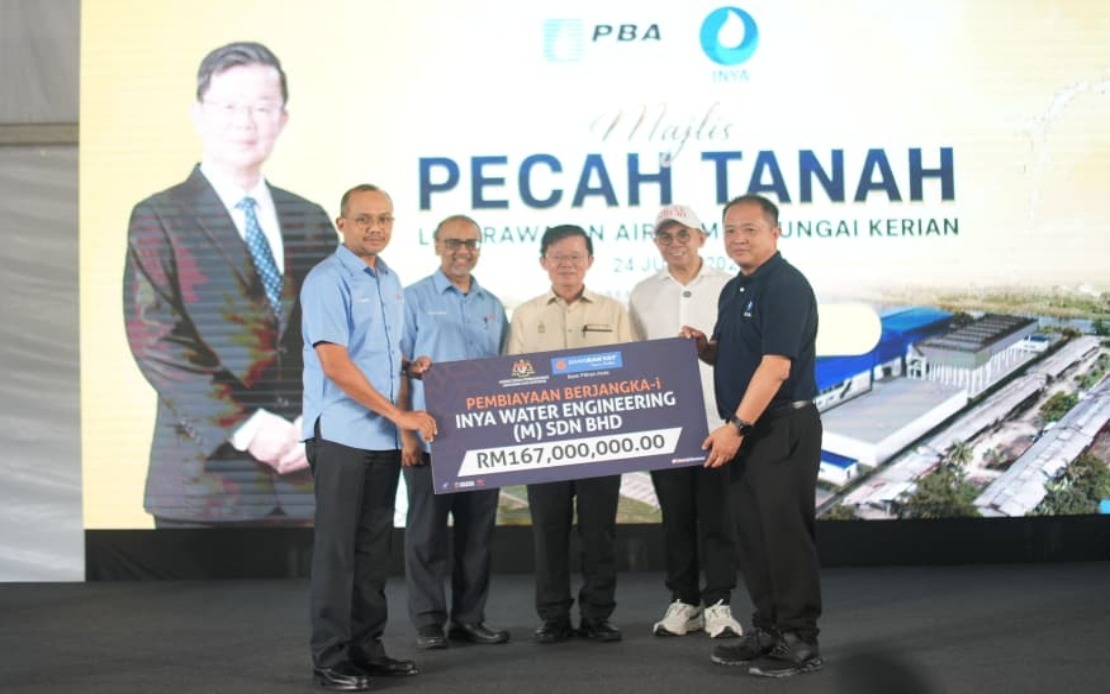
Bank Rakyat is extending RM167 million in financing support for the Sungai Kerian Water Treatment Plant project situated in Seberang Perai Selatan, a commitment that will underwrite approximately 80 per cent of the facility's total construction expenditure. The financing arrangement underscores the state-owned financial institution's expanding remit beyond traditional small business lending towards critical infrastructure development that carries broader implications for public welfare and economic advancement across the nation.
Entrepreneur and Cooperatives Development Minister Steven Sim framed the initiative as emblematic of Bank Rakyat's dual mandate, operating simultaneously as both a commercial lender to micro, small and medium enterprises and as a strategic participant in infrastructure financing. According to Sim, this particular project exemplifies how financial support can catalyse improvements to essential services while simultaneously unlocking industrial expansion and creating fresh economic pathways for communities dependent upon reliable water infrastructure. The minister's characterisation reflects a growing policy emphasis within Malaysia's development framework, wherein state financial institutions are increasingly tasked with channelling capital towards public goods alongside conventional business lending operations.
The Sungai Kerian WTP project itself represents a substantial investment, with total costs exceeding RM209 million. The plant will be engineered to process water at a daily capacity of 80 million litres, delivered through a 30-year Build-Operate-Transfer model where Bank Rakyat serves as the exclusive financing partner across a 15-year disbursement period. Notably, the bank is extending an additional two-year grace period on repayment obligations, a concession that acknowledges both the extended payback horizons characteristic of infrastructure projects and the state's desire to ease initial operational burdens on the implementing entity.
Penang Chief Minister Chow Kon Yeow, who presided over the project's ground-breaking ceremony, contextualised the venture within Penang's broader water security strategy. Upon commencing operations in mid-2027, the facility will furnish approximately 80 million litres of treated water daily to roughly 223,000 residents distributed across Seberang Perai Selatan and Seberang Perai Tengah, addressing longstanding supply constraints in these growth corridors. This geographical focus reflects deliberate planning to prioritise water infrastructure development in areas experiencing demographic expansion and heightened demand pressures.
The BOT framework employed for Sungai Kerian represents a first for Penang's water sector, marking a notable departure from conventional procurement methodologies. Inya Water Engineering (M) Sdn Bhd has been contracted to undertake all construction, operational and maintenance responsibilities across the designated 30-year concession period, after which assets revert to the Penang Water Supply Corporation (PBAPP). This arrangement effectively transfers construction risk and operational burden to the private concessionaire while preserving public sector ownership and ultimate control, a balance increasingly attractive to Malaysian water authorities seeking to modernise infrastructure without overburdening government budgets.
Chow, who also chairs the PBAPP Board, articulated the financial mechanics underpinning the arrangement. Although the facility deploys conventional water treatment technology rather than cutting-edge innovations, the BOT procurement model itself constitutes a significant structural innovation within Penang's water governance architecture. By outsourcing both construction and operations, PBAPP avoids bearing capital and operational expenses directly, instead entering a water purchase agreement commencing in 2027 at an initial rate of RM0.98 per cubic metre, with price adjustments scheduled every five years consistent with contract provisions. This approach effectively transforms capital expenditure into managed operating costs distributed across the repayment horizon.
The incremental capacity expansion warrants careful consideration within the broader context of Penang's water supply dynamics. The 80 million litres daily output represents merely 6.6 per cent of PBAPP's total treated water production capacity of 1,208 million litres documented in the preceding year, suggesting that the new facility addresses genuine supply constraints rather than providing redundant capacity. Chow indicated that PBAPP will integrate the purchase costs within its existing operational budget for the initial two years of plant operation, thereby insulating consumers from tariff increases attributable to the Sungai Kerian project during 2027 and 2028.
The implications for Malaysian water security extend beyond Penang's immediate borders. The Sungai Kerian project exemplifies how strategic partnerships between state development financial institutions and local authorities can accelerate infrastructure modernisation whilst distributing financial risk across multiple stakeholders. As Malaysia's urban and industrial zones expand, water supply limitations increasingly constrain economic development and population growth, making projects of this nature essential components of national competitiveness. The successful execution of the Sungai Kerian BOT model may establish a replicable template for other states confronting similar supply challenges and fiscal constraints.
Bank Rakyat's participation carries additional significance for the broader development finance landscape within Southeast Asia. Malaysian state-owned financial institutions increasingly serve as catalysts for infrastructure development, demonstrating that development banks need not restrict themselves to microfinance or traditional lending to remain commercially viable. The 15-year financing horizon combined with the two-year grace period reflects sophisticated structuring designed to match debt service capacity with projected revenue streams from water sales, a maturity increasingly evident in Malaysian infrastructure financing arrangements.
The project's timeline, with operations commencing in mid-2027, positions the Sungai Kerian facility to contribute meaningfully towards addressing water supply pressures during Penang's anticipated continued urbanisation and industrial expansion. The facility will deliver treated water at scale, enhancing supply reliability for both domestic consumers and manufacturing enterprises dependent upon consistent water availability. For Malaysian policymakers, the successful conclusion of this initiative may validate the BOT model's applicability across multiple infrastructure sectors, potentially accelerating the deployment of public-private arrangements within areas including transportation, energy and telecommunications.

