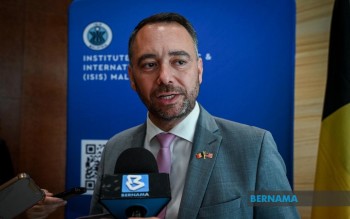
Belgium's Deputy Prime Minister and Foreign Affairs Minister Maxime Prévot has identified offshore energy as a cornerstone of potential cooperation between his country and Malaysia, arguing that both nations stand to benefit from collaboration as they navigate the global shift towards decarbonised power systems. Speaking during his inaugural visit to Malaysia since taking office in February 2025, Prévot outlined a vision of deepened partnership extending across multiple sectors, with renewable energy production emerging as the most immediately promising avenue for mutual advantage.
The Belgian official arrived in Kuala Lumpur for a two-day working visit, using engagements at the 39th Asia-Pacific Roundtable to amplify his message. Beyond offshore wind, Prévot identified semiconductors, logistics networks, clinical research, biotechnology development and pharmaceutical manufacturing as additional domains where Belgium and Malaysia could meaningfully advance shared interests. Each of these sectors aligns with Malaysia's ongoing efforts to position itself as a high-value manufacturing and innovation hub within Southeast Asia, while Belgium seeks to deepen European engagement across the Indo-Pacific region.
What distinguishes Belgium's offshore energy proposition is the counterintuitive efficiency of its achievements relative to its geographic constraints. Operating merely 60 kilometres of coastline, Belgium has engineered offshore wind installations currently delivering two gigawatts of electricity to its population—a significant portion of national power demand. This technological feat becomes even more striking when viewed against Belgium's ambitious expansion timeline: the government intends to escalate capacity to between six and seven gigawatts within the coming years, an output equivalent to the electricity generation of five to seven nuclear power plants. For Malaysia, which possesses substantially longer coastlines and greater marine resources, such expertise could prove transformative in developing renewable capacity across the Strait of Malacca and the South China Sea.
Preývot emphasised that Belgium's intensified focus on offshore wind reflects a deliberate strategy to simultaneously address energy security and climate commitments. European nations have grown increasingly anxious about supply chain vulnerabilities and geopolitical dependencies on fossil fuel imports, particularly following Russia's invasion of Ukraine. By expanding renewable generation capacity, Belgium and its EU partners seek to insulate themselves from volatile energy markets while meeting binding European Green Deal targets. Malaysia faces comparable pressures: rapid industrialisation and economic growth have strained electricity generation capacity, while carbon reduction commitments under international climate agreements necessitate transitioning away from coal and natural gas dependence.
The financial dimension of this proposed partnership acquired concrete form through Prévot's announcement of the EU's Global Gateway Strategy commitment to ASEAN. The European Union plans to mobilise €10 billion—equivalent to approximately RM46.5 billion—specifically designated to support the ASEAN Power Grid and the region's broader energy transition. This capital injection represents far more than symbolic support; it constitutes a substantial down payment on European interests in securing Southeast Asian cooperation on climate action while simultaneously accessing growing markets for clean technology exports and green finance services. The timing coincides with intensifying strategic competition between Europe and China for influence across ASEAN, with energy infrastructure serving as a crucial battleground.
The ASEAN Power Grid initiative carries particular significance for Malaysia and its regional neighbours. This ambitious infrastructure project aims to interconnect electricity systems across Southeast Asia, enabling nations with abundant renewable resources—such as Laos with hydroelectric potential or the Philippines with geothermal capacity—to export clean power to neighbours facing generation shortfalls. Malaysia's geographic position makes it a natural transit corridor and potential hub for such regional electricity trading. By positioning itself as a partner to European offshore wind expertise while simultaneously benefiting from EU-backed grid modernisation, Malaysia could emerge as a linchpin in ASEAN's energy security architecture.
Preývot articulated that stronger continental alignment on clean energy accelerates the green transition across multiple domains. European companies increasingly view Southeast Asia not merely as a market for renewable equipment but as a location for manufacturing value chains. Belgium, despite its small size, hosts significant chemical, pharmaceutical and materials processing industries that can be decarbonised through cheaper renewable electricity. Should bilateral energy cooperation flourish, Malaysian producers in allied sectors—petrochemicals, electronics manufacturing, food processing—could similarly reduce their carbon footprints while accessing preferential European market access under evolving trade frameworks increasingly weighted toward climate credentials.
The economic relationship between Malaysia and Belgium, while modest in absolute terms, demonstrates untapped potential. Bilateral trade reached RM9.74 billion during 2025, comprising RM6.85 billion in Malaysian exports and RM2.89 billion in Belgian imports. This imbalance suggests Malaysia currently supplies more commodities and intermediate goods to Belgium than it receives in sophisticated manufactured products and services. Energy partnership could rebalance this equation by enabling joint ventures in offshore technology, renewable equipment manufacturing and green finance services, sectors where Belgium possesses established expertise and market access.
Belgian investments in Malaysia already show promise, with 67 approved projects involving RM5.1 billion in capital commitments and prospects for creating 4,605 employment opportunities. These initiatives span conventional manufacturing, logistics and emerging technology sectors. An energy transition partnership could catalyse additional investment flows as Belgian firms seek to establish regional headquarters, research facilities and manufacturing bases to serve ASEAN's growing renewable energy infrastructure demands. Such expansion would complement Malaysia's broader industrial policy objectives while creating high-skilled employment in engineering, project management and technical services.
Preývot's emphasis on long-term, sustainable and locally beneficial development reflects a philosophical difference between European and some competing offers of infrastructure support. Rather than emphasising short-term capital extraction, the EU's stated approach prioritises knowledge transfer, local capacity building and environmental safeguards. For Malaysia, this philosophical orientation carries weight, particularly given historical experiences with extractive economic partnerships. An offshore wind collaboration framed around Malaysian technicians acquiring European expertise, domestic companies developing supply chains, and revenues ultimately flowing to Malaysian stakeholders presents an attractive alternative to purely extractive arrangements.
The broader strategic context cannot be overlooked. As European nations strengthen Indo-Pacific engagement and China intensifies its regional presence through Belt and Road Initiative projects, clean energy emerges as contested terrain. European frameworks emphasise climate ambition, financial transparency and local ownership, while alternative models sometimes prioritise speed of deployment and capital availability over environmental standards. Malaysia's positioning as an energy transition partner of Belgium and the EU signals alignment with rule-based international order while simultaneously maximising access to diverse sources of capital, technology and expertise.
Looking forward, concrete mechanisms for collaboration remain to be finalised through follow-up negotiations. These will likely encompass bilateral research partnerships between Belgian and Malaysian universities in marine engineering, joint ventures for offshore wind farm development, technology licensing arrangements, and potential involvement of Malaysian entities in European offshore projects. The convergence of Belgium's technical leadership, European financial commitment through the Global Gateway Strategy, and Malaysia's geographic assets and strategic importance creates a compelling foundation for deepening ties across the renewable energy sector and beyond.

