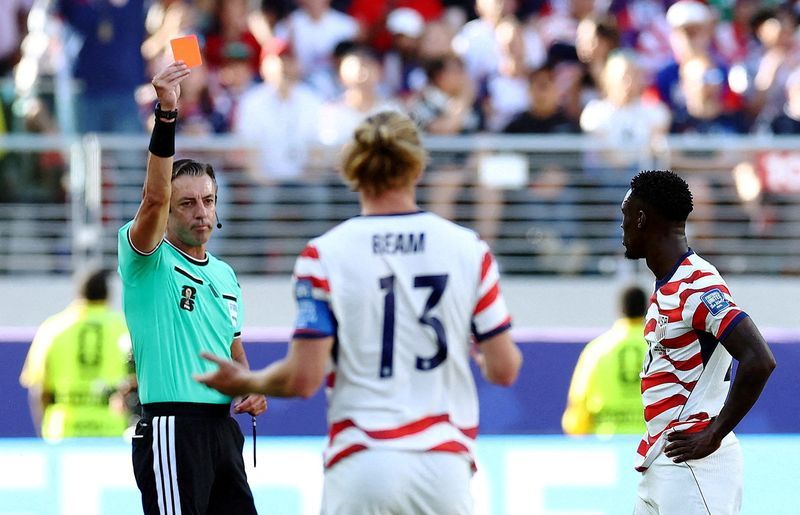
In a rare collision between high-stakes international politics and professional sports governance, Belgium has erupted in protest over FIFA's decision to suspend a red-card ban for a prominent United States striker ahead of Monday's World Cup last-16 encounter in Seattle. The reversal, which came after United States President Donald Trump personally contacted FIFA President Gianni Infantino to revisit the disciplinary case, has prompted widespread allegations of improper interference in the sport's regulatory framework and sparked considerable backlash from Brussels officials and Belgian citizens alike.
The incident centres on the extraordinary nature of Trump's direct intervention in what should be a routine enforcement matter determined solely by FIFA's established protocols and independent disciplinary procedures. When the United States President telephoned the FIFA leadership seeking reconsideration of the suspension, it appeared to cross a line that separates political courtesy from unseemly meddling in sporting affairs. The subsequent lifting of the ban has become emblematic of concerns about whether powerful political figures can sidestep institutional rules through personal appeals to sports executives.
Belgian street opinion reflects deep frustration with the perceived corruption of fair play principles. One Brussels resident, Therese Kpooubie, articulated the logical inconsistency at the heart of FIFA's decision by questioning the fundamental purpose of disciplinary action. She argued that red cards exist precisely because players commit serious infractions warranting suspension, and that the retroactive erasure of this consequence undermines the entire foundation of sports justice. Her rhetorical challenge—whether the original referee had erred in issuing the card—cuts to the heart of why such reversals strike at FIFA's credibility and the integrity of competition itself.
The potential influence of political pressure on sporting decisions represents a sovereignty concern that transcends football. If international sports bodies can be swayed by telephone calls from heads of state, the question arises whether any nation's teams compete on genuinely equal terms. This becomes particularly acute in knockout tournament stages where single matches determine advancement, as marginal differences in player availability can prove decisive. Belgian football officials and citizens recognize that allowing such precedents threatens the legitimacy of World Cup competition for all participating nations, not merely those disadvantaged in this specific instance.
Belgium's Deputy Prime Minister Maxime Prevot framed the episode as a potential violation of fundamental sporting principles, suggesting that if Trump's call directly precipitated FIFA's decision, the action constitutes a fundamental breach of sport's basic governance rules. His statement indicates that Belgium's government views this as more than a technical disagreement over procedure but rather as an assault on the institutional independence that competitive sports require to function fairly. The official condemnation signals that Belgium intends to maintain pressure on FIFA regarding this matter, potentially raising it through diplomatic channels if the precedent threatens to recur.
The United States Ambassador to Belgium, Bill White, issued a defensive statement denying Trump's involvement in the actual decision-making process, claiming merely that the President thanked FIFA after the reversal occurred. This distinction—between influencing a decision and expressing gratitude for a favourable outcome—strikes many observers as insufficient to address the fundamental concern about the timing and nature of Trump's intervention. Whether the phone call directly caused the reversal or simply preceded an independently made decision remains ambiguous, but the appearance of impropriety has already damaged FIFA's institutional credibility.
Among ordinary Belgians, reactions ranged from indignation to defiant motivation. While some residents expressed outrage at what they perceived as transparent manipulation of sporting justice, others, like passerby Bastien Noel, channelled frustration into competitive determination. He suggested that the controversial decision should serve as inspiration for Belgium's national team—nicknamed the Red Devils—to prove on the pitch that external interference cannot shake their resolve. This response reflects the Belgian football culture's tendency to transform external adversity into psychological motivation for performance.
The incident raises broader questions about FIFA's governance structure and its vulnerability to pressure from powerful nations. As a Switzerland-based international organization with significant financial resources and media visibility, FIFA operates within a geopolitical context where major powers wield considerable soft power. The willingness of Trump to make a personal plea regarding a disciplinary matter, and FIFA's apparent receptiveness to such an appeal, demonstrates how sports governance exists not in isolation from power politics but intertwined with it. This dynamic becomes especially concerning for smaller nations like Belgium, which lack equivalent channels of direct influence with FIFA leadership.
The timing of this controversy—occurring during the tournament's most intense and consequential phases—amplifies its significance. World Cup knockout matches carry immense importance for national pride, economic returns from broadcasting rights, and the trajectories of players' international careers. That such high-stakes competition could be influenced by political rather than purely sporting factors strikes at the tournament's legitimacy. Future editions may face erosion of confidence if nations cannot trust that disciplinary decisions reflect genuine adherence to rules rather than diplomatic convenience.
Belgium's response to the crisis reflects both institutional and grassroots commitment to defending sporting integrity. From Deputy Prime Minister Prevot's formal objections to individual citizens' calls for their national team to prove themselves through performance rather than administrative victories, the Belgian perspective emphasizes that real sporting achievement must transcend governmental interference. The Red Devils' challenge in Seattle has now become symbolically loaded—a test not merely of tactical prowess but of whether competitive integrity can survive in an era when political leaders view sporting outcomes as matters worthy of direct personal intervention.
Looking forward, this episode may catalyze broader discussions within FIFA about governance reform and procedures for resisting political pressure. The organization's credibility as a neutral arbiter of international competition depends on maintaining consistent, transparent disciplinary standards immune to influence from powerful actors. Belgium's principled resistance to the reversal, articulated by officials and citizens alike, serves as a reminder that even prestigious international bodies ultimately answer to the sports community's collective expectations regarding fairness and institutional independence.

