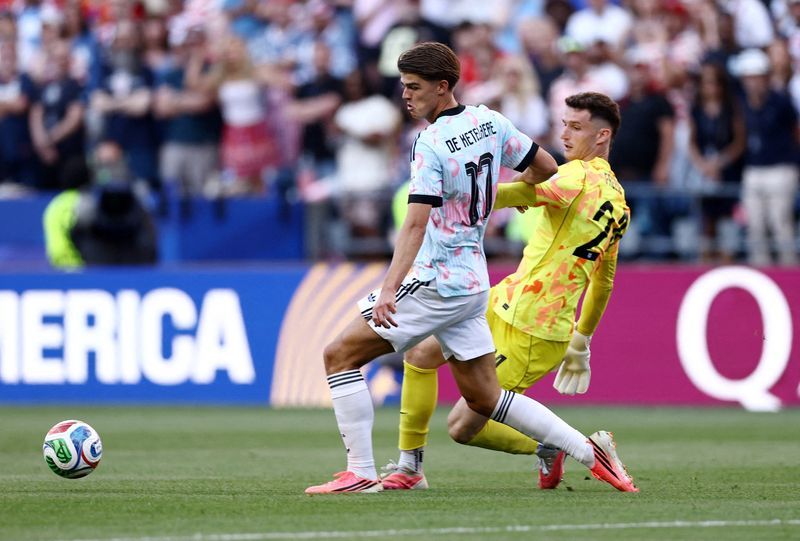
Belgium's football evolution at the World Cup reached an inflection point on Monday when coach Rudi Garcia made the bold decision to bench some of his most celebrated players, including talisman Kevin De Bruyne, in favour of a reconfigured midfield that dismantled the hosts with a comprehensive 4-1 victory in Atlanta. The strategic gamble, which left many observers questioning whether the Belgian federation would support such an unconventional approach, instead vindicated Garcia's tactical vision and suggested the team had finally discovered a playing style capable of challenging elite opponents on football's grandest stage.
The path to this breakthrough had been decidedly rocky. Belgium arrived at this World Cup as one of the tournament favourites, yet spent the group stage limping through two draws before salvaging progression with a crushing 5-1 win over New Zealand. Their knockout round encounter with Senegal proved equally harrowing—they faced near-certain elimination at 2-0 down with merely five minutes remaining in regular time, only to scramble through via a penalty in extra time following their opponent's defensive catastrophe. Such precarious margins suggested systemic problems that cosmetic adjustments could not resolve.
Garcia's response was to fundamentally reimagine Belgium's structure rather than tinker at the margins. Out went Jeremy Doku and De Bruyne, the latter not even making the travelling squad to Seattle, replaced instead by Nicolas Raskin and Amadou Onana in midfield. Hans Vanaken, a veteran midfielder long on the periphery, returned to the fold, with Charles De Ketelaere repositioned as a centre forward. The coherence this new configuration provided proved immediately apparent, as De Ketelaere netted twice in the opening half to establish Belgium's control of the contest before the outcome was ever truly in doubt.
The tactical framework underpinning these personnel changes represented Garcia's primary innovation. Rather than constructing play around De Bruyne's creativity and Lukaku's physical presence, Belgium instead built around a more aggressive midfield unit that prioritised regaining possession and exploiting space in wide areas. Captain Youri Tielemans, operating from a more advanced position, consistently pressed higher to contest second balls, while the midfield's newfound agility allowed Belgium to transition from defence to attack with a fluidity absent from earlier performances. This intensity exposed fundamental vulnerabilities in the United States' defensive setup, which appeared both static and brittle under sustained pressure.
Garcia's pre-match comments revealed the thinking had crystallised only hours before kickoff, though his strategic direction remained resolute. He emphasised that De Bruyne's exceptional quality meant he could be introduced as a tactical weapon should circumstances demand it, yet the Belgian performance proved sufficiently commanding that such an intervention never materialised. The coach's confidence in his alternate line-up derived from observed training form and the specific tactical requirements he had identified, suggesting a deeper analytical process rather than arbitrary rotation or punishment of established stars.
The departure of Onana through knee injury midway through the first half threatened to disrupt Belgium's newfound equilibrium, yet the introduction of Vanaken to shield the three-man defence maintained structural integrity. Vanaken's introduction proved symbolically significant for Garcia, who noted the veteran's own satisfaction at finding the net for his country at age 33, a notable achievement for a player previously experiencing inconsistent international exposure. This moment encapsulated the philosophical shift—Belgium was no longer dependent upon its most decorated names but could instead draw strength from collective cohesion.
The implications of this tactical transformation extend beyond a single match result. Belgium had endured sustained criticism within their domestic context throughout the group stage, with many questioning whether Garcia possessed the tactical sophistication required at this level of competition. The comprehensive nature of the victory over the co-hosts, combined with the clarity of the team's attacking and defensive shape, substantially quietened such scepticism. Belgian football observers recognised they were witnessing a team moving in the correct directional trajectory rather than remaining mired in crisis management.
Looking forward to Friday's quarter-final encounter with Spain in Los Angeles, Belgium's sudden ascendancy positions them as genuine title contenders rather than ageing squad members grasping at fading legacy opportunities. The Spanish represent a fundamentally different challenge—a team accustomed to controlling possession and dictating tempo through technical superiority. Whether Garcia's more physical, aggressive midfield configuration can replicate its success against a side prioritising possession and spatial awareness remains an open question that will substantially influence tournament predictions.
The broader significance of Belgium's tactical reset resonates across European football. The willingness to temporarily marginalise marquee names in favour of collective stability and tactical coherence represents a philosophical statement about modern football's evolution. Rather than defaulting to star-driven approaches, Garcia demonstrated that carefully constructed team structures and disciplined midfield pressing could generate outcomes superior to those achieved through individual brilliance. For emerging football nations and regional federations observing this World Cup, the Belgian example provides instructive lessons about courage in selection and the enduring validity of coherent collective approaches.

