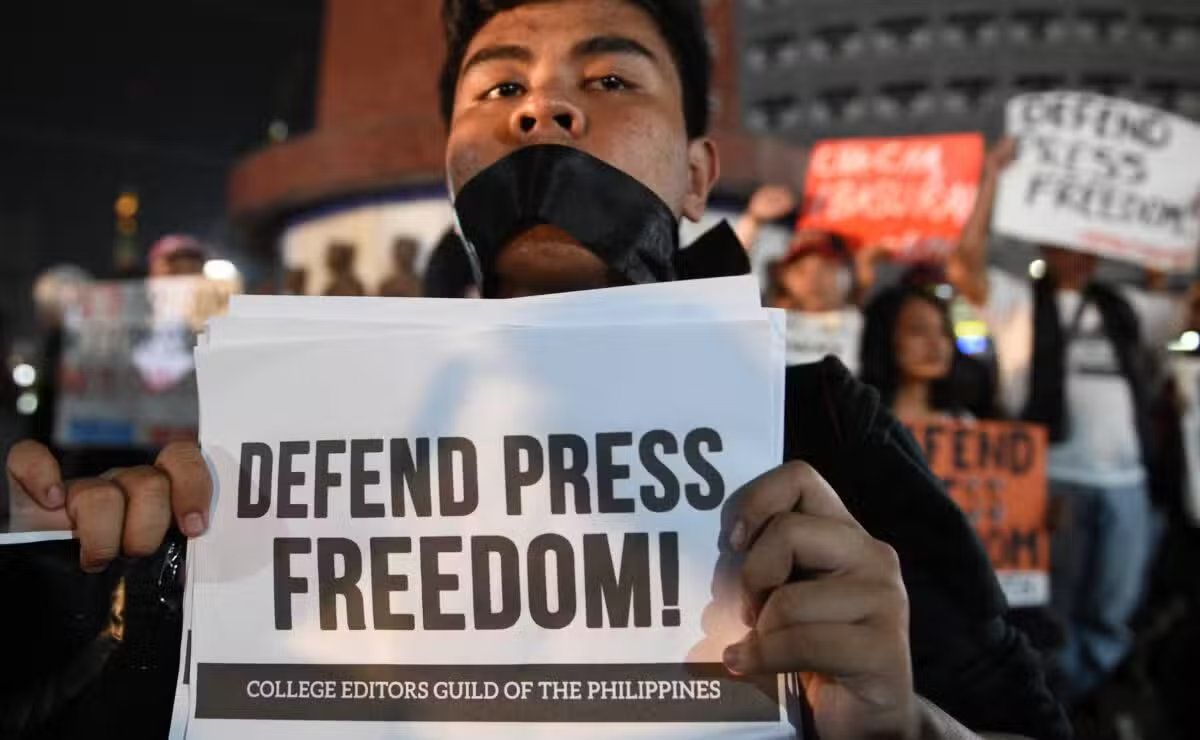
The danger facing journalists in the Philippines has intensified markedly during President Ferdinand Marcos Jr.'s administration. The National Union of Journalists of the Philippines has compiled documentation of approximately 260 attacks against media workers over the past four years, a catalogue that underscores deepening pressures on press freedom in the archipelago. Yet this overall tally masks a more concerning reality: the vulnerability is sharply concentrated among those working furthest from the capital's major newsrooms.
When the NUJP data is examined closely, a stark pattern emerges. More than 180 of the recorded incidents — well over two-thirds of the total — involved journalists employed by community radio stations, local newspapers, independent outlets and campus publications. This distribution reveals that the burden of intimidation and violence falls disproportionately on media organisations operating with thin margins, minimal institutional infrastructure and workers earning modest wages. These smaller outlets frequently lack the legal resources, security protocols and international prominence that can insulate larger metropolitan news organisations. The implication is sobering: those closest to their communities often enjoy the fewest protections.
The geographic and economic dimensions of this vulnerability cannot be overlooked. Provincial journalists operate in environments where they lack what their Metro Manila counterparts take for granted. They report on stories in neighbourhoods where they live, covering officials they encounter socially, and serve readers who are their neighbours. This proximity — the core strength of community journalism — simultaneously amplifies personal risk. Without the institutional backing of major news organisations, without substantial legal budgets or corporate security apparatus, these reporters face threats ranging from cyberlibel suits to physical assault with remarkably limited resources to mount a defence. The disparity between their modest compensation and the real dangers they navigate represents a form of inequality rarely discussed in media freedom discourse.
The case of Jay Lavapiez exemplifies these pressures. The 48-year-old station manager of Baskom Radyo in Roxas City, Capiz, survived an assassination attempt in June when two men on a motorcycle fired four bullets into his vehicle. His ordeal began earlier that year when he and his wife, fellow journalist India, reported on a cemetery owned by a local official and allegations of corruption and abuse. The couple subsequently faced multiple cyberlibel and libel complaints filed in different jurisdictions — Manila, Muntinlupa and Capiz — a legal assault designed to exhaust resources and instil fear. This coordinated harassment illustrates how local power structures weaponise the judicial system against inconvenient reporting.
Provincial journalism in the Philippines operates under constraints that fundamentally distinguish it from metropolitan practice. Lavapiez articulates this distinction starkly: community journalists cannot simply resign and relocate when pressure mounts. They inhabit the same streets, encounter the same people daily, and must continue their work within communities where they are personally known and potentially vulnerable. The economic reality compounds this trap. Salaries in provincial media outlets bear no proportion to the risks journalists accept, creating a situation where commitment to public service is tested against financial survival and personal safety. Yet despite these circumstances, community journalists persist in covering stories that powerful interests prefer remain untold.
The toll has occasionally been fatal. In April, community journalist RJ Ledesma was killed in Toboso, Negros Occidental, where he was conducting investigations into renewable energy projects and their impacts on agricultural communities. He died during a military operation that a fact-finding mission later condemned for serious violations, including what appeared to be indiscriminate firing despite clear sightlines. His death represents an extreme manifestation of the hazards facing those who ask difficult questions in provincial contexts, yet it remains part of a broader pattern of intimidation that encompasses legal harassment, online abuse and threats.
The barriers confronting community media extend beyond individual safety to systemic sustainability. Unlike large newsrooms with established institutional relationships, legal departments and revenue diversification, small outlets operate with minimal redundancy. When journalists are arrested, killed or forced into silence through litigation, the entire operation becomes compromised. Readers in those communities lose their primary source of accountability journalism. The loss is not merely professional but civic — ordinary citizens lose their principal vehicle for understanding how public resources are deployed and how local power operates.
Lavapiez emphasises that community journalism has never been fundamentally about financial reward. Rather, it reflects a conviction that someone must ask uncomfortable questions when public money is involved and ordinary citizens feel voiceless. Yet the irony he identifies cuts to the heart of the problem: proximity to community — the defining feature and strength of local journalism — simultaneously creates vulnerability. Everyone knows where community journalists work, where they live, who their families are. This transparency, essential to their credibility, simultaneously exposes them.
The distinction between Manila-based and provincial journalism also matters for regional Southeast Asian dynamics. As press freedom deteriorates in the Philippines, smaller Southeast Asian democracies observe whether community journalists receive meaningful protection or whether they face systematic pressure designed to silence local accountability journalism. The pattern established now — where smaller outlets absorb the brunt of attacks while larger, wealthier organisations maintain greater safety — could become a template elsewhere in the region if not actively resisted.
Journalists themselves resist the framing that they deserve special privilege. Lavapiez and his peers ask only for what should be fundamental: the ability to conduct their work without threats, harassment, strategic prosecution designed to silence, or physical violence. They seek the elementary freedom to question public officials and decisions without facing coordinated legal attack or mortal danger. This baseline demand — not exceptional, but foundational — remains unfulfilled for community journalists working across the Philippine archipelago's provinces.
The NUJP's assertion carries particular weight: behind each figure in their documentation lies a journalist, a newsroom and a community whose access to truth is imperilled. Community journalism represents the last institutional check on corruption and abuse in many provincial areas. When those journalists face disproportionate danger while earning minimal wages, entire communities lose their eyes and ears. The deteriorating condition of community press freedom in the Philippines therefore represents not merely a media problem but a democratic deficit affecting millions of Filipinos distant from Manila.

