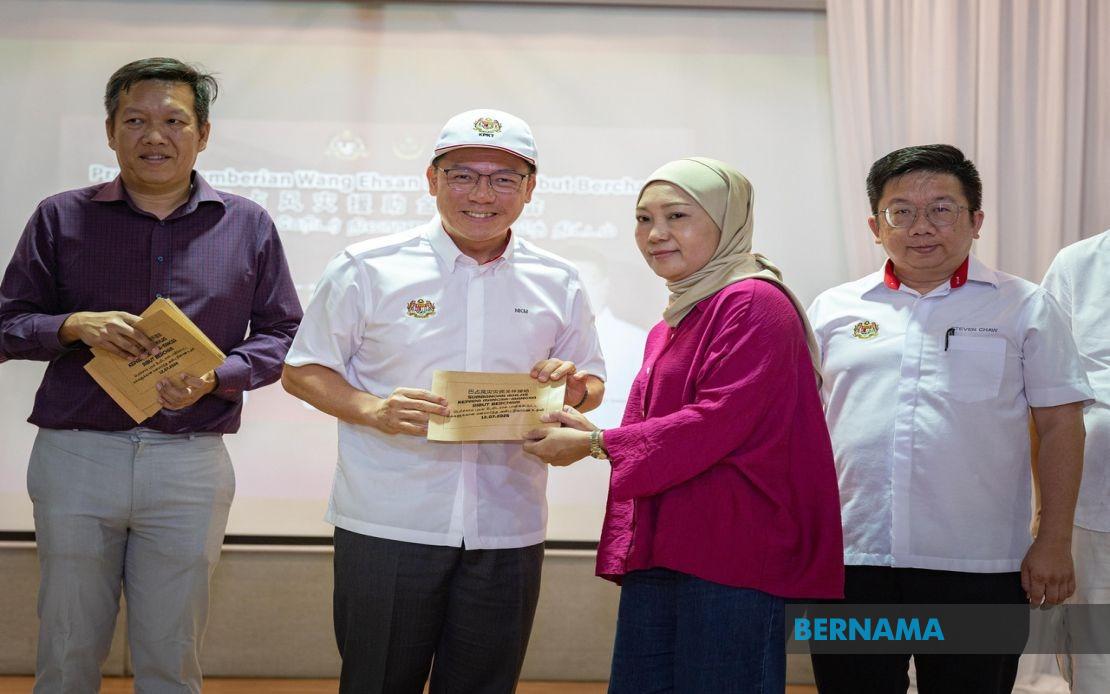
More than half a thousand families ravaged by the severe storm that swept through Bercham on June 19 have now received RM1 million in fresh financial assistance, bringing their total aid package to RM1.8 million when combined with previous government disbursements. Housing and Local Government Minister Nga Kor Ming distributed RM1,800 to each of the 554 affected households during a formal presentation ceremony held in Ipoh on July 12, marking a significant step towards rebuilding efforts in the stricken residential communities.
The latest tranche of relief funding represents a collaborative effort between the government and the private sector. Genting Malaysia and Genting Bersama Malaysia together contributed the RM1 million, demonstrating corporate commitment to disaster recovery in the region. This corporate backing follows earlier relief measures, with each family previously receiving RM1,000 from government assistance channels and an additional RM300 distributed through the district chief's office. The layered approach to financial aid reflects the scale of destruction and the need for sustained support across multiple sources.
During the ceremony, Nga acknowledged the limitations of disaster relief funding while reinforcing the government's commitment to affected residents. He emphasised that despite fiscal constraints, authorities recognise their responsibility to communities in distress and will continue seeking additional resources to bridge gaps in recovery efforts. The minister's remarks touched on the tension between genuine need and budgetary reality, a challenge facing disaster management authorities across Malaysia and the broader region when responding to climate-related emergencies.
The Bercham incident itself revealed the vulnerability of densely populated residential areas to extreme weather events. The June 19 storm unleashed nearly two hours of relentless heavy rainfall accompanied by powerful winds that systematically damaged more than 500 homes across five separate residential zones within Bercham. The concentrated nature of the damage—affecting multiple neighbourhoods simultaneously—compounded challenges for rescue and recovery operations, stretching local resources and requiring intervention from state and federal authorities.
Bercham assemblyman Ong Boon Piow's presence at the aid distribution underscored the local political dimension of disaster response. As the elected representative for the constituency, his participation reflected the essential role played by state-level lawmakers in bridging communication between affected constituents and higher-level decision-makers. This presence also signalled that relief efforts would continue to receive political attention and oversight as communities moved through the reconstruction phase.
The disaster highlighted the particular vulnerability of established residential communities in Perak to meteorological hazards. Bercham's mixed residential character meant that damage affected families across various economic circumstances, necessitating a comprehensive relief approach rather than targeted assistance to specific demographics. The breadth of the aid programme—touching 554 households—underscores the widespread nature of the storm's impact and the challenge of maintaining equity in disaster response.
From a regional perspective, the Bercham incident exemplifies patterns increasingly observed across Southeast Asia as climate variability intensifies. Malaysia's experience with concentrated rainfall and wind damage in residential zones mirrors challenges faced by neighbouring countries grappling with enhanced severe weather events. The coordination demonstrated between government, corporate partners, and local authorities provides a model for scalable disaster response, though the acknowledged funding constraints point to systemic challenges in rapid mobilisation of adequate relief resources.
The cumulative aid package of RM1.8 million per family, while substantial, reflects what Nga characterised as inevitable limitations in responding to large-scale disasters affecting hundreds of households simultaneously. This reality carries implications for future disaster preparedness policy in Malaysia and suggests that recovery from weather-related disasters requires planning beyond immediate emergency relief toward longer-term reconstruction frameworks and improved early warning systems.
Looking forward, the recovery trajectory in Bercham will depend on several factors beyond immediate financial assistance, including access to affordable construction materials, labour availability, and insurance coverage for affected families. The three-tier aid structure—combining government emergency assistance, district-level support, and corporate contributions—demonstrates flexibility in funding mechanisms but also reveals how authorities must piece together resources from multiple streams to mount adequate response efforts. As Malaysia continues urbanising and climate volatility increases, the Bercham experience offers lessons for strengthening institutional capacity to respond swiftly to community-scale disasters.

