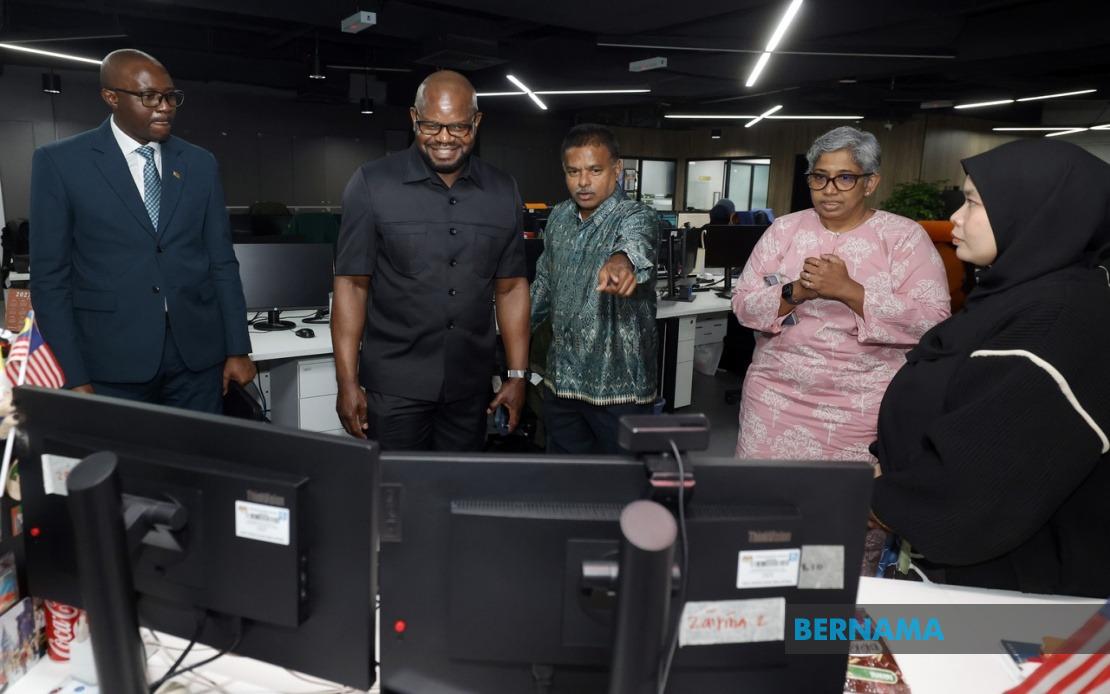
Malaysia's national news agency Bernama and Zimbabwe's Ministry of Information, Publicity and Broadcasting Services have opened discussions aimed at deepening media cooperation across digital transformation, artificial intelligence applications, and multimedia journalism. The engagement signals a broader effort by news organisations across the global South to address common challenges in the rapidly shifting media environment, where technological disruption and changing audience behaviours are reshaping how information is gathered, produced, and disseminated.
The Zimbabwean delegation, headed by the ministry's Secretary Nick Mangwana, visited Bernama's headquarters in Kuala Lumpur on Thursday for extensive talks with Editor-in-Chief Arul Rajoo Durar Raj and senior management. The discussions encompassed operational frameworks for modern newsrooms, strategies for integrating emerging technologies, and approaches to sustaining quality journalism amidst evolving consumption patterns. Both sides recognised that news organisations today must navigate a fundamentally different business environment than existed even a decade ago, requiring constant innovation and strategic adaptation.
During the meeting, the delegations examined how news agencies can effectively implement artificial intelligence tools to enhance productivity and news quality, strengthen their social media presence and audience engagement, and restructure editorial operations for maximum efficiency. The focus on practical newsroom best practices reflects a shared understanding that technical capabilities alone cannot drive success—rather, they must be paired with thoughtful editorial strategy and audience-centred thinking. The emphasis on multimedia journalism particularly underscores how traditional text-based news models must expand to encompass video, audio, data visualisation, and interactive formats to remain competitive and relevant.
Arul Rajoo expressed optimism that the visit would catalyse a productive long-term partnership between Malaysian and Zimbabwean media organisations. He highlighted Bernama's own transformation journey, noting that the agency has continuously expanded beyond its traditional text and photograph services to encompass television, radio, and comprehensive digital platforms. This evolution, he suggested, reflects a deliberate institutional philosophy of embracing change rather than resisting it. The message conveyed is that survival in modern media demands constant vigilance and willingness to experiment with new tools and distribution channels.
Bernama's senior team represented at the discussions included Mohd Shukri Ishak (Deputy Editor-in-Chief, News Services), Harlina Samson (Deputy Editor-in-Chief, Economic News), Nor Hamzeela Md Hambali (Head of Television), and Massita Ahmad (Executive Editor, International News Services). The breadth of departmental representation signals that the agency views this partnership as touching multiple operational and strategic areas rather than serving as a peripheral diplomatic exercise.
Mangwana articulated a perspective that carries particular resonance for news organisations in developing nations. He noted that media and news agencies worldwide are grappling with a seismic shift in their fundamental business model and operational paradigm. Historically, news agencies functioned as wholesale suppliers of content to newspapers, broadcasters, and other outlets that paid for their services. The digital era has dismantled this model, with news now available freely to the public through countless channels and platforms. This transition has squeezed traditional revenue streams while simultaneously democratising information access—a double-edged sword that news organisations worldwide are struggling to navigate.
Mangwana emphasised that the current moment demands intensive knowledge-sharing and experience exchange between news agencies, particularly those in the Global South facing resource constraints. The implication is that Zimbabwe and Malaysia, despite geographic distance, face remarkably similar structural challenges and can benefit meaningfully from examining each other's solutions, innovations, and lessons learned. Regional cooperation frameworks between media institutions offer a practical pathway for agencies to avoid duplicating failed experiments while accelerating adoption of proven strategies.
Addressing the challenge of misinformation and information integrity, Mangwana revealed that Zimbabwe is exploring the establishment of a centralised government fact-checking platform. The concept would provide citizens with a single authoritative source for verifying contested claims and information. This approach reflects growing recognition that combating false information requires institutional mechanisms backed by credible authority, though it also raises questions about press independence and government control of fact-checking authority—tensions that require careful navigation in any democratic context.
The partnership represents a continuation of established institutional ties. Bernama has maintained a memorandum of understanding with Zimbabwe's state-owned national news agency, New Ziana, since 2004. This longstanding framework provides foundation for expanding cooperation, though the focus on contemporary challenges like AI, digital platforms, and multimedia production reflects how quickly the media landscape has evolved even within the past five years. The refresh of this partnership agenda indicates both agencies recognise that historical agreements must be complemented by new frameworks addressing current realities.
For Malaysia and the broader Southeast Asian media ecosystem, the engagement with Zimbabwe signals Bernama's commitment to positioning itself as a leader in navigating media transformation within the Global South. As regional news organisations grapple with digitalisation, audience fragmentation, and sustainability pressures, knowledge networks linking agencies across Africa, Asia, and other regions become increasingly valuable. Such partnerships enable smaller national news agencies to access insights and innovations they might otherwise discover only through costly trial-and-error, while simultaneously elevating Malaysia's profile as a hub of media innovation and expertise.

