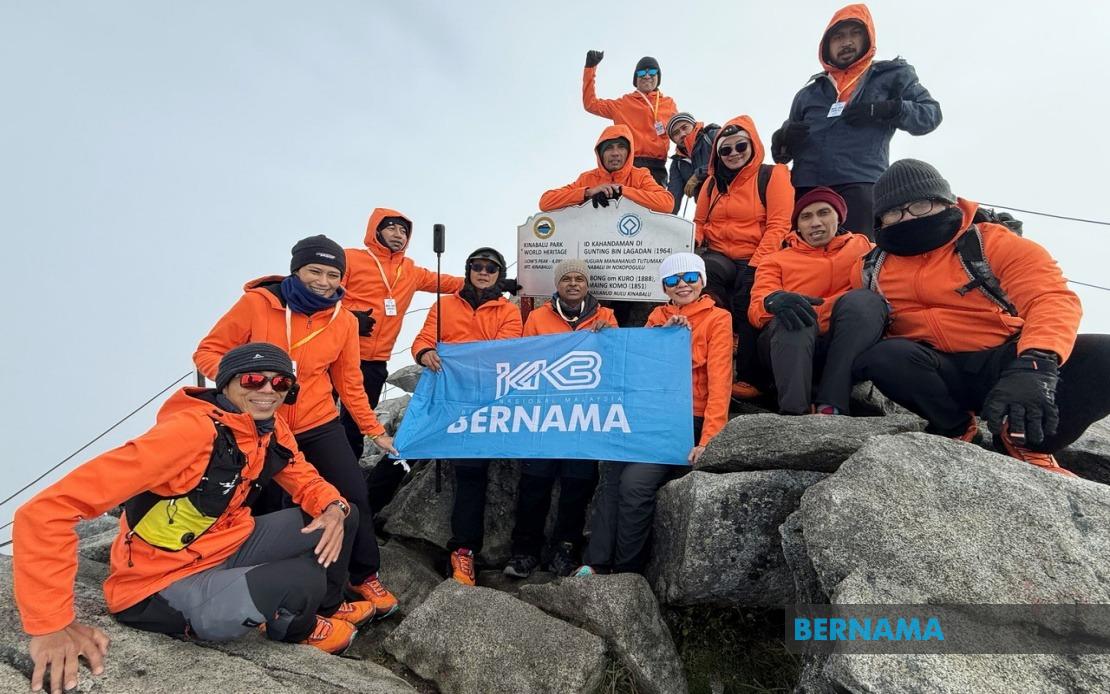
Twenty-three journalists, photographers, editors and broadcast personnel from Bernama, Malaysia's national news agency, successfully summited Mount Kinabalu on July 1 in a landmark expedition timed to commemorate National Journalists' Day (HAWANA) 2026. The achievement marks a significant moment for the state-owned news organisation, which organised the climb through its internal staff club for the first time. The team traversed from Timpohon Gate starting at 10 am the previous day, spent a night at Panalaban mountain hut, and resumed their push upward at 2:30 am, reaching the 4,095.2-metre summit around 7:20 am after contending with rain, dense mist and powerful winds throughout the ascent.
The expedition's leadership by Bernama Editor-in-Chief Arul Rajoo Durar Raj held particular significance, as he became the first person in his position to successfully reach the mountain's peak. The climb encompassed staff across the organisation's spectrum: reporters covering multiple beats, photographers and videographers, sub-editors handling content, television production crew members, and administrative personnel. This composition underscores how the climb functioned as more than a symbolic gesture—it represented the entire journalistic operation mobilising around a shared objective, reflective of how newsrooms traditionally operate during major assignments or crisis reporting.
Beyond the physical achievement, Bernama explicitly targeted two entries in the Malaysia Book of Records during the expedition. The first aims to recognise the largest gathering of media professionals from a single organisation to climb Malaysia's and Southeast Asia's tallest peak. The second seeks to document the first media organisation producing news content simultaneously in four languages from the mountain summit—a technically demanding feat that required coordinating interviews, translations, and broadcasting while operating at high altitude. This dual-record strategy reveals how state media organisations in Southeast Asia increasingly view stunts and expeditions as tools for institutional branding and record-breaking, elevating routine commemorative events into nationally-documented milestones.
Mount Kinabalu's designation as a UNESCO World Heritage Site and its inclusion in the Kinabalu UNESCO Global Geopark adds environmental and cultural weight to the climb's context. Situated within the 754-square-kilometre Kinabalu Park in Sabah, the mountain functions as both a natural monument of global significance and a symbol of Malaysian geographical identity. For a national news organisation to conduct an expedition here during a professional commemoration ties journalism to Malaysia's natural heritage, framing media work within a broader narrative of national pride and environmental stewardship.
The expedition fulfilled multiple institutional objectives simultaneously. Beyond pursuing record recognition, Bernama framed the climb as a celebration of HAWANA 2026, an annual recognition of journalism and press freedom in Malaysia. The organisation explicitly stated that the expedition aimed to strengthen internal teamwork, develop physical and mental resilience among staff, and promote healthier lifestyle practices—objectives that echo modern corporate wellness initiatives while maintaining connection to journalism's traditionally demanding work environment. Mountain climbing, with its inherent risks and requirement for collective coordination, serves as a powerful metaphor for the collaborative pressures of newsroom operation.
The logistical complexity of organising such an expedition reveals how resource-intensive even symbolic corporate exercises have become. The climb attracted support from multiple commercial and government entities: BMAI sportswear, Batik Air aviation, 100PLUS beverages, Malaysia Airports, Marathon Baker, and the Sabah Parks authority. This constellation of sponsors illustrates how government-linked organisations leverage partnerships across private and public sectors to distribute the costs and expand the promotional reach of institutional initiatives. Each partner gains visibility and association with Bernama's reach and credibility, creating a mutually beneficial ecosystem around what ostensibly serves as professional commemoration.
For Malaysian media observers, the expedition highlights broader trends in how state institutions manage their public image and internal culture simultaneously. Bernama's investment in this climb—requiring staff leave, transportation, accommodation, and equipment—signals an organisation attempting to modernise its internal operations and public perception. The emphasis on record-breaking reflects how media organisations worldwide increasingly compete for attention through experiential and record-setting activities, transcending traditional news gathering into lifestyle and institutional branding domains. The multilingual news production from the summit specifically positions Bernama as a technologically capable, cosmopolitan operation rather than a domestic-focused news service.
The timing around HAWANA 2026 also situates journalism as a physically demanding profession requiring courage, preparation, and teamwork—messaging that counters frequent criticisms of media organisations as insular institutions. By having reporters and photographers document their own climb, Bernama generated internal content showcasing their staff as dynamic, athletic professionals rather than desk-bound operators. This narrative aligns with broader efforts by news organisations globally to rebrand journalism as an adventurous, engaging profession amid declining recruitment and concerns about industry viability.
For Malaysian journalism more broadly, the event reflects how professional recognition ceremonies have evolved beyond traditional awards dinners and lectures into experiential challenges that generate multimedia content and institutional narratives. The combination of achievement documentation, record pursuit, and strategic partnerships creates a self-reinforcing cycle where institutional acts generate news coverage that benefits the institution itself—a dynamic that blurs the distinction between news and public relations in state media environments.
The climb's success also underscores Sabah's continued importance to Malaysian national identity and government-linked organisations' operations. Mount Kinabalu remains the primary symbol of Malaysian geographical achievement and natural patrimony, making it an inevitable destination for institutional feats seeking national resonance. The partnership with Sabah Parks authority legitimises the expedition within local environmental governance frameworks, ensuring that symbolic climbs operate within established conservation and safety protocols.
Ultimately, the Bernama expedition demonstrates how commemoration practices among professional institutions have transformed from passive recognition into active, record-seeking challenges that generate institutional pride, internal cohesion, and broader public engagement. For Malaysian readers, the climb represents their national news agency asserting its continued relevance, institutional strength, and forward-looking vision during a period of significant transformation in global media landscapes.

