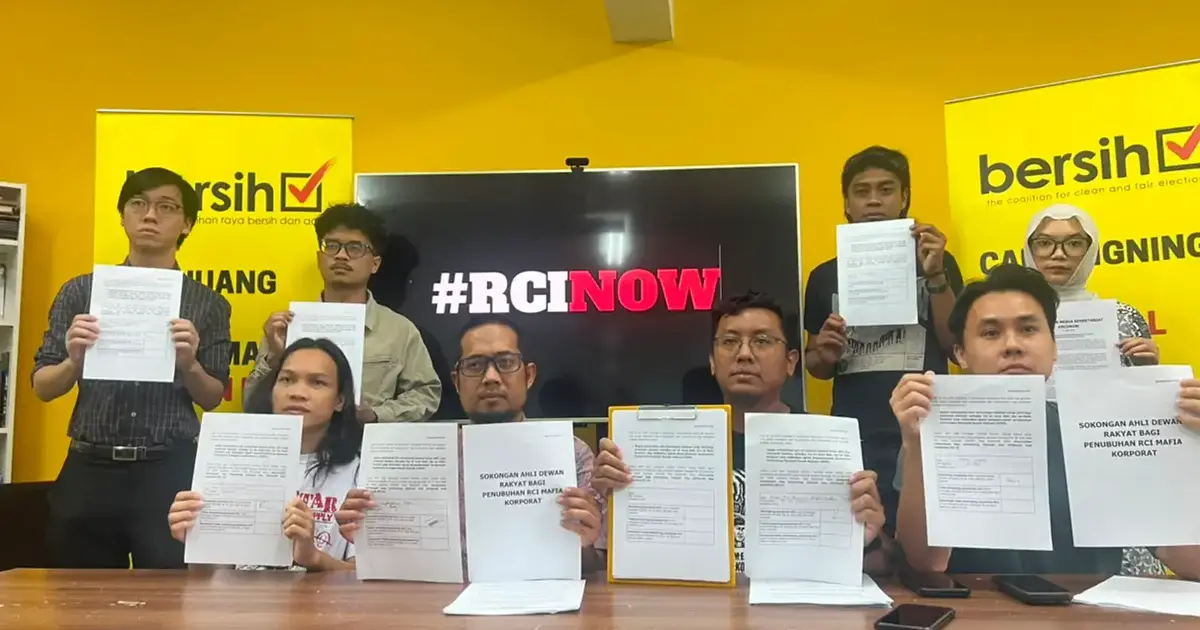
The electoral watchdog coalition Bersih has declared that 34 members of parliament spanning the country's major political parties are willing to endorse the establishment of a Royal Commission of Inquiry to investigate what it terms "corporate mafia" activities. The cross-party backing, which includes representation from PKR, PAS, DAP and Umno, suggests significant parliamentary concern about the scope and scale of organised corporate misconduct that may warrant formal judicial scrutiny.
The breadth of support across ideological and political divides is noteworthy in Malaysia's fractious parliamentary landscape. The inclusion of legislators from both government and opposition blocs indicates that the issue of corporate accountability transcends routine partisan divisions. This consensus, at least in principle, reflects growing recognition among lawmakers that certain forms of corporate behaviour may have crossed into territory that demands investigation beyond regulatory and enforcement mechanisms currently at the disposal of individual government agencies.
Bersih's announcement carries particular significance given the watchdog's track record of scrutinising institutional processes and governance structures. As an organisation focused on electoral integrity and democratic accountability, Bersih's involvement in highlighting corporate mafia concerns suggests the issue has gained traction within civil society circles. The coalition has long advocated for systemic reform and institutional strengthening across multiple governance domains, positioning this call for an RCI within a broader framework of institutional integrity.
The concept of a Royal Commission of Inquiry represents a formal investigative mechanism that carries considerable weight in Malaysian governance. An RCI possesses subpoena powers, the authority to compel testimony under oath, and the capacity to demand production of documents and records. These tools distinguish it from ordinary parliamentary inquiries or agency-level investigations, making it a more robust instrument for uncovering complex webs of corporate misconduct that may span multiple jurisdictions or involve coordinated activities across numerous entities.
The characterisation of certain corporate practices as "corporate mafia" reflects evolving discourse about the nature of economic crime and organised misconduct in the corporate sector. The terminology suggests coordination, hierarchy, coercion and systematic extraction of value through illegitimate means—operating structures that bear similarity to traditional organised crime but operate within commercial and corporate frameworks. Understanding what behaviour Bersih and these parliamentarians classify under this umbrella will be crucial to assessing both the scope and feasibility of potential investigative mandates.
The political composition of the 34 supporting MPs deserves closer examination. PKR's participation reflects the reformist agenda that has characterised the party since its founding, with emphasis on institutional accountability and anti-corruption measures. PAS's backing potentially signals that Islamic political values, including concepts of public trust and accountability rooted in religious principles, align with calls for corporate governance oversight. DAP's consistent advocacy for transparency and institutional reform makes its support predictable, while Umno's involvement—as the largest single party—indicates that even within the establishment, concerns about certain corporate practices have reached a political threshold that demands response.
For Malaysian business and investors, such parliamentary signals carry implications for the regulatory environment and enforcement momentum. An RCI that uncovers systemic corporate mafia operations could trigger follow-on reforms in company law, corporate governance requirements, or enforcement protocols. The investigation itself might expose vulnerabilities in current oversight mechanisms or identify enforcement gaps that become targets for legislative correction. Companies operating in sectors identified as problematic zones could face heightened scrutiny from both regulators and market participants.
Regionally, Malaysia's approach to investigating organised corporate misconduct may have ripple effects across Southeast Asia. The region has grappled with similar governance challenges, with several nations confronting questions about the intersection of corporate power, political influence and organised crime. An RCI that produces actionable findings could provide a model for regional counterparts considering similar investigative mechanisms, while also contributing to broader transnational dialogue about corporate accountability standards in developing economies.
The timing of Bersih's announcement also warrants consideration. Parliamentary support for institutional investigations often reflects political momentum and public concern reaching a critical juncture. The emergence of 34 MPs willing to formally endorse an RCI suggests that private conversations among parliamentarians have crystallised into public political position. Whether this translates into concrete institutional action depends on whether the necessary political will materialises to formally lodge the RCI request through appropriate channels and secure cabinet approval.
Establishing an RCI requires formal government initiation, typically through cabinet decision or ministerial recommendation. The gap between parliamentary interest and institutional reality means that the 34 MPs' stated support, while significant, represents only one element of a complex political calculus. Determining whether this coalition can convert parliamentary sentiment into formal institutional action will test both their political leverage and the government's openness to inquiry mechanisms that might uncover uncomfortable truths about corporate structures operating within Malaysia's economy.
The investigation itself would likely require substantial resources, expertise and time. Corporate misconduct typically involves complex financial structures, international transactions and intricate webs of corporate entities. An RCI tasked with investigating such operations would need forensic accountants, legal specialists and investigators capable of unravelling sophisticated schemes. The scope definition—what precisely constitutes corporate mafia activity worthy of investigation—would shape the investigation's parameters and ultimate findings.
Public interest in the outcome would likely remain high, particularly if initial investigations reveal patterns of corporate misconduct affecting consumers, employees or market participants. An RCI that produces clear documentation of systematic wrongdoing could create political momentum for significant corporate governance reforms, including enhanced transparency requirements, strengthened enforcement mechanisms and revised corporate liability standards. The investigation's capacity to translate parliamentary concern into concrete reform could ultimately determine whether the 34 MPs' support catalyses meaningful institutional change.

