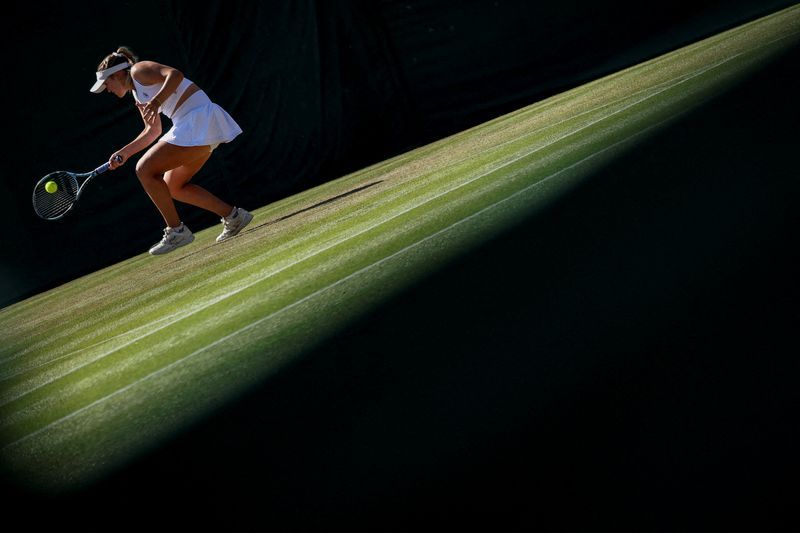
Every summer, the All England Club opens its gates to what many consider tennis's most prestigious championship, where 149 years of accumulated tradition shape every detail from the perennial ryegrass courts to the strict dress codes enforced upon competitors. Yet for all the pageantry and ceremonial grace that distinguishes Wimbledon from other Grand Slam events, the tournament's true essence emerges not from its manicured lawns or the strawberries-and-cream hospitality that defines the spectator experience, but from the fierce, unrelenting competition that drives approximately 675 matches across all categories to completion over two weeks.
Wimbledon's visual identity stands in deliberate contrast to other major sporting events that unfold simultaneously on the global calendar. While the FIFA World Cup captured international attention with its vibrant colors, dramatic celebrations, and uninhibited expressions of national pride, the All England Club maintained its understated elegance through strict white-only dress codes extending even to footwear, creative millinery among the crowd, and the ceremonial presence of members of the royal family in reserved seating areas. To the casual observer, Wimbledon might appear as a tournament where tradition and social convention matter more than athletic excellence. This perception, however, masks a fundamental truth about the championship's character and appeal to the world's greatest players.
Beneath the polished veneer of tradition beats a competitive heart that pulses with the same intensity as any World Cup match or Olympic final. The best players on earth gather at the All England Club not primarily to participate in a ceremonial ritual but to claim tennis's most coveted individual prize. They arrive understanding that Wimbledon, despite its emphasis on decorum and tradition, demands the same ruthlessness, tactical acuity, and mental fortitude required to prevail in any major sporting contest. This duality between external gentility and internal ferocity creates a unique tension that sets Wimbledon apart from the sport's other three Grand Slams.
Photographers assigned to document the championship for international news outlets discovered this hidden dimension through moments that revealed players stripped of professional composure. One such moment involved Alexandra Eala, the 21-year-old competitor attempting to dethrone third seed Iga Swiatek, a six-time major tournament winner. During a critical point, Eala fell while attempting to execute a forehand return, her gritted teeth visible even as she crashed to the grass. For photographer Toby Melville, who had positioned himself expecting to capture a moment of celebration, the unexpected tumble presented an unguarded glimpse of the intense battle between an underdog and an established champion. Melville later reflected on his technical approach, noting how Eala's fall naturally transformed the frame from vertical to horizontal format, accidentally capturing one of the tournament's most visceral competitive moments.
The psychological weight of competition at Wimbledon manifests in countless ways throughout the fortnight. Otto Virtanen, engaged in a hard-fought first-round encounter, approached a courtside barrier during a moment of intense frustration, his body language suggesting he wished to vanish entirely from the arena's scrutiny. Photographer Jaimi Joy captured this moment of despair, documenting how the pressure of Grand Slam competition can strip away the veneer of professional control and expose the raw emotions beneath. These instances of vulnerability remind viewers that tennis, despite its individual nature, places extraordinary mental and physical demands upon participants competing at the sport's highest levels.
Yet Wimbledon also produces moments of triumphant assertion that showcase why players dedicate their careers to reaching such pinnacle events. Naomi Osaka's progression to the quarter-finals for the first time in the championship generated significant intrigue, particularly when the two-time major tournament winner strutted across Centre Court in a kimono-inspired dress that radiated confidence and fearlessness. Photographer Marko Djurica's image captured this moment of supreme self-assurance, documenting an athlete performing at the highest level while claiming her narrative through fashion and presence. Osaka's run to the quarter-finals represented a significant achievement that justified her continued pursuit of excellence despite earlier career interruptions and challenges.
The interplay between light and shadow on the championship's grass courts created additional layers of visual and symbolic meaning for photographers documenting the tournament. Jannik Sinner, the men's singles champion, found himself captured mid-air during the final match against Alexander Zverev as he stretched his body to its maximum extension to return a forehand stroke. His elongated shadow appeared to extend his physical reach even further, a visual metaphor for the extraordinary efforts required to succeed at the sport's highest level. Similarly, Marko Djurica documented the women's doubles champions Guo Hanyu and Kristina Mladenovic embracing after their victory, their intertwined shadows creating an illusion of a solitary player raising a fist in triumph—a poetic representation of how individual and collective achievement blur in moments of supreme satisfaction.
The physical toll of competition becomes evident only after the tournament concludes and spectators depart. Andy Couldridge's time-lapse photography of Centre Court revealed the gradual wearing away of grass caused by thousands of players' footsteps and explosive movements across two weeks of unrelenting competition. The visible patches of worn turf serve as eloquent testimony to the cumulative effort expended by competitors pursuing Wimbledon's prize, far more eloquent than any statistical measure of distance covered or points contested. These worn patches represent the collision between the championship's carefully preserved traditions and the raw physical reality of elite athletic competition.
For Malaysian and Southeast Asian readers, Wimbledon's dual nature—combining ceremonial tradition with ferocious competition—offers important insights into how sporting excellence operates within established institutional frameworks. The championship demonstrates that traditions and achievement are not mutually exclusive; rather, the deepest traditions derive their meaning from the excellence they cultivate and commemorate. Similarly, the tournament's global reach and appeal remind regional audiences that Southeast Asian players increasingly compete at the highest levels of professional tennis, measuring themselves against the world's elite competitors on the sport's most prestigious stages.
The photographs and moments captured during the championship ultimately reveal that Wimbledon's true soul resides neither in its historical significance nor in its ceremonial grandeur, but rather in the intense human drama created when the world's greatest competitors pursue excellence on its storied courts. The silence before a crucial serve, the quiet determination visible in a player's expression during a difficult rally, the unbounded relief following victory, and the crushing disappointment of defeat—these universal human experiences transcend cultural boundaries and explain Wimbledon's enduring appeal to global audiences. The championship succeeds precisely because it honors tradition while demanding that players subordinate all other considerations to the singular pursuit of victory, creating a competition as uncompromising as any in sport.

