Prime Minister Narendra Modi's Bharatiya Janata Party has launched a pointed attack on the student movement that galvanised New Delhi last month, questioning why the Cockroach Janta Party has maintained a relatively subdued presence during ongoing demonstrations in Jharkhand. The accusation cuts to the heart of contentious debates in Indian politics about the motivations behind protest movements and whether activism serves genuine reform or partisan interests.
BJP spokesperson Keya Ghosh characterised the Cockroach Janta Party's apparent distance from the Jharkhand agitation as evidence of selective activism. She argued that the group's prominent role in organising New Delhi demonstrations—which ultimately led to the resignation of Education Minister Dharmendra Pradhan over examination irregularities—masked a deeper agenda to undermine the Modi administration rather than pursue consistent principle. The timing of the party's withdrawal from public-facing protest activities after securing the minister's resignation, juxtaposed against simultaneous unrest in eastern India, provided ammunition for this narrative.
The Jharkhand demonstrations represent a distinct chapter in India's current protest landscape. Unlike the New Delhi movement, which was coordinated by an established pressure group with organisational capacity, the eastern state's agitation emerged organically from students and job aspirants frustrated by alleged irregularities in state recruitment examinations. The decentralised nature of these protests meant that established activist networks had less natural purchase, though some individuals connected to the earlier movement did participate. This fundamental structural difference between the two movements complicates any straightforward comparison of commitment or consistency.
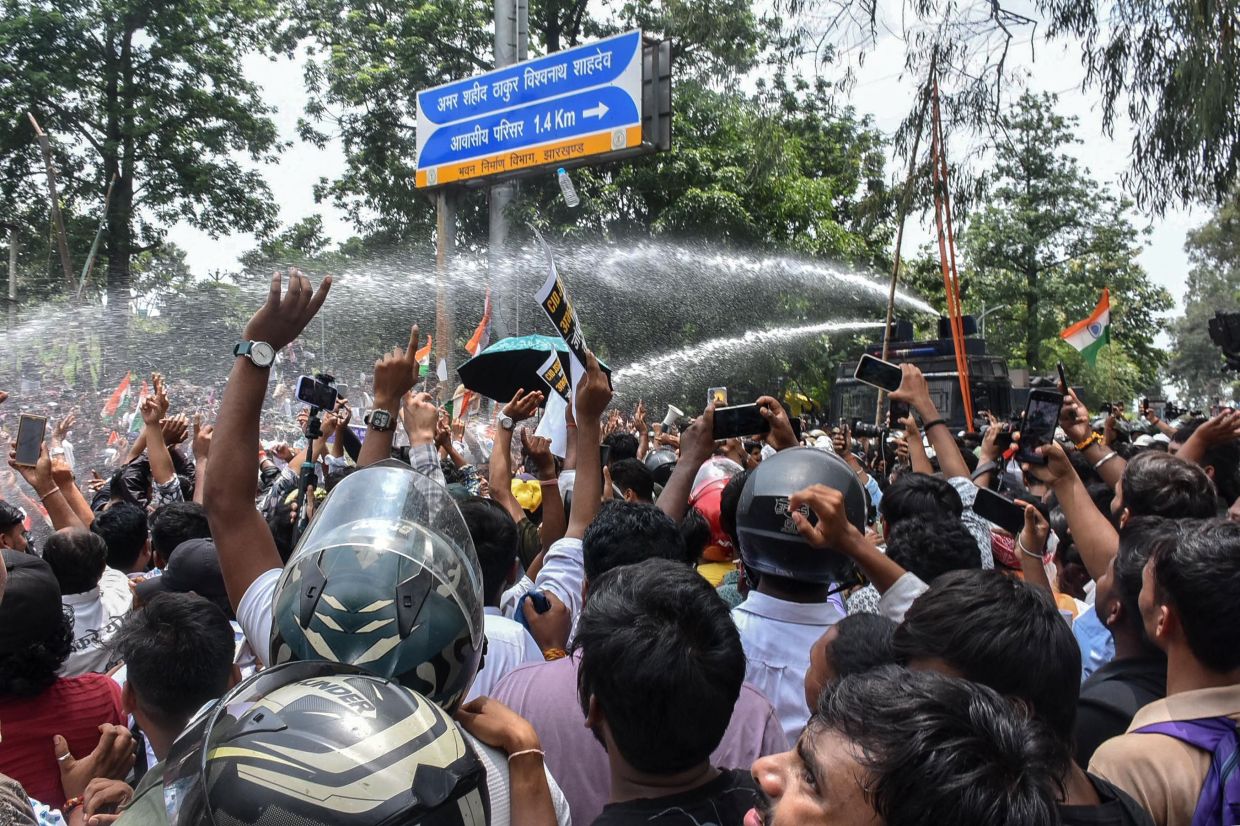
Cockroach Janta Party founder Abhijeet Dipke has not remained entirely silent on events unfolding in Jharkhand. Following police deployment of water cannons and batons against demonstrators, he issued statements condemning what he characterised as state violence against students. His intervention, however measured, did acknowledge the legitimacy of grievances driving the eastern state's unrest. This rhetorical engagement stands somewhat at odds with Ghosh's portrayal of the movement as a "mute spectator" to events beyond the capital.
The political configuration in Jharkhand adds another layer to the BJP's critique. The state falls under a coalition government led by the Jharkhand Mukti Morcha, with the Indian National Congress as a junior partner, while the BJP occupies the opposition benches. This arrangement meant that criticising a state government—as the protest movement implicitly did through demands for investigation into exam irregularities—would not serve obvious partisan advantage for Congress-aligned activists. Ghosh seized upon this dynamic, questioning why national opposition leader Rahul Gandhi had not visited protest sites, suggesting that the coalition's governance role explained the muted response from some quarters of Indian politics.
Gandhi, notably, has avoided direct physical presence at either the New Delhi or Jharkhand demonstration sites, though he has issued statements affirming students' rights to peaceful assembly and calling for dialogue-based solutions. His measured approach contrasts sharply with the organisational intensity that characterised the New Delhi movement, where various political figures attempted to associate themselves with the agitation. This restraint may reflect either tactical calculation or genuine concern about being perceived as instrumentalising student grievances for political gain—exactly the charge the BJP now levels against the Cockroach Janta Party.
What distinguishes the Cockroach Janta Party from conventional political organisations is its origins as a satirical social movement that gradually accumulated organisational capacity and political influence. This unconventional trajectory creates genuine ambiguity about whether the group functions as a pressure organisation pursuing consistent demands or as an ad hoc coalition mobilising around specific grievances. The BJP's attack implicitly exploits this definitional uncertainty, suggesting that inconsistent participation across two protest movements reveals the group's true purpose.
Akshay Shinde, the Cockroach Janta Party's national coordinator, has countered these accusations by emphasising the group's participation in Jharkhand demonstrations and commitment to seeing the agitation through to its conclusion. This assertion receives some corroboration from local reporting indicating that party members have indeed joined the eastern state's mobilisations. The tension between national-level accusations and ground-level participation illustrates how protest movements operating across multiple geographies can present contradictory images depending on perspective and measurement.
For Malaysian observers, these dynamics illuminate broader questions about civil society activism in large, diverse democracies. The ability of pressure groups to sustain consistent engagement across multiple regions whilst maintaining independence from political manipulation represents a genuine governance challenge. The BJP's attack, whether strategically motivated or substantively grounded, highlights the vulnerability of student movements to accusations of partisanship—a concern equally relevant to Southeast Asian contexts where similar agitations occur regularly.
The Jharkhand protests themselves reflect underlying anxieties about examination integrity and employment opportunity that resonate across South Asia. Job aspirants demanding transparent recruitment processes address grievances that could mobilise constituencies across multiple states if properly coordinated. Whether established activist networks can facilitate such coordination without sacrificing perceived independence remains an open question, one that will likely determine their political relevance in India's turbulent protest landscape.
Beyond the immediate dispute between the BJP and the Cockroach Janta Party, these events suggest that organised student activism in India faces a structural challenge. Movements that succeed in forcing policy concessions—as the New Delhi group did through Pradhan's resignation—create expectations for similar outcomes elsewhere. When subsequent movements either fail to achieve comparable victories or receive reduced activist attention, the resulting perception of inconsistency invites precisely the kind of accusations now emanating from government circles.

