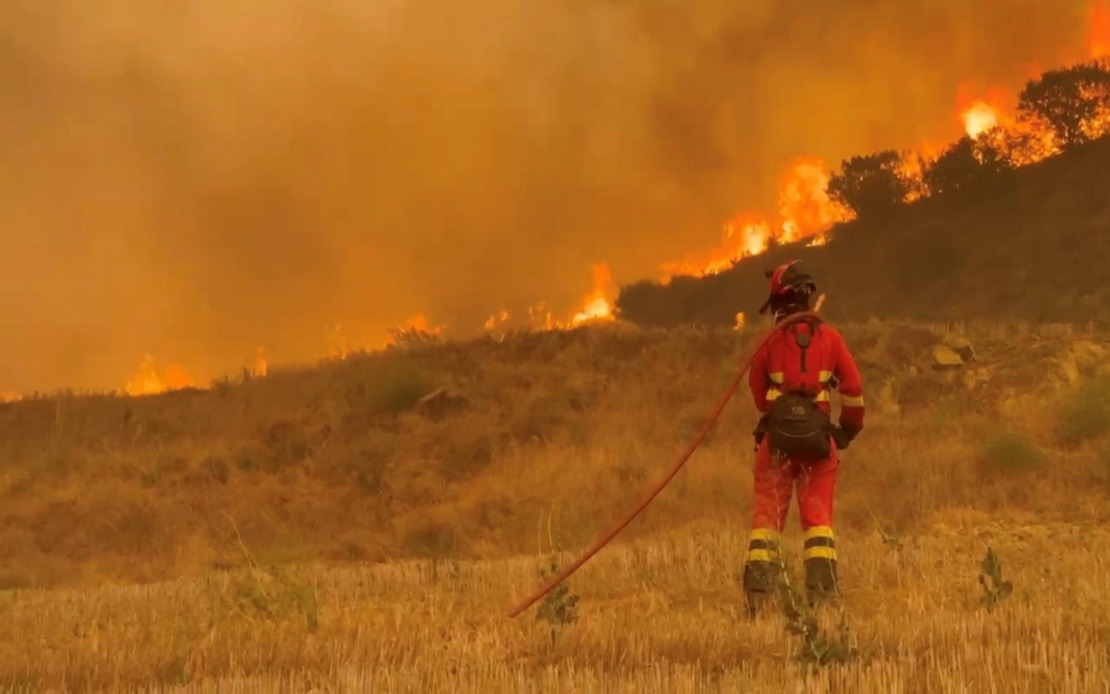
Britain's government has convened an urgent crisis meeting scheduled for Wednesday as the nation grapples with an escalating weather emergency spanning extreme temperatures, widespread wildfires and rapidly expanding drought conditions. The emergency Cobra meeting, which will be chaired by Andy Burnham, represents an acknowledgment by authorities that the interconnected environmental challenges are straining critical national infrastructure and workforce capacity across multiple sectors simultaneously.
The convergence of these crises is placing unprecedented pressure on the country's emergency services, particularly firefighting personnel who are battling significant blazes such as the major wildfire currently consuming large areas of the New Forest in Hampshire. Simultaneously, agricultural workers face severe water shortages and restrictions as drought declarations expand geographically, while the National Health Service contends with surge demand related to heat-related illnesses and vulnerabilities affecting elderly and at-risk populations. This triple threat scenario reflects how climate-related hazards compound institutional strain when occurring in tandem.
Meteorological authorities have issued stark warnings underscoring the severity of the immediate threat. The Met Office, Britain's weather service, has released a rare amber extreme heat warning specifically for Thursday, signalling conditions of sufficient danger to warrant elevated public alert status. More significantly, the agency reported this week that current temperature trajectories place the country on course to record its hottest summer on record when measured by average temperature across the season, a sobering indicator of the broader climatic shift underway.
The geographic scope of drought conditions has expanded dramatically in recent weeks. Wales entered official drought status on July 30 as sustained high temperatures and inadequate precipitation depleted water reserves, while approximately half of England was placed under drought declaration the previous month following record-low rainfall combined with prolonged heat exposure. By this week, additional areas across England were reclassified into drought status as conditions deteriorated further, suggesting the dry conditions are neither isolated nor transitory phenomena.
The human toll from the prolonged heat has proven devastating. During the May and June heat wave periods, the UK Health Security Agency documented 2,877 excess deaths attributable to extreme heat exposure—a figure nearly double the 1,504 excess deaths recorded during the entire summer of 2025. This sharp increase demonstrates that the intensity and duration of the recent heat events have exceeded public health system capacity to adequately protect vulnerable populations, raising critical questions about preparedness for future occurrences.
Green Party leader Zack Polanski seized on the emergency meeting announcement to articulate an alternative policy framework for addressing the underlying crisis. His statement emphasised that negotiation with scientific realities regarding climate change is futile, positioning the weather emergency as fundamentally a consequence of continued fossil fuel dependence. His proposals for consideration include taxation mechanisms to compel major fossil fuel companies to finance emergency response equipment such as firefighting helicopters, establishment of cooling centres accessible to all communities, institutional mandates restricting maximum working temperatures, and cessation of new petroleum and natural gas extraction projects in the North Sea—all framed as necessary immediate interventions alongside longer-term decarbonisation.
For Malaysian and Southeast Asian readers, the British weather crisis carries instructive implications regarding climate vulnerability and institutional response capacity. Many tropical and subtropical nations in the region already experience episodic extreme heat, water stress and wildfire events that rival or exceed British severity, yet often with more limited resource availability for emergency response and disaster management. The UK's current struggle to coordinate across firefighting, health and agricultural sectors despite substantial institutional capacity and funding underscores how rapidly climate hazards can overwhelm even well-resourced systems.
The emergency meeting itself represents an important escalation in governmental recognition of the crisis magnitude. Cobra meetings, formally known as Civil Contingencies Committee meetings, represent the highest level of emergency coordination in the British system and are convened only when situations exceed normal departmental response capacity. The decision to invoke this mechanism signals that authorities now view the convergence of heat, drought and wildfire as a systemic national emergency requiring integrated cross-government action rather than siloed departmental management.
The timing of these events during summer, when European energy demand for air conditioning should theoretically decline, creates perverse pressures on electricity systems already stressed by geopolitical disruptions affecting energy supply. Simultaneously, the agricultural challenges emerging from drought conditions will influence food production and pricing throughout coming months, potentially affecting import-dependent nations globally. Britain's current predicament thus foreshadows broader supply chain and economic implications likely to ripple through interconnected international systems.
The absence of dramatic policy announcements in the initial reporting on the emergency meeting suggests that government strategy remains in development, with the Wednesday gathering likely to establish coordination frameworks and resource allocation priorities rather than announce finalised interventions. This measured approach stands in contrast to the Green Party's immediate programmatic proposals, illustrating the political tension between urgency advocates demanding rapid transformation and officials tasked with managing complex implementation across fragmented institutional structures.

