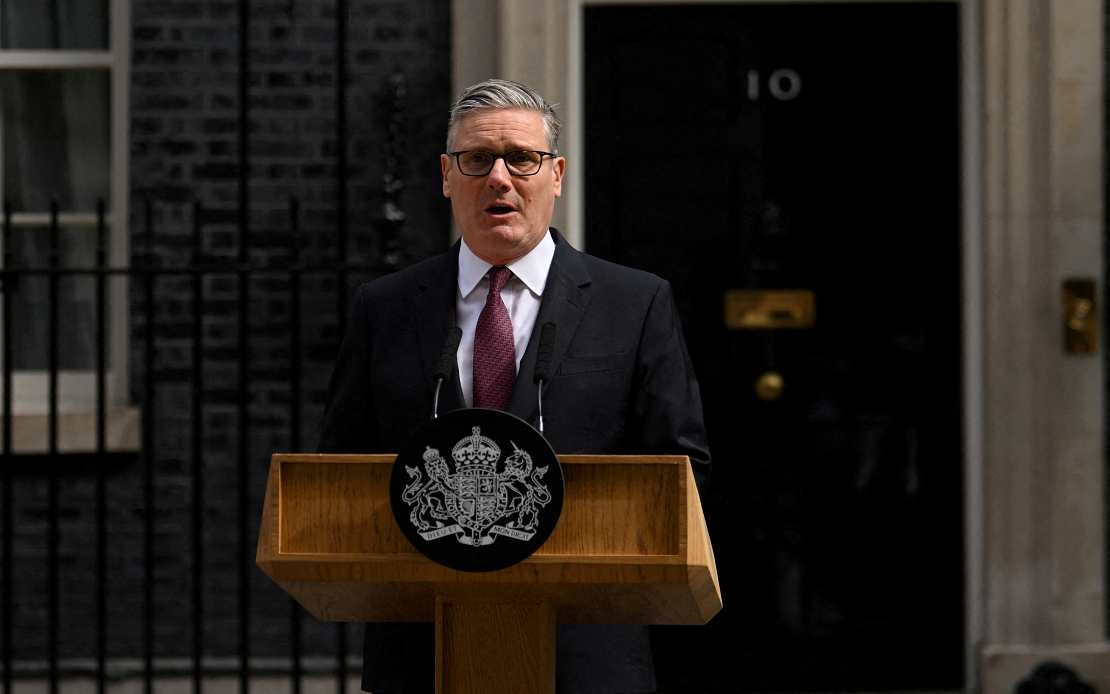
British Prime Minister Keir Starmer has intensified calls for an immediate restoration of dialogue between Washington and Tehran, warning that the escalating standoff over the Strait of Hormuz poses grave risks to international maritime commerce and regional security. Speaking at a multinational gathering in Paris on Monday alongside leaders from France, Germany, and Ukraine, Starmer underscored the gravity of recent hostilities and outlined his government's readiness to support stabilisation efforts in one of the world's most strategically vital waterways.
The situation in the Persian Gulf has deteriorated markedly following a weekend exchange of military strikes between American and Iranian forces. President Donald Trump announced that the United States would reinstate sanctions pressure on Iran's oil exports and establish a controlled shipping corridor through the Strait of Hormuz, with vessels required to pay for safe passage guarantees. This unilateral move represents a significant hardening of American policy and directly contradicts earlier expectations that regional tensions would ease following diplomatic developments in recent months.
Starmer was unequivocal in condemning Tehran's actions, characterising attacks on merchant vessels and assaults targeting allied Gulf states as unacceptable provocations that must cease immediately. The British leader's rhetoric reflected widespread concern among Western powers that unchecked escalation could spiral into broader regional conflict. His statement carried particular weight given Britain's historic naval presence in the Gulf and its substantial commercial interests in ensuring unimpeded passage through one of Earth's most critical chokepoints for global energy supplies.
The underlying dispute traces back to February, when Israel launched military operations against Iran-backed militias, triggering a broader confrontation that threatened to engulf the entire region. Iran's retaliation during this period included direct attacks on Israeli territory, raising fears of an even more destructive conflict. A memorandum of understanding signed in June appeared to offer hope for de-escalation, with expectations that normal maritime traffic could resume freely through the Strait of Hormuz, which serves as the conduit for roughly one-third of the world's seaborne oil trade.
However, that optimism has proven premature. Iran had previously implemented measures that effectively restricted access to the Strait in response to the broader conflict, citing security concerns and asserting its right to defend regional interests. The anticipated reopening of this vital passage never fully materialised, and now fresh hostilities threaten to deepen the impasse. For Malaysia and other Southeast Asian nations heavily dependent on Middle Eastern energy supplies, such disruptions carry immediate economic consequences through higher shipping costs, insurance premiums, and potential fuel price volatility.
Starmer's emphasis on negotiation reflects a broader Western strategy aimed at preventing the crisis from metastasising into outright warfare. The British government has signalled its willingness to contribute military assets to protect commercial shipping lanes, a position that echoes Cold War-era commitments to freedom of navigation. This commitment underscores the international dimension of the dispute—what transpires in the Gulf directly affects supply chains, inflation pressures, and economic stability across Asia-Pacific and beyond.
The involvement of French, German, and Ukrainian representatives at the Paris meeting suggests a coordinated diplomatic effort to isolate Iran's conduct while leaving channels open for eventual settlement. Germany's participation is particularly noteworthy given its economic exposure to Middle Eastern instability, while Ukrainian involvement signals broader Western alliance cohesion amid multiple geopolitical crises. This coalition-building approach reflects recognition that isolated condemnation carries limited weight without credible incentives or enforcement mechanisms.
The Trump administration's decision to introduce shipping tolls through the Strait introduces a novel and contentious element. While framed as compensation for American military protection, such measures could invite counter-measures from Iran and other regional actors, potentially triggering further tit-for-tat escalations. For international shipping firms and commodity traders, the uncertainty alone creates significant cost pressures and operational complications that ripple through global supply networks.
For Malaysian policymakers and business leaders, developments in the Strait of Hormuz warrant careful attention. As an energy-importing nation and a major node in regional maritime commerce, Malaysia's economic fortunes remain tied to stability and predictability in the Gulf. The current trajectory—marked by escalating military posturing and unilateral assertions of control—threatens precisely the rules-based international order that benefits smaller nations unable to project military power across vast distances.
Starmer's call for unrestricted freedom of navigation specifically addresses this concern, invoking principles enshrined in international maritime law. His willingness to commit British naval resources to enforce such freedoms suggests a return to more confrontational approaches after years of diplomatic engagement. Whether this combination of military deterrence and negotiation can reverse current trajectories remains uncertain, but the stakes for global commerce and regional peace are unmistakably high.

