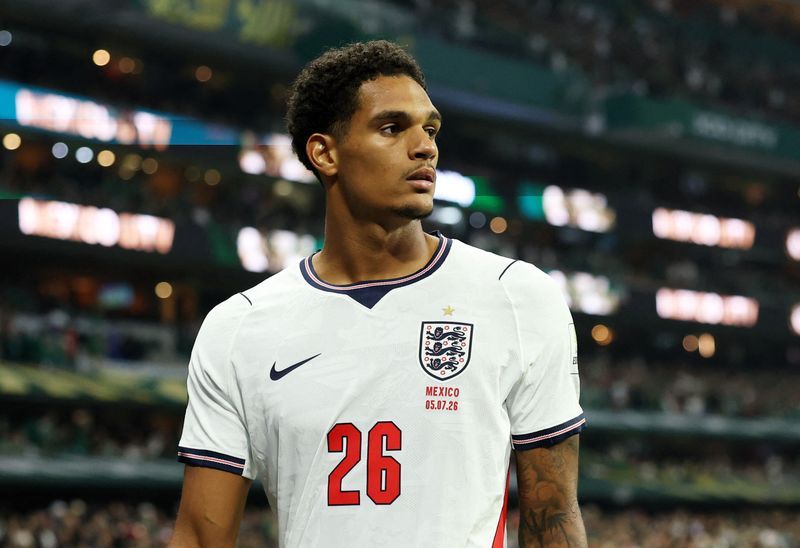
The controversy surrounding American striker Folarin Balogun's suspended ban has now engulfed England's World Cup campaign, as British politicians demand that FIFA extend the same treatment to defender Jarell Quansah following his red card in England's dramatic 3-2 victory against Mexico at the Azteca Stadium. The intervention represents an unprecedented attempt to leverage a single disciplinary decision into broader policy on the tournament's biggest stage, forcing football's governing body to confront questions about the consistency and fairness of its enforcement mechanisms.
Two Labour MPs, Noah Law and Melanie Onn, separately petitioned FIFA President Gianni Infantino through social media this week, requesting that Quansah's automatic one-match suspension be deferred until after the World Cup concludes. Their argument rests directly on FIFA's decision regarding Balogun, establishing a legal and moral framework for equal treatment of players facing materially identical circumstances. Law acknowledged in his correspondence that the red card itself was justified, yet contended that deferring the consequent suspension aligns with FIFA's demonstrated willingness to prioritise tournament continuity over rigid application of automatic disciplinary codes.
The affair gained international prominence when United States President Donald Trump publicly disclosed his direct communication with Infantino concerning Balogun's suspension, transforming what might have been a routine disciplinary matter into a geopolitical flashpoint. While Infantino maintained that FIFA's independent judicial bodies made the determination autonomously, the revelation sparked immediate accusations from European football authorities and politicians that political pressure had penetrated the supposedly impartial disciplinary process. This perception now haunts FIFA's World Cup administration, as each subsequent decision faces intense scrutiny regarding potential external influence.
Caroline Dinenage, the Chair of the House of Commons Culture, Media and Sport Committee, escalated parliamentary engagement by formally demanding that FIFA urgently clarify the reasoning behind Balogun's reprieve and address allegations of political interference. Dinenage's statement positioned the disciplinary inconsistency as fundamentally corrosive to the sport's credibility, warning that without transparent explanation and consistent application of rules, FIFA risks permanently damaging confidence in its governance structures. She framed England's thrilling victory against Mexico as exemplifying football's transcendent power, then cautioned that FIFA's handling of discipline threatened to overshadow the tournament's sporting achievements with questions of institutional integrity.
The English Football Association is reportedly evaluating its options regarding potential appeals or formal requests to FIFA, according to sources with knowledge of the federation's deliberations. This cautious approach reflects the FA's attempt to navigate between supporting their injured player and avoiding overt political pressure tactics that might further inflame FIFA's institutional sensitivities. The formal exploration of appeal mechanisms, however, indicates that England views Quansah's case as having legal and procedural merit worthy of serious consideration rather than dismissing it as settled law.
Quansah's predicament mirrors Balogun's in nearly every material respect. Both players received dismissals during World Cup matches, both faced automatic suspension protocols, and both penalties would remove key defensive assets from their nations' subsequent fixtures at critical tournament stages. The symmetry makes the divergent treatment increasingly difficult for FIFA to justify, particularly when the governing body has publicly asserted that its judicial independence remains inviolate despite Trump's acknowledged communication with Infantino.
Onn emphasized that applying fundamentally different standards to comparable cases would undermine FIFA's disciplinary credibility more severely than granting Quansah equivalent relief would damage tournament integrity. She argued that inconsistency represents a greater institutional threat than flexibility applied uniformly, a position that inverts traditional arguments about upholding strict rules regardless of political pressure. This rhetorical framing positions the MPs' intervention not as special pleading but as defense of principled governance structures.
The timing of England's quarter-final matchup against Norway in Miami on Saturday adds operational urgency to the dispute, as FIFA must address the matter before Quansah's potential unavailability affects tournament outcomes. Should FIFA grant Quansah's deferral, it effectively acknowledges the Balogun precedent applies broadly. Should it reject the request, FIFA must publicly explain why materially identical cases warrant different treatment, inevitably confronting the political interference allegations directly. Neither option allows FIFA comfortable passage through this controversy.
For Malaysian and Southeast Asian football observers, this episode illuminates how political pressure at the highest levels can penetrate supposedly insulated institutional processes, with implications extending far beyond immediate disciplinary matters. The precedent-setting nature of FIFA's Balogun decision demonstrates how single discretionary rulings can cascade into systemic inconsistencies, particularly when those decisions appear influenced by external political considerations. As Asian football develops stronger regional governance structures and potentially greater influence within FIFA, the question of institutional independence versus political responsiveness becomes increasingly relevant to governance debates across the region.
The broader significance extends to how international sporting organizations balance rule consistency with contextual flexibility, a tension that affects not merely World Cup administration but the foundational legitimacy upon which sports governance rests. FIFA's handling of this situation will signal whether institutional integrity remains viable under political pressure or whether world sporting bodies have become fundamentally susceptible to state-level intervention. For nations with emerging football programs and developing political influence, the outcome carries instructive lessons about institutional power dynamics in international sports governance.

