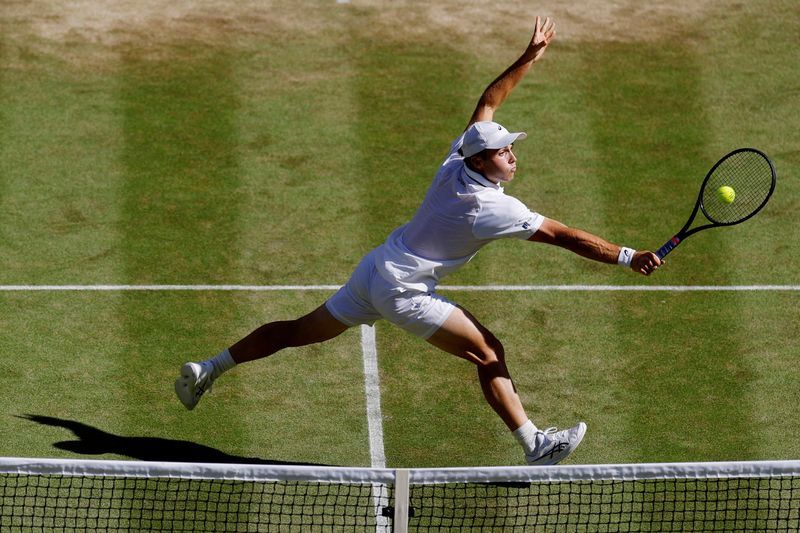
Arthur Fery's improbable journey through Wimbledon has captured the imagination of British tennis fans at a moment when domestic hopes appeared all but extinguished. The 24-year-old wildcard entry faces an intriguing quarterfinal clash with Italian world number 10 Flavio Cobolli on what would be his birthday, a remarkable turn of events for a player who began the Championships ranked outside the world's top 110. His presence on Centre Court represents a welcome reprieve for British supporters after a disappointing early exit by most of the nation's seeded representatives.
The contrast between Fery's breakthrough and the broader context of British representation at the tournament underscores just how significant his contributions have become. Of the 19 British singles players competing at this year's Championships, 15 fell at the first hurdle, leaving the burden of representing the host nation almost entirely on the shoulders of this unheralded wildcard. That responsibility has been magnified by the drama and quality of his victories, each requiring extraordinary reserves of mental fortitude and physical resilience.
Fery's second-round triumph over Grigor Dimitrov exemplified the character he has demonstrated throughout his run. Dimitrov, a 35-year-old former world number three with extensive Wimbledon pedigree, appeared to have the contest in his grasp when he moved to 4-3 with a break in the fourth set. The veteran's experience and court craft seemed poised to overcome youthful energy. Yet Fery orchestrated one of the most compelling comebacks seen at the venue in recent memory, ultimately prevailing 7-5, 3-6, 4-6, 6-4, 7-6(7) in a contest that captivated the crowd and earned plaudits from Roger Federer, observing from the Royal Box.
The timing of Fery's victory carried particular emotional weight for the assembled supporters. The announcement of England's dramatic World Cup victory over Mexico in the last sixteen had electrified the nation mere hours earlier, and that sporting euphoria transferred directly to Centre Court. The surge of patriotic feeling that swept through the stadium when Fery sealed his victory created an almost football-like atmosphere, a rarity at Wimbledon's historically composed environment. The roar that greeted his match point victory was, by contemporary standards, among the loudest heard at the tournament in years, a testament to both his achievement and the hunger of British audiences for homegrown tennis success.
Fery's path to this quarterfinal berth already included a remarkable third-round encounter against Belgian Zizou Bergs on Saturday. That contest tested his resilience in ways that few matches can, as he overcame a two-set deficit combined with a double break down in the fourth set. He also competed while battling a succession of nosebleeds, a physical challenge that would have derailed many competitors but which Fery overcame through sheer determination. At the time of that victory, it represented the longest match in the entire tournament, a statistic that underlined both the epic nature of his challenge and the caliber of opponent he was dispatching.
The California-educated player's background adds an interesting dimension to his emergence as Britain's unlikely tennis hero. Despite being born in France and later raised in London, Fery's credentials as a serious international competitor were not widely recognized heading into the fortnight. His college tennis experience at Stanford provided a foundation that has clearly developed into something more substantial. The fact that he had previously defeated Cobolli at this year's Australian Open suggests his recent form represents a genuine elevation rather than temporary tournament magic. That prior victory provides tangible evidence that his Wimbledon performances reflect genuine improvements in his game rather than fortunate draws and hot streaks.
Observations from established players have validated what British crowds are witnessing. American sixth seed Taylor Fritz, who practised with Fery during the build-up to the 2024 World Tour Finals, recognized the quality immediately. Fritz recalled being repeatedly outplayed during training sessions, noting that Fery's combination of athleticism, powerful serving, and baseline strength proved consistently superior. The American acknowledged that despite playing well during that period and subsequently reaching finals at Turin, Fery demonstrated the kind of all-around game that suggested genuine breakthrough potential. Such endorsements from peers carry particular weight in tennis, where professional practitioners understand the difference between flash and substance.
The statistical trajectory of Fery's ranking reflects the magnitude of his Wimbledon achievement. Beginning the week ranked 114th in the world, his quarterfinal position has already propelled him inside the top 70, a jump that would typically require months of consistent performance. This concentration of ranking points through a single tournament represents the kind of opportunity that transforms careers, particularly for players in the secondary tier of professional tennis where each breakthrough competition carries exponential significance. Should Fery continue his march through the remaining rounds, the ranking implications would become even more dramatic, potentially catapulting him into the world's elite tier.
For Malaysian and Southeast Asian tennis followers, Fery's trajectory carries particular interest as it demonstrates the possibilities available to players from outside the traditional tennis powerhouses who seize unexpected opportunities. His reliance on a wildcard entry rather than conventional ranking progression mirrors the pathway available to developing players across the region. The manner in which he has converted that opportunity through consistent performance and mental resilience provides a blueprint for aspiring professionals elsewhere in Asia seeking to establish themselves at the highest levels of international competition.
Fery's emergence also reflects broader shifts within tennis, where ranking-based selection and traditional hierarchies increasingly encounter challenges from players capable of elevating their games dramatically over short periods. His performance suggests that talent development pathways outside the conventional circuit structures can still produce competitors capable of thriving at Grand Slam level. The support he has received from Centre Court crowds, typically reserved for established favorites, reveals how readily tennis audiences embrace compelling narratives centered on breakthrough performances by determined underdogs.
Looking toward his quarterfinal encounter with Cobolli, Fery enters with the psychological advantage of a previous victory and the enormous confidence that flows from consecutive five-set epics. The Italian player, despite his elite ranking, will face an opponent operating at an emotional peak with nothing to lose and everything to prove. The dynamic between these players has already been established, with Fery's Australian Open victory providing a template for successful engagement. Whether such advantage can be translated into another upset victory remains uncertain, but Fery has demonstrated that conventional expectation carries minimal relevance to his current performance level.

