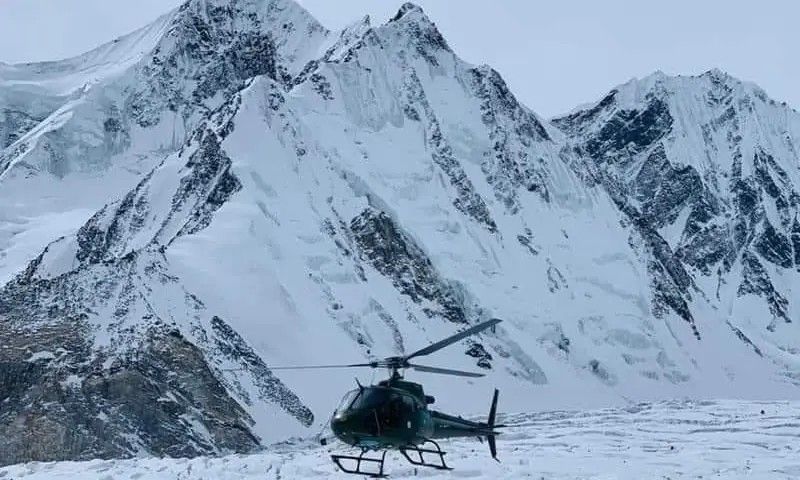
A major search and rescue operation commenced on Friday in the high-altitude reaches of Broad Peak in Gilgit-Baltistan after an avalanche engulfed a group of climbers the previous day around midday, leaving 10 mountaineers unaccounted for and sparking international concern within the climbing community. Among those missing are Nirmal Purja, a Nepali mountaineer of international renown, and Sohail Sakhi, one of Pakistan's most accomplished high-altitude climbers, alongside eight other expedition members from Nepal, Oman, the United States, and China.
According to the Alpine Club of Pakistan, the missing climbers represent a diverse international contingent. The Nepali contingent consists of six experienced mountaineers: Purja himself, along with Pur Bahadur Gurung, Kili Pemba Sherpa, Nima Sherpa, Nawang Thindu Sherpa, and Gyalu Sherpa. Accompanying them are Nadhira Ahmed Abdullah Al Harthy from Oman, Sakhi from Pakistan, Wang Zhong from China, and Mallory Geis from the United States. This composition reflects the increasingly international character of expeditions on the world's most challenging peaks, with climbers from across Asia, the Middle East, North America, and beyond converging on these dangerous mountains in pursuit of mountaineering achievement.
The immediate rescue response mobilised substantial resources, with the Pakistan Army Aviation deploying two dedicated rescue helicopters equipped with specialised rescue personnel and equipment to the region. The Alpine Club of Pakistan's leadership, spearheaded by Major General Irfan Arshad and ACP General Secretary Ayaz Shigri, coordinated closely with governmental authorities and relevant agencies to facilitate the operation. Officials acknowledged that helicopter-assisted rescue efforts were expected to commence as weather and operational conditions permitted, though the inherent unpredictability of high-altitude weather patterns presented a significant constraint on rescue timing and effectiveness.
Geographic and logistical details emerging from initial reports painted a grave picture. Data received from GPS devices on some of the missing climbers indicated that the avalanche had swept the climbing party approximately 1,000 metres downslope, leaving them in a precarious position amid avalanche debris and extreme altitude conditions. Rescue coordinators expressed additional concern that local high-altitude porters, who typically accompany expedition teams to provide logistical support on the mountain, may also have been caught in the avalanche, though the full extent of porter involvement remained unclear as rescue operations unfolded.
Nirmal Purja, 43, represents one of modern mountaineering's most accomplished figures. The Nepali climber, who previously served in Britain's prestigious Brigade of Gurkhas before joining the Special Boat Service of the Royal Marines, transitioned to full-time mountaineering and guiding and subsequently established himself as a record-breaking climber of extraordinary capability. Most notably, Purja completed an ascent of all 14 mountains exceeding 8,000 metres elevation—the so-called "eight-thousanders"—in the remarkably compressed timeframe of six months and six days between April and October 2019, establishing a record that redefined the outer limits of high-altitude mountaineering achievement. Building on this extraordinary accomplishment, Purja went on to complete the first winter ascent of K2 in 2021 alongside a team of nine fellow Nepali climbers, further cementing his status as one of the world's foremost mountaineers.
Sohail Sakhi, the Pakistani climber among those missing, had likewise established himself as an exceptionally skilled high-altitude mountaineer in his own right. Hailing from the mountainous Hunza region of Gilgit-Baltistan, Sakhi demonstrated technical excellence and determination by summiting Kanchenjunga in Nepal in May of this year—a climb placing him among only a select group of mountaineers to reach the world's third-highest peak. His climbing résumé encompasses successful ascents of K2, Nanga Parbat, and both Gasherbrum I and Gasherbrum II, all accomplished without supplemental oxygen assistance. This unoxidised climbing approach, which demands extraordinary physical conditioning and mental fortitude, positioned Sakhi among Pakistan's most formidable high-altitude alpinists.
Gilgit-Baltistan's regional administration mobilised governmental resources in support of rescue efforts. Chief Minister Amjad Hussain Advocate issued directives ensuring all relevant administrative departments remained on high alert and worked in close coordination with Pakistan Army units to expedite rescue operations. The chief minister instructed district administration authorities and other relevant bodies to deploy all available resources toward the recovery operation, while emphasising that despite challenging weather conditions, both aerial and ground-based rescue teams should maintain constant readiness to respond immediately once weather conditions permitted helicopter operations or ground advancement.
The incident underscores persistent dangers inherent to Broad Peak, a 8,051-metre summit located in the Karakoram Range and renowned among mountaineers as one of the range's technically demanding objectives. Avalanches represent one of mountaineering's most capricious hazards—sudden, often unpredictable, and catastrophically destructive when they occur. The fact that multiple expedition teams had begun coordinated summit pushes at the time of the avalanche suggests the timing coincided with what climbers term the "summit window," when atmospheric and weather conditions briefly align to permit safe passage toward high-altitude peaks. Such windows create temporal pressure encouraging climbers to proceed despite inherent risks, and the clustering of multiple expeditions increases the likelihood that an avalanche event will impact larger numbers of mountaineers simultaneously.
The disappearance of Purja and Sakhi carries particular significance for the international mountaineering community given their elevated profiles and the inspiration they provide to aspiring climbers across South and Southeast Asia. Purja in particular has cultivated a substantial global following through social media documentation of his climbing pursuits, making him recognisable to mountaineering enthusiasts worldwide. The incident thus carries implications extending beyond the immediate tragedy of the missing climbers to encompass broader questions about expedition safety protocols, the adequacy of rescue infrastructure at extreme altitudes, and the ongoing debate within the climbing community regarding acceptable risk tolerances when pursuing mountaineering objectives on the world's most dangerous peaks.
For Malaysian mountaineers and adventure enthusiasts, the incident serves as a sobering reminder of the unforgiving nature of extreme-altitude climbing environments. While Malaysian climbers have increasingly turned to high peaks in pursuit of challenge and personal achievement, accidents on mountains like Broad Peak demonstrate that technical skill, financial resources, and determination alone cannot fully mitigate the profound hazards present above 8,000 metres elevation. The rescue operation unfolding in Gilgit-Baltistan represents a test of Pakistan's aerial rescue capabilities at extreme altitude and will likely inform lessons applicable to mountaineering rescue protocols throughout Asia. As search operations continued into subsequent days, the international climbing community watched anxiously for news of the missing mountaineers.

