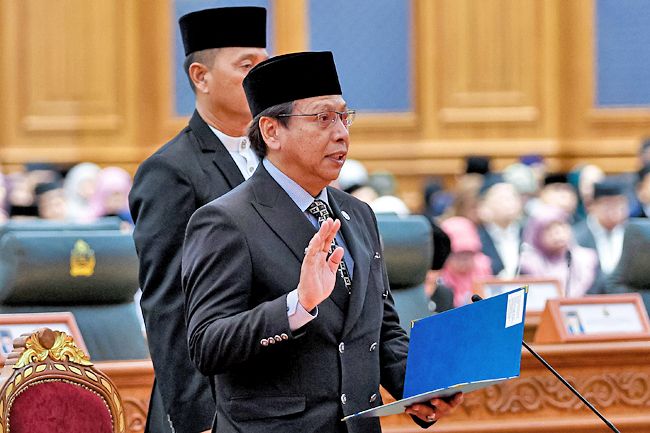
Brunei Darussalam held a formal swearing-in ceremony on Monday to induct four newly appointed Cabinet members into the country's Legislative Council, marking the opening of the second parliamentary session under the 22nd sitting. The administrative protocol, rooted in the 1959 Constitution, represents a standard procedural transition whenever ministerial appointments occur in the sultanate's governance structure, ensuring that senior government officials maintain their ex-officio seats within the legislative chamber. This routinized yet significant constitutional act underscores Brunei's adherence to established democratic formalities and the formal separation of powers that governs the nation's political framework.
The four ministers elevated to their Legislative Council memberships represent critical portfolios spanning national security, economic development, spiritual governance, and infrastructure. Among those sworn in was Datuk Seri Setia Awang Sufian Sabtu, who now holds the Minister at The Prime Minister's Office (Security and Law) portfolio—a position that places him at the nexus of internal security policy, law enforcement coordination, and constitutional matters directly answerable to the premier's office. His appointment signals the sultanate's continued emphasis on security apparatus modernization and legal affairs management in the face of evolving regional challenges and domestic governance demands.
Energy policy likewise received cabinet-level reinforcement through the induction of Datuk Seri Setia Awang Mohamad Azmi Mohd Hanifah, who oversees the Ministry at The Prime Minister's Office (Energy, Upstream and Downstream). This ministerial role assumes particular significance given Brunei's historical dependence on oil and gas exports as the primary revenue drivers of its economy. With such portfolios positioned directly under the Prime Minister's oversight rather than as standalone ministries, the sultanate demonstrates its strategic prioritization of energy sector management, resource development efficiency, and integration with broader macroeconomic planning amid global energy market volatility and regional competition.
Religious governance in Brunei, a Muslim-majority nation with Islam as the official state religion, gained renewed representation through the appointment of Pengiran Datuk Seri Setia Mohammad Tashim Pengiran Hassan as Minister of Religious Affairs. This ministry carries substantial weight in Brunei's political culture, as religious policy intersects with constitutional law, public morality, education curriculum oversight, and interfaith relations across the sultanate. The appointment reflects the government's continued commitment to Islamic institutional development and the management of religious affairs according to both constitutional provisions and Islamic jurisprudential principles.
The fourth ministerial appointment brought Datuk Seri Setia Awang Mohammed Riza Datuk Paduka Mohammed Yunos into the Legislative Council as Minister of Transport and InfoCommunications. This combined portfolio underscores Brunei's recognition that modern transportation networks and digital infrastructure increasingly function as integrated systems. Responsibility for telecommunications, digital economy development, and physical transport connectivity places this minister at the forefront of the sultanate's efforts to position itself as a technologically progressive nation and to enhance regional connectivity across Southeast Asia through improved cross-border transportation and communications capacity.
The ceremony's formal character was underscored by the presence of Pehin Orang Kaya Seri Lela Datuk Seri Setia Awang Abdul Rahman Datuk Setia Mohamed Taib, who serves as Speaker of the Legislative Council. This official representation affirmed the constitutional solemnity of the proceedings and highlighted the interconnection between executive appointments and legislative procedures within Brunei's governance model. The Speaker's attendance also reinforced the legislative branch's role as custodian of constitutional propriety, even as appointed ministers join its ranks in their ex-officio capacity.
From a regional Southeast Asian perspective, ministerial transitions within Brunei's cabinet reflect broader governance patterns across ASEAN nations regarding executive-legislative relations. Many Southeast Asian states similarly employ ex-officio seats to integrate executive and legislative functions, though the precise mechanisms and constitutional frameworks vary considerably. Brunei's methodical approach, grounded in constitutional tradition dating back to 1959 and the granting of self-governance prior to independence in 1984, demonstrates continuity in institutional practice and respect for established protocols even as individual personnel change.
The timing of these appointments—during the second meeting of the 22nd Legislative Council session—suggests strategic governance sequencing, wherein ministerial restructuring or appointments occur during parliamentary sittings to facilitate immediate integration into the legislative process. This approach allows newly appointed ministers to participate in ongoing policy discussions and legislative deliberations from their inception into office, potentially accelerating their administrative effectiveness and policy coordination with fellow lawmakers.
For Malaysian observers, Brunei's cabinet reshuffle and legislative integration procedures offer comparative perspective on neighboring governance models. While Malaysia operates under a different constitutional architecture with distinct separation between executive and parliamentary functions, the principle of senior ministerial participation in legislative business remains relevant to discussions about executive accountability and ministerial oversight within Westminster-influenced systems across the region.
The swearing-in ceremony also reflects Brunei's commitment to maintaining institutional continuity and constitutional adherence as the sultanate navigates contemporary economic and geopolitical pressures. By ensuring that newly appointed ministers formally integrate into the Legislative Council through constitutionally prescribed procedures, Brunei's leadership underscores institutional stability and the rule of law as foundational to national governance. Such procedural fidelity, though routine, carries symbolic weight in affirming constitutional governance principles within an absolute monarchy system.

