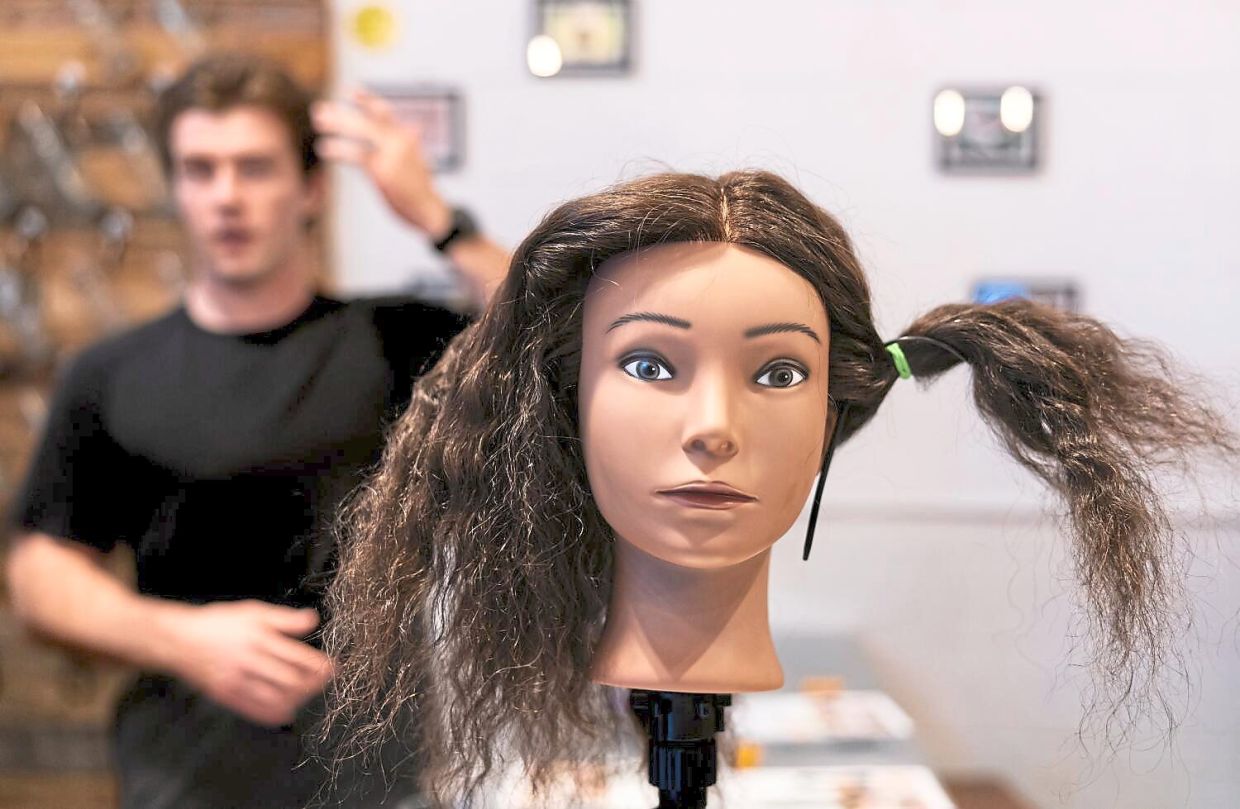
Austin Nieves looked around Captain Fatty's Brewery in Santa Barbara County one late May evening and saw exactly what he had hoped to create: fifteen men, aged thirty to sixty, stepping outside their comfort zones together. The venue had sold out for the night's activity—a father-focused version of the British viral phenomenon "Pints and Ponytails," where dads would learn to braid hair using salon mannequins in a relaxed, masculine environment. Within minutes of the first drink being poured, the initial stiffness melted away, and men who had arrived hesitant began helping each other master techniques they had never attempted before.
Nieves, a Pasadena native who relocated to Santa Barbara in April 2025, founded the Santa Barbara Dads group specifically to create these moments of connection and practical learning. The idea emerged from his own experience as a first-time father. When his son Hudson was born, his wife Katie immediately gained access to multiple mothers' groups and structured parenting classes offering advice, friendship, and training. As a new father, Nieves found himself isolated, relying primarily on his brothers for guidance—a stark contrast to the network of support immediately available to his wife. That disparity sparked a realization that many fathers might be experiencing the same loneliness and confusion without the institutional support systems that mothers typically access.
The scientific community has increasingly documented what many fathers intuitively know: the transition to parenthood can be emotionally turbulent and socially isolating. Research published by Chris Knoester and David J. Eggebeen in the 2006 Journal of Family Issues revealed that fatherhood often triggers declining feelings of well-being and reduced participation in social activities as men dedicate less time to friendships. Clinical psychologists Hillary Halpern and Maureen Perry-Jenkins have characterized the shift from single life to fatherhood as an emotional rollercoaster that many men navigate without adequate support. More recent investigation from Stockholm's Karolinska Institute in 2021 suggested that fathers specifically benefit from structured group participation during their transition into active parenting roles.
The evidence supporting fathers' groups is compelling. The 2021 Karolinska study found that men participating in father groups reported high satisfaction with the experience, noting that such groups positively influenced their relationships with both partners and children. Beyond emotional benefits, members reported increased self-confidence, improved family equality within their households, and notably reduced feelings of loneliness. These outcomes address genuine psychological needs that many fathers experience but struggle to articulate or address independently. For men accustomed to managing challenges through self-reliance, accessing support through a peer group offers both practical utility and psychological safety.
Nieves experienced this shift firsthand after Hudson's birth. His leisure time and social interactions fundamentally changed, creating an unexpected chasm between his concerns and those of his former friend group. Conversations that once centred on entertainment and television shifted to infant development milestones—topics that suddenly felt urgent and consuming. He recognized the need to connect with people inhabiting the same life stage, prompting him to formalize what might otherwise remain an isolated experience. In October 2023, while living in Costa Mesa with Katie, he established the Orange County Dads club with the simple goal of creating regular connection points for fathers.
The Orange County group quickly evolved beyond basic socializing. Nieves organized coffee shop meetings, coordinated zoo outings, hosted collaborative musical events during holidays, and arranged practical CPR training sessions. Despite marketing itself exclusively as a fathers' club, the group's growth accelerated significantly through an unexpected channel: wives and partners sharing Nieves's social media content with their husbands. Mikhail Alfon, founder of Blue Light Media, a social media strategy company, brought his son Santos to multiple meetings and noted on social media that finding peers navigating identical life stages provided invaluable perspective. The organic word-of-mouth expansion demonstrated latent demand among fathers for exactly this type of community infrastructure.
When Nieves and his family purchased a home in Santa Barbara and relocated in April 2025, he faced the prospect of leaving his established community behind. Rather than accepting this disruption, he replicated the model he had developed, establishing the Santa Barbara Dads group within a month of arrival. The first gathering occurred in May 2025, with the group committing to monthly meetups. This rapid reconstitution illustrates both the template's effectiveness and the genuine hunger among fathers for community structures that acknowledge their specific role and challenges.
Austin Jones discovered the Santa Barbara Dads group through Instagram and immediately recognized its value. As a real estate agent, investor, and father, Jones articulated a widespread sentiment among busy professionals: the combination of career demands, marital responsibilities, and parental obligations creates significant pressure with insufficient support mechanisms. Finding peers "in the trenches" with him offered perspective and validation that his struggles were neither unique nor shameful. Jones's specific interest in the Pints and Ponytails event stemmed from practical need—his two-and-a-half-year-old daughter Noa possessed textured, curly hair requiring care techniques he had never mastered. He had previously limited himself to headbands, a makeshift solution reflecting his uncertainty about hair care for textured hair types.
The Pints and Ponytails event exemplified how fathers' groups translate emotional support into tangible skill development. By the evening's conclusion, Jones had gained sufficient confidence using the salon mannequin to commit to attempting braiding with his daughter soon. This modest practical victory carried psychological weight—it represented progress on a daily parenting challenge while occurring within a supportive peer environment. The combination of expert instruction, peer encouragement, and a deliberately masculine setting removed barriers that might otherwise prevent fathers from seeking skill development through traditional routes like salon consultations or parenting classes.
The expansion of fathers' groups across the United States reflects recognition of a structural gap in parental support systems. Mothers have benefited from formalized networks, classes, and institutional support for generations, but fathers historically lacked parallel infrastructure. As contemporary fatherhood embraces more active caregiving roles—from hair braiding to emotional attunement—the absence of peer support becomes increasingly problematic. Nieves's initiative addresses this gap by creating spaces where fathers can simultaneously learn practical skills, build genuine friendships, and normalize conversations about parenting challenges. The model's replicability suggests potential for expansion to other regions, potentially influencing how communities support men navigating parenthood.
For Southeast Asian readers observing these developments, the implications merit consideration. Many Asian cultures emphasize traditional gender roles in parenting, with mothers assuming primary caregiving responsibility. However, demographic shifts, economic pressures requiring dual incomes, and evolving attitudes toward masculinity increasingly push fathers toward more active parenting roles. The American fathers' group model offers a potential template for communities seeking to support this transition. As fathers across Asia take on expanded caregiving responsibilities—whether through choice, circumstance, or cultural evolution—structured peer support networks might ease the emotional and practical transition. The success of initiatives like Nieves's demonstrates that men readily engage with peer support when it acknowledges their specific role and addresses their actual needs rather than importing generic parenting frameworks designed primarily for mothers.

