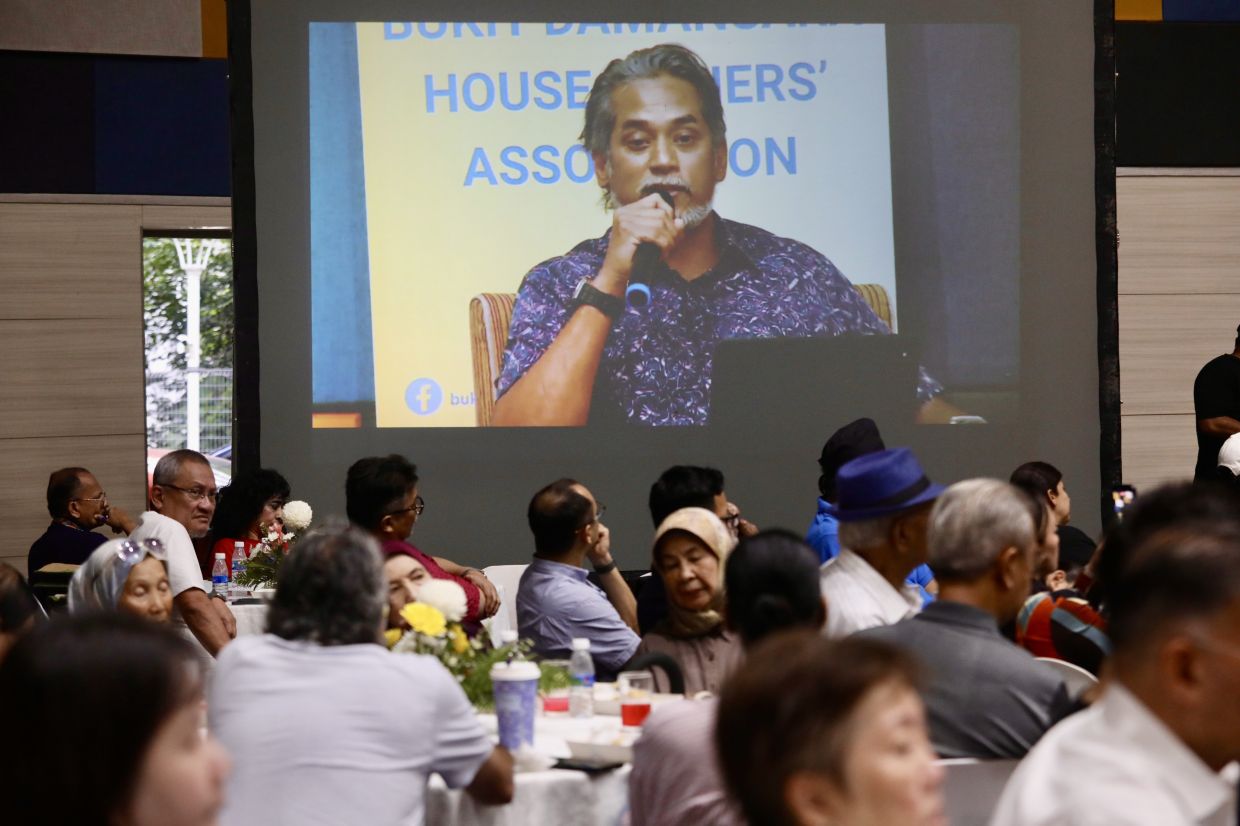
Roughly 400 residents of Bukit Damansara converged on Pusat Komuniti Bukit Damansara for a three-hour town hall session where they pressed Kuala Lumpur City Hall to rescind a building permit for a semi-detached property undergoing renovation to add an additional floor. The gathering, held under the theme "Your Voice Matters," marked the first major community dialogue since Khairy Jamaluddin assumed the presidency of the Bukit Damansara Home Owners' Association in early August, and it underscored the depth of resident frustration over what many view as an inadequate consultation process preceding the approval.
The focal point of resident discontent centred on a construction project that transforms a traditional double-storey semi-detached dwelling into a three-storey structure. Resident A. Zakki explained that the original architectural harmony of the row of semi-detached properties faces disruption through this vertical expansion, which he characterised as fundamentally at odds with the neighbourhood's established character. The approval timeline reveals a pattern of regulatory turbulence: City Hall granted initial permission in December 2025, community opposition prompted a stop-work order in January 2026, yet the project received renewed approval around June 2026 following an apparent reassessment by municipal authorities.
Zakki, representing community sentiment, indicated that a signature campaign had gathered 19 neighbouring households in formal opposition to the works. The disruption extends beyond aesthetic concerns—he documented structural damage, with construction activity triggering visible cracks in adjacent residences. As of the town hall date, the project had progressed approximately ten percent, with support pillars already erected on site. The residents' formal request to City Hall was unambiguous: withdraw the construction permit immediately and restore the neighbourhood to its previous regulatory status.
Khairy, moderating the dialogue, sat alongside Rosli Nordin, executive director of City Hall's Planning Department, and Supt Ahmad Firdaus Mustafia Kamal, deputy chief of the Brickfields police district, both present to field questions and propose solutions. Rosli acknowledged that City Hall would examine the complications residents had experienced from the renovation activities, though he did not commit to permit revocation. This measured response highlighted the tension between municipal approval authority and community expectations—a friction point increasingly common in Malaysian urban neighbourhoods where rapid development intersects with established residential districts.
Beyond the semi-detached house dispute, residents raised transportation infrastructure as a secondary grievance. Traffic congestion materialised twice daily outside SK Bukit Damansara and Stella Maris International School Damansara, specifically between 7:00 and 7:30 in the morning and again from 2:00 to 4:00 in the afternoon. The congestion, residents indicated, stemmed partly from inadequate drop-off and pick-up discipline among parents, many of whom double-parked in restricted zones. Supt Ahmad Firdaus affirmed that police operations were being conducted in response, though the frequency and consistency of such enforcement appeared inconsistent with community expectations.
Ameirul Azraie Mustadza, chairman of the school's Parent-Teacher Association, acknowledged the challenge and revealed that the school had repeatedly counselled parents on proper vehicle management. Financial constraints, he noted, prevented the association from engaging Rela security volunteers to oversee parking discipline, a shortfall that pushed responsibility toward official traffic police oversight. Ameirul expressed hope that police deployment could transition from intermittent operations on selected days to sustained daily monitoring, a structural change that would require resource reallocation within the police force.
Water infrastructure emerged as a third community concern, with residents petitioning Air Selangor to undertake comprehensive inspections of the pipeline network serving Bukit Damansara. Recent ruptures in the distribution system had prompted anxious calls for systematic renewal of aging conduits. An Air Selangor representative acknowledged awareness of the bursts and indicated that the company had formulated plans to progressively replace the deteriorating pipeline infrastructure, though specific timelines and financial commitments remained undetailed during the town hall exchange.
Khairy characterised the town hall format as instrumental in narrowing the communicative distance between residents and institutional decision-makers. He framed the forum as a mechanism through which hyperlocal grievances—which might otherwise remain diffuse and unheard—could be articulated directly to representatives holding mandate and authority. His stated commitment to expedite follow-up action and catalyse solutions reflected an emerging model in Malaysian municipal governance where elected figures and residents' associations function as intermediaries in problem-solving, translating grievance into action through institutional channels.
The Bukit Damansara situation illuminates broader patterns in Malaysian urban development governance. The renovation permit dispute demonstrates how expansion-focused municipal approvals can trigger community resistance when planning processes lack transparent stakeholder engagement. Similarly, the traffic and utilities challenges reveal how established neighbourhoods struggle to absorb contemporary pressures—school traffic volumes, aging water infrastructure—without corresponding municipal investment or coordination. For Malaysian property owners and residents in comparable mixed-age neighbourhoods across Selangor and Federal Territories, the Bukit Damansara episode underscores the importance of early community mobilisation and formal representation when development pressures emerge near residential areas.

