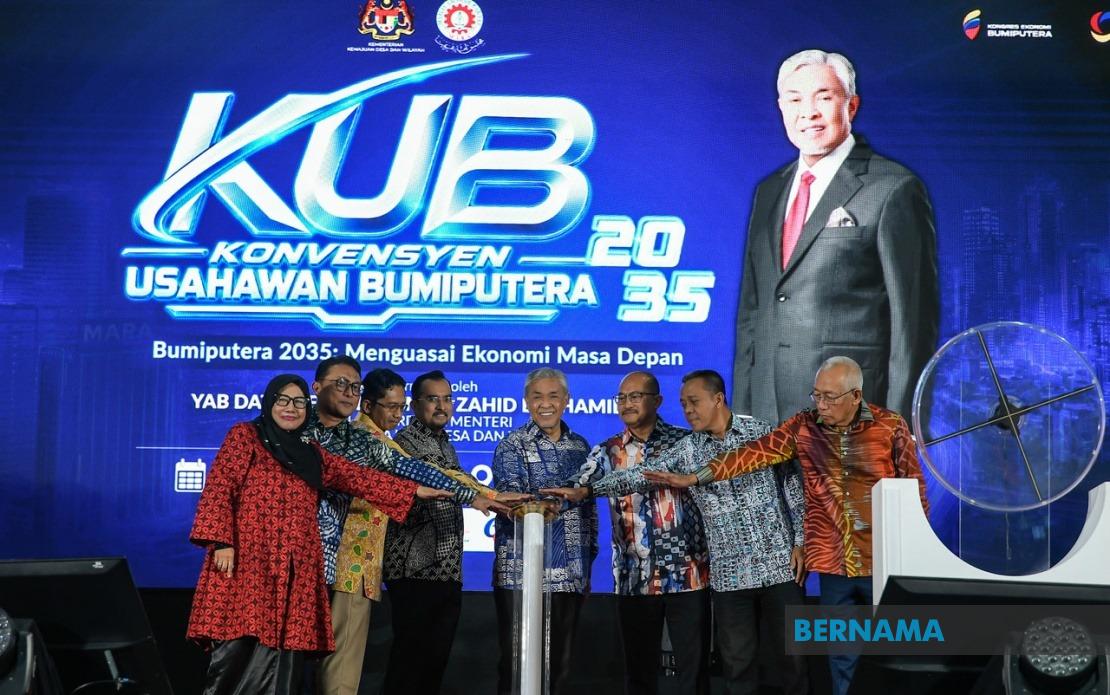
Deputy Prime Minister Datuk Seri Dr Ahmad Zahid Hamidi has issued a clarion call for Bumiputera entrepreneurs to graduate from passive participation in Malaysia's economic landscape to becoming proprietors and market leaders in their respective sectors. Addressing attendees at the closing ceremony of the Bumiputera Entrepreneurs Convention (KUB) 2035 Declaration in Alor Setar, Ahmad Zahid articulated a strategic shift in how the nation should approach indigenous business development, emphasizing that the time has come to move decisively from building mere participation to constructing genuine ownership and control.
The Deputy Prime Minister, who also holds the portfolio of Rural and Regional Development Minister, acknowledged the foundational work undertaken over preceding years to integrate Bumiputera businesses into Malaysia's economic structures. However, he contended that this participatory phase, while necessary, must now give way to a more ambitious agenda where Bumiputera entrepreneurs possess substantive ownership stakes, command larger market share, and exercise meaningful influence over the industries in which they operate. This philosophical reorientation represents a significant departure from incremental inclusion policies towards transformative wealth creation and economic empowerment.
Ahmad Zahid underscored that while government would continue furnishing opportunities and constructing supportive infrastructure, entrepreneurs themselves must demonstrate the fortitude to expand their ventures, embrace competitive challenges, and generate measurable economic value. This emphasis on mutual responsibility signals that the era of sheltered participation is drawing to a close, replaced by expectations of entrepreneurial dynamism and market competitiveness. The government's role would evolve from protective guardian to facilitator and ecosystem builder, creating conditions for private-sector led growth rather than sustaining dependency on preferential treatment.
Central to Ahmad Zahid's vision for Bumiputera entrepreneurship by 2035 is a fundamental restructuring of the support ecosystem currently fragmented across multiple agencies and channels. He identified integration of the support architecture as the first critical pillar, acknowledging that entrepreneurs presently navigate a labyrinthine system where financing, skills development, and market access opportunities operate through disconnected pathways. This fragmentation imposes unnecessary transaction costs on business operators and dilutes the efficacy of government interventions. By consolidating these services into a coherent framework, entrepreneurs would access capital, training, and commercial networks through streamlined mechanisms, enhancing overall productivity and reducing administrative friction.
The second transformational shift Ahmad Zahid advocated involves reorienting government support from the wholesale production of entrepreneurs towards the deliberate cultivation and acceleration of existing entrepreneurs. Rather than proliferating shallow training programmes generating nominal business registrations with minimal viability, the amended approach would concentrate resources on nurturing enterprises with genuine growth potential, providing intensive mentorship, capital injections, and market connections. This calibrated strategy reflects international best practices emphasizing quality over quantity and acknowledging that sustainable entrepreneurial ecosystems require sustained engagement with serious business operators throughout their developmental trajectory.
Thirdly, Ahmad Zahid stressed that national economic expansion must be accompanied by corresponding strengthening of locally-owned companies, particularly those led by Bumiputera proprietors. This represents an implicit critique of patterns wherein foreign firms capture disproportionate value while domestic enterprises remain confined to secondary roles. By consciously linking macroeconomic growth to Bumiputera business advancement, Malaysia could engineer a more inclusive and equitable development model where wealth accumulation becomes distributed across indigenous business communities rather than concentrated among multinational corporations and foreign investors.
The implications of Ahmad Zahid's pronouncements extend beyond rhetorical repositioning to potentially reshape how government allocates resources, structures incentives, and evaluates success metrics for Bumiputera business development programmes. A transition towards ownership and scale-up mentality would necessitate expanding access to equity financing, venture capital mechanisms, and longer-term patient capital instruments that facilitate business expansion. Procurement policies might be recalibrated to favour larger Bumiputera enterprises capable of meeting government supply chain requirements, thereby creating guaranteed revenue streams supporting organizational growth.
For Malaysian entrepreneurs and investors monitoring policy direction, Ahmad Zahid's remarks suggest shifting emphasis towards companies demonstrating scalability and competitive capability rather than those relying predominantly on affirmative action mechanisms. This recalibration could reshape business strategy across the Bumiputera entrepreneurial landscape, encouraging greater innovation, efficiency, and market-responsive positioning. Industries characterized by high entry barriers and capital intensity might witness increased Bumiputera participation as government facilitates ownership consolidation through institutional mechanisms.
The Deputy Prime Minister's framing also carries implications for regional competitiveness. As Southeast Asian economies increasingly integrate through trade arrangements and investment flows, Malaysian Bumiputera enterprises must develop capabilities enabling them to compete effectively beyond domestic markets. An ecosystem emphasizing scale and ownership would presumably equip local businesses with organizational maturity, financial resources, and operational sophistication necessary for regional market participation, potentially enhancing Malaysia's competitive positioning within ASEAN economic structures.
Implementing the three-pillar strategy Ahmad Zahid outlined would require substantial coordination across government ministries, agencies, and private-sector stakeholders. Success hinges upon translating aspirational policy statements into concrete institutional reforms, budgetary commitments, and measurable performance indicators. The Bumiputera Entrepreneurs Convention 2035 Declaration presumably encapsulates these commitments, though practical realization remains contingent upon political will, bureaucratic capacity, and sustained resource allocation throughout the coming decade.
Moving forward, stakeholders will monitor whether government demonstrates genuine commitment to ecosystem integration or whether fragmented support systems persist. Similarly, tracking Bumiputera business growth trajectories, ownership concentration, and sectoral representation would provide empirical measures of programme effectiveness. Ahmad Zahid's pronouncements establish clear philosophical direction, but the challenging task of institutional transformation and sustainable business development acceleration remains ahead.

