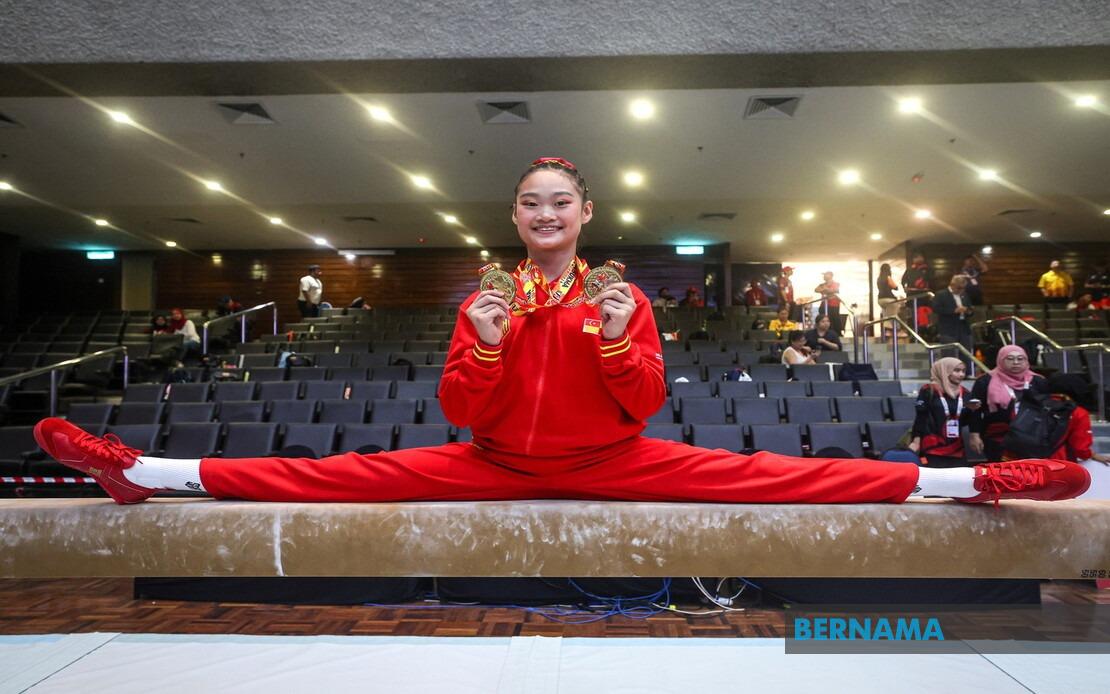
The host state of Selangor has asserted its dominance in artistic gymnastics at the Malaysia Games (SUKMA) 2026, with 17-year-old Cadence Teh Zi Qi delivering a commanding performance at the Dewan Canselor Tun Abdul Razak (DECTAR) venue at Universiti Kebangsaan Malaysia (UKM) in Bangi. Cadence secured two gold medals on August 21, successfully defending her women's individual all-around championship while anchoring Selangor's triumph in the team competition, underscoring the state's sustained excellence in the sport.
Cadence's all-around victory came with a total score of 48.550 points, reflecting consistent performances across all four apparatus. Her vault earned 12.050 points, uneven bars contributed 11.400, balance beam yielded a strong 13.350, and floor exercise added 11.750. The scoring pattern reveals her particular strength on the balance beam, where she posted her highest marks—a strategic advantage that likely reflects months of targeted preparation for this biennial national sporting showpiece.
The competition for the all-around title extended beyond Selangor's borders, with Sarawak's Aurin Zulkarnain mounting a competitive challenge to finish in second place with 44.500 points. The bronze medal was shared between two athletes: Federal Territories' Annabelle Ho Syin Yee and Penang's Amanda Ching Lee Wern, both recording identical scores of 42.250 points. This distribution of medals across multiple states reflects the growing competitive depth in Malaysian women's gymnastics, though Selangor's performance clearly separated the top performer from her rivals.
Beyond her individual accolade, Cadence's contribution proved pivotal to Selangor's team gold medal, which requires coordination among multiple athletes across the same apparatus. She combined with teammates Nicole Wong Ziyi, Airisha Zuraidi, Wong Zi Qi, Leong Yee Shean, and Haifa Izzazi Mohd Faizul to accumulate a commanding team total of 169.300 points. This substantial margin over competitors demonstrates the depth of Selangor's gymnastics programme and suggests that the state's investment in athlete development is yielding measurable returns across both individual and collective performances.
Federal Territories secured the team silver medal with 166.300 points, trailing Selangor by three points—a gap that underscores the competitive nature of the event while highlighting how individual performances compound into team outcomes. Johor's bronze medal finish with 157.000 points completes the podium, indicating that the nation's gymnastics talent remains concentrated among a handful of state programmes. The relatively large point spread between the top-three teams suggests that institutional support, coaching infrastructure, and access to training facilities remain unequally distributed across Malaysian states.
Cadence's post-competition interview revealed the psychological challenges inherent in elite gymnastics competition, providing insight into the mental demands that accompany physical skill development. She recounted beginning the all-around competition on uneven bars, where initial nervousness manifested in reduced bodily awareness and culminated in a fall. Her candid acknowledgment of this setback—rather than glossing over it—demonstrates mature self-reflection uncommon in athletes of her age. However, her ability to refocus and elevate her performance on subsequent apparatus illustrated the mental resilience required for top-tier competition.
The gymnast's recovery trajectory through the remaining apparatus was marked by progressive improvement, particularly on balance beam where she achieved her highest apparatus score. She described her floor exercise performance as meeting expectations, suggesting she had managed that event according to pre-competition planning. Notably, she disclosed that she had deliberately reduced the difficulty of her vault routine to execute a Tsukahara pike rather than an intended more complex variant—a strategic decision that prioritised securing points through successful execution over maximising difficulty with higher risk.
Cadence's comments regarding her balance beam routine carry particular significance for Malaysian gymnastics' international ambitions. She indicated that she had elevated the difficulty of her balance beam content to the level she intends to perform at the 2026 Asian Games, suggesting that SUKMA 2026 served partly as a testing ground for more challenging elements destined for continental competition. This forward-looking preparation strategy indicates that her coaching team is calibrating her development toward specific international targets, moving beyond simply winning domestic medals toward competitive positioning at the Asian level.
Looking ahead to apparatus finals, Cadence identified technical and psychological dimensions requiring further refinement. She acknowledged that managing competition nerves and sustaining focus throughout multi-apparatus competition remain ongoing developmental areas. The fact that a two-time all-around champion competing at the national level still actively works on nerve control illustrates the perpetual psychological challenge of gymnastics at any level. Such transparency about areas for improvement contrasts with narratives that present elite performance as seamless, offering Malaysian audiences a more realistic understanding of athletic development as an incremental process.
Cadence's competition schedule extends across three apparatus finals scheduled for the following two days, during which she will pursue additional medals in uneven bars, balance beam, and floor exercise. The staggered finals format allows individual athletes to feature across multiple medal opportunities, potentially extending Selangor's medal tally in artistic gymnastics. Given her dominant all-around performance and the margin by which she defeated her nearest rival, Cadence enters the apparatus finals as the clear favourite in each event, particularly on balance beam where her 13.350 score significantly exceeded competitors' totals on that apparatus.
The sporting narrative surrounding Cadence Teh and Selangor's gymnastics programme reflects broader patterns in Malaysian elite sports development, where certain states and specific sports disciplines receive disproportionate institutional support and achieve consistent medal success at national games. The sustainability of Selangor's dominance in gymnastics—demonstrated through both individual champions and competitive team compositions—depends on continued investment in coaching development, athlete identification, and training infrastructure. As Malaysia considers its strategic positioning ahead of the 2026 Asian Games, performances like Cadence's suggest that gymnastics remains a sport where focused state-level investment can yield competitive outcomes that reflect positively on Malaysia's sporting capability within the region.

