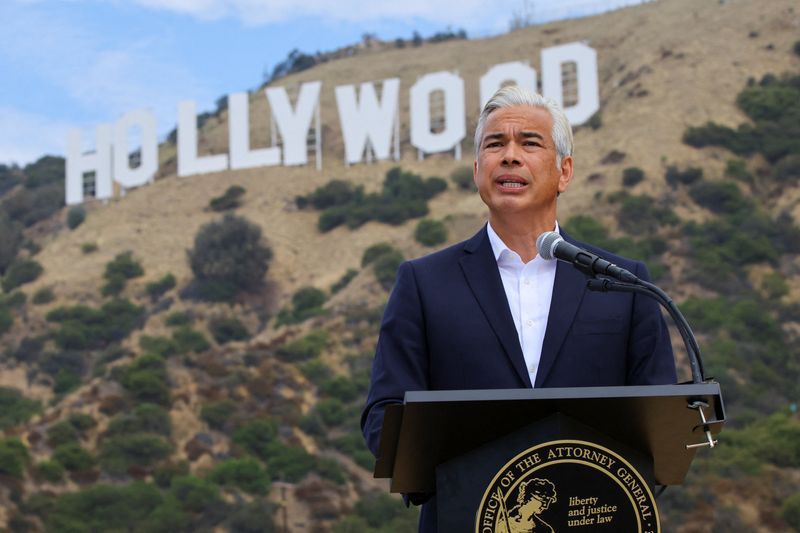
California and eleven other American states have initiated legal action to block Paramount's proposed $110 billion acquisition of Warner Bros Discovery, contending that the transaction would consolidate too much power in a single entertainment conglomerate and ultimately harm consumers and workers across the industry. The lawsuit, filed in Oakland federal court, directly challenges the strategic vision of Paramount CEO David Ellison to position his company as a formidable competitor against entertainment giants Netflix and Disney. The legal challenge represents a significant complication for what many expected to be a straightforward corporate transaction following the US Department of Justice's clearance last month.
The twelve states—California, Arizona, Colorado, Connecticut, Massachusetts, Minnesota, Nevada, New Jersey, New Mexico, New York, Oregon, and Washington—argue that the merged entity would wield unprecedented control over film distribution and television programming. According to their filing, the combined company would capture more than 25 cents of every dollar generated by wide-release theatrical films and basic cable channels in the United States, creating what they characterise as a media behemoth with pricing power that could fundamentally reshape the entertainment landscape. This concentration of market control, the states contend, would ripple through multiple sectors of the economy, affecting not only moviegoers and television subscribers but also theatre operators, cable providers, and thousands of entertainment industry workers.
The attack on the Paramount-Warner Bros Discovery merger reflects broader concerns within the entertainment ecosystem. Theatre owners have expressed anxiety that reduced competition between the two studios would result in fewer film releases and potentially more aggressive licensing terms. Hollywood workers, including writers, actors, and crew members, fear that post-merger consolidation would accelerate job losses as the combined entity eliminates redundancies across operations. Cable subscribers worry about price increases for channels including CNN, MTV, HGTV, Cartoon Network, and Nickelodeon, which collectively represent significant portions of basic cable offerings across the continent.
Paramount counters that the states have misunderstood both antitrust law and competitive dynamics within the entertainment sector. The company's leadership, particularly Ellison, has committed to maintaining robust film production, pledging that the merged studios would release thirty theatrical films annually and invest heavily in content creation rather than slashing output. The company further argues that eliminating approximately six billion dollars in redundant infrastructure, marketing, and administrative functions would create operational efficiency and enable greater investment in the creative content that audiences demand. These efficiency gains, Paramount suggests, would ultimately benefit consumers through improved programming and reduced costs.
The lawsuit carries unmistakable political dimensions that merit examination. All twelve state attorneys general pursuing the case are Democrats, while the DOJ's approval of the merger came under the Trump administration. Critics have observed that billionaire Larry Ellison, Paramount CEO David Ellison's father and Oracle co-founder, has developed close political relationships with Republican President Donald Trump, raising questions about whether such connections influenced federal regulatory approval. California Attorney General Rob Bonta, who is leading the coalition, explicitly characterised the Trump administration as pro-business consolidation and cited multiple major antitrust cases that the DOJ has settled rather than litigated aggressively.
Yet the politicisation of antitrust enforcement extends beyond party lines. Several Republican state attorneys general have joined Democratic-led challenges in other significant merger cases, including challenges to Live Nation's ticketing dominance and Nexstar's acquisition of broadcaster Tegna, suggesting that concerns about corporate consolidation transcend traditional political boundaries. Bonta pointedly noted during a Monday press conference that Republican colleagues had not joined this particular challenge, leaving the door open for additional states to file supporting legal actions even at this late stage of the process.
Antitrust enforcement has increasingly become a vehicle through which political leaders at both state and federal levels attempt to channel public frustration with rising living costs and declining consumer welfare. The Paramount case exemplifies this trend, allowing state attorneys general to demonstrate responsiveness to constituent concerns about big business power while pursuing a legitimate regulatory agenda. For Democratic-led states in particular, merger challenges have become a meaningful way to express opposition to the Trump administration's regulatory posture without awaiting federal action, effectively creating a parallel antitrust enforcement mechanism at the state level.
The states have quantified their concerns with specific market share figures. The combined entity would control 27 percent of the overall film distribution market, 30 percent of blockbuster film distribution specifically, and 27 percent of basic cable channels. These percentages, while not automatically determinative under antitrust law, provide a concrete foundation for arguing that post-merger competition would be substantially reduced. Without continued competition between Paramount and Warner Bros Discovery for premium theatrical release dates and screens across thousands of American cinemas, the states argue that both theatres and moviegoers face inevitable pressure toward price increases and potentially reduced content quality.
The financial stakes for all parties involved are substantial and create urgency around the lawsuit's resolution. Paramount has committed to paying approximately 650 million dollars in termination fees to Warner Bros Discovery shareholders for each quarter the transaction remains unclosed beyond October, transforming any significant legal delay into a direct financial cost for the acquirer. A detailed review of comparable merger litigation by Reuters found that recent federal cases require an average of eight months for judicial determination, suggesting that Paramount faces the prospect of accumulating multiple quarterly payments while regulatory uncertainty persists. Beyond these immediate financial pressures, prolonged litigation could force Paramount to renegotiate financing arrangements, create sustained stock price volatility, and potentially render the entire transaction economically unviable.
Paramount's stock market response to the lawsuit filing provided an unexpected reaction. Rather than declining, Paramount shares gained 2.9 percent following the news, while Warner Bros Discovery shares rose 2.6 percent, suggesting that investors may view the litigation as creating opportunities for deal restructuring or alternative arrangements rather than outright failure. Industry analyst Paolo Pescatore of PP Foresight characterised the state lawsuit as the most credible threat yet to the transaction's completion, noting that even if Paramount ultimately prevails in court, the costs and delays associated with prolonged litigation would impose substantial economic consequences on both companies regardless of the final outcome.
The implications of this case extend well beyond the commercial interests of Paramount and Warner Bros Discovery. For Southeast Asian media and entertainment companies considering American expansion or partnerships with major Hollywood studios, the lawsuit demonstrates that significant regulatory complexity and political risk now accompany major entertainment sector consolidation in the United States. Malaysian media companies in particular, operating in a different regulatory environment and with varying political dynamics, should monitor how American states assert independent antitrust authority and use regulatory tools to counter federal clearances. The case also illustrates how entertainment industry consolidation drives broader economic concerns around employment, consumer pricing, and small business viability—considerations that resonate across borders as streaming and media companies increasingly operate as global entities subject to scrutiny in multiple jurisdictions.
The lawsuit's ultimate resolution will significantly shape the feasibility of large-scale entertainment sector consolidation for years to come. If the states succeed in blocking or substantially reshaping the Paramount-Warner Bros Discovery transaction, other pending and prospective mergers would face heightened scrutiny and potentially face simultaneous legal challenges across multiple state jurisdictions. Conversely, if Paramount prevails despite the legal challenge, the outcome would reinforce that federal regulatory approval provides a durable shield against state-level antitrust action, though the costs and delays of defending against coordinated state litigation would remain substantial. The case will ultimately reveal whether states have emerged as effective counterweights to federal regulatory decisions and whether antitrust enforcement will continue its evolution toward explicitly political instrument.

