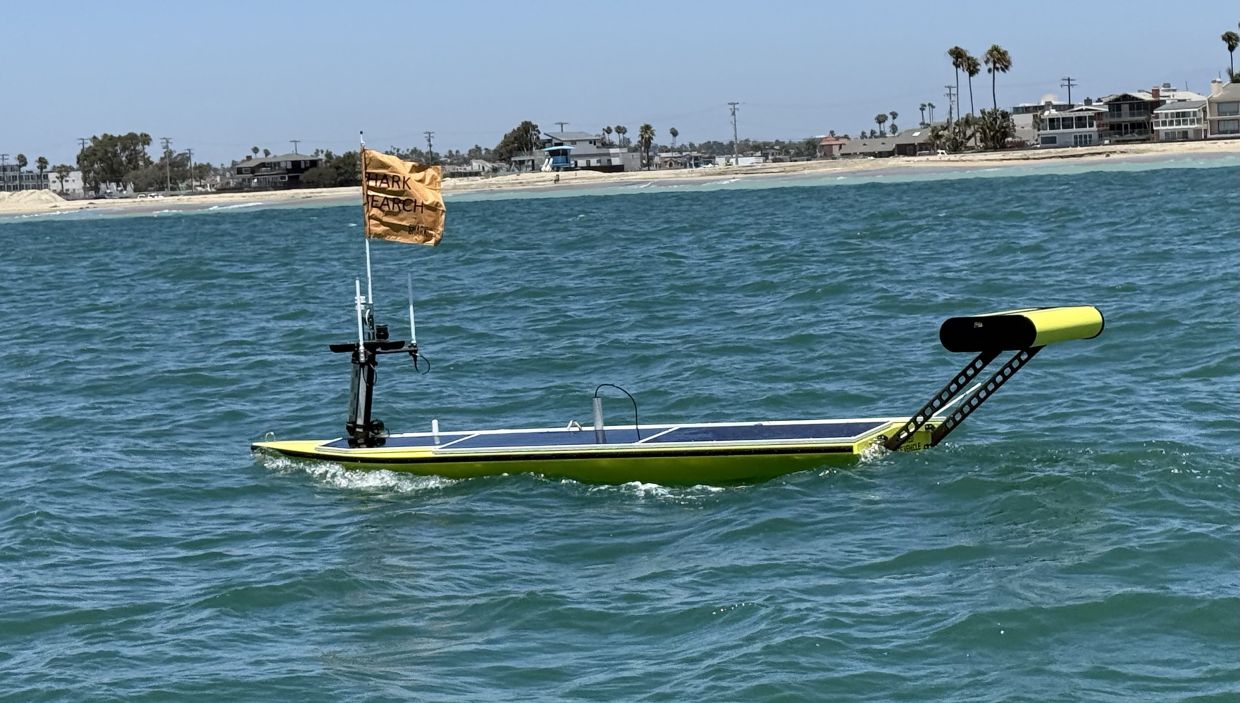
Researchers at California State University Long Beach have begun field testing an innovative unmanned surveillance system designed to detect great white sharks in coastal waters. The prototype vessel, measuring approximately three metres in length and one metre in width, represents a significant advancement in marine safety monitoring and has already conducted initial operations in Southern California waters. The technology combines multiple detection methods to provide real-time information about shark presence, addressing growing public concern following several high-profile incidents in recent years.
The semi-autonomous craft operates by patrolling near beaches for extended periods of up to seven days, using specialised acoustic receivers to detect great white sharks that researchers have previously tagged with transmitters. The vessel also incorporates onboard camera systems and will soon integrate a drone capable of capturing live 360-degree aerial footage, with data transmitted directly to lifeguards and marine biologists stationed on shore. According to Chris Lowe, professor of marine biology and director of the Shark Lab at CSU Long Beach, the system functions with minimal human intervention once programmed, allowing either lifeguards or lab-based operators to direct its movements across designated patrol zones.
Scientists at the Monterey Bay Aquarium Research Institute are developing complementary technology that would enable the craft to detect environmental DNA shed by sharks through skin cells, mucous and metabolic waste. This emerging capability represents a potential breakthrough in identifying shark presence without requiring direct visual confirmation or pre-tagged individuals. The eDNA approach has already proven effective in other marine research applications, including monitoring endangered salmon populations in rivers and tracking invasive species in freshwater systems, though researchers acknowledge significant limitations related to water movement and DNA degradation rates.
While shark attacks generate substantial media attention and public anxiety, the statistical reality remains starkly different from public perception. California has recorded 236 shark attacks since 1950, resulting in only 17 fatalities across seven decades. San Diego County accounts for the highest number with 27 incidents, followed by San Mateo County with 22 and Santa Barbara County with 21. Despite millions of Californians swimming, surfing and diving annually in ocean waters where sharks regularly patrol, unprovoked attacks remain extraordinarily rare events. Recent drone footage and acoustic tagging data reveal that sharks routinely swim near swimmers and surfers without incident, a phenomenon occurring virtually every day in California's coastal zones.
Recent fatal attacks have nonetheless intensified public concern and justified the surveillance initiative. In December, Erica Fox, a 55-year-old resident of Pebble Beach, was fatally attacked while swimming off Lovers Point in Pacifica, Monterey County. Autopsy findings indicated she sustained a single bite from an estimated 16-foot great white shark. This incident followed earlier incidents in the same area, including a serious non-fatal attack on Steve Bruemmer, another member of Fox's swimming club, the Kelp Krawlers, during June 2022. Prior to Fox's death, the region's last fatal attack occurred on 9 May 2020, when Ben Kelly, a 26-year-old surfer, was bitten off Manresa State Beach by a 10 to 12-foot shark, with the bite severing an artery in his leg.
The apparent increase in incidents reflects both changing shark behaviour and expanded human ocean use rather than a fundamental escalation in danger. Great white sharks primarily consume seals and sea lions as adult predators, while juveniles feed on fish, squid and rays. Marine biologists theorise that most human bites result from mistaken identity, with sharks briefly confusing people with their natural prey species. Lowe emphasises that humans lack the necessary characteristics to appeal to shark predation instincts—people neither smell, appear nor sound like seal or sea lion prey. Consequently, dozens of undetected shark-human encounters likely occur weekly throughout California's waters without any aggressive contact.
The surveillance system carries important implications for international sporting events and coastal management strategies. Lowe anticipates completing the device by 2028, coinciding with the Los Angeles Olympic Games, when triathletes will compete in Long Beach Harbor, a location known to attract great white sharks. The technology's primary purpose extends beyond threat elimination; rather, it aims to provide substantive information enabling informed decision-making by ocean users. Lowe emphasises that the initiative seeks not to create panic through shark warnings but to empower swimmers, surfers and divers with knowledge comparable to safety signage at Yellowstone National Park regarding bison proximity.
The project has garnered support from Stanford University's Barbara Block, a leading great white shark researcher, who characterises the initiative as representing significant progress in marine surveillance capabilities. Block notes that juvenile white sharks, which inhabit shallower waters closer to beaches, do not attack humans, contradicting assumptions about shallow-water danger. She acknowledges both advantages and constraints in eDNA technology, particularly regarding temporal uncertainty—genetic material persists in water for up to 72 hours before degradation, meaning positive detections cannot definitively determine whether a shark remains present or passed through days earlier. Real-time acoustic tagging and drone surveillance therefore provide superior information accuracy for immediate safety assessments.
The broader technological foundation underlying the shark surveillance system draws upon established marine research methods that have been individually deployed for years. Jim Birch, a scientist at MBARI, notes that the integration of these tools into a single autonomous platform represents the novel contribution. The eDNA technology has demonstrated utility beyond shark monitoring, identifying harmful algae blooms and tracking species distribution patterns between San Francisco and Alaska's Aleutian Islands. This broader applicability demonstrates the system's potential for comprehensive marine ecosystem monitoring and climate change impact assessment across multiple species and environmental indicators.
The project has received US$300,000 in funding from the Seaver Institute, a Los Angeles-based private philanthropic foundation established in 1955 by Frank Roger Seaver, a San Jose-born attorney and oil drilling equipment company owner who became a significant donor to educational and nonprofit institutions. Additional support comes from the New York University Center for Robotics, enabling collaborative development of advanced robotic systems. Researchers propose expanding surveillance deployment across Southern California locations including Santa Monica Bay and Huntington Beach, with sufficient funding potentially enabling expansion to Central and Northern California marine waters.
For Malaysian and Southeast Asian readers, this development offers important lessons regarding coastal safety management, public communication about wildlife risk, and technological applications for marine ecosystem monitoring. Tropical waters throughout Southeast Asia support diverse shark species, and similar surveillance approaches could inform regional beach safety protocols. The research demonstrates how technological innovation can transform risk perception by replacing speculation with evidence-based information, enabling coastal communities to coexist with marine predators through informed rather than reactive management strategies. The project ultimately illustrates how scientific advancement serves public welfare not through eliminating natural wildlife presence but through expanding human understanding of shared marine environments.

