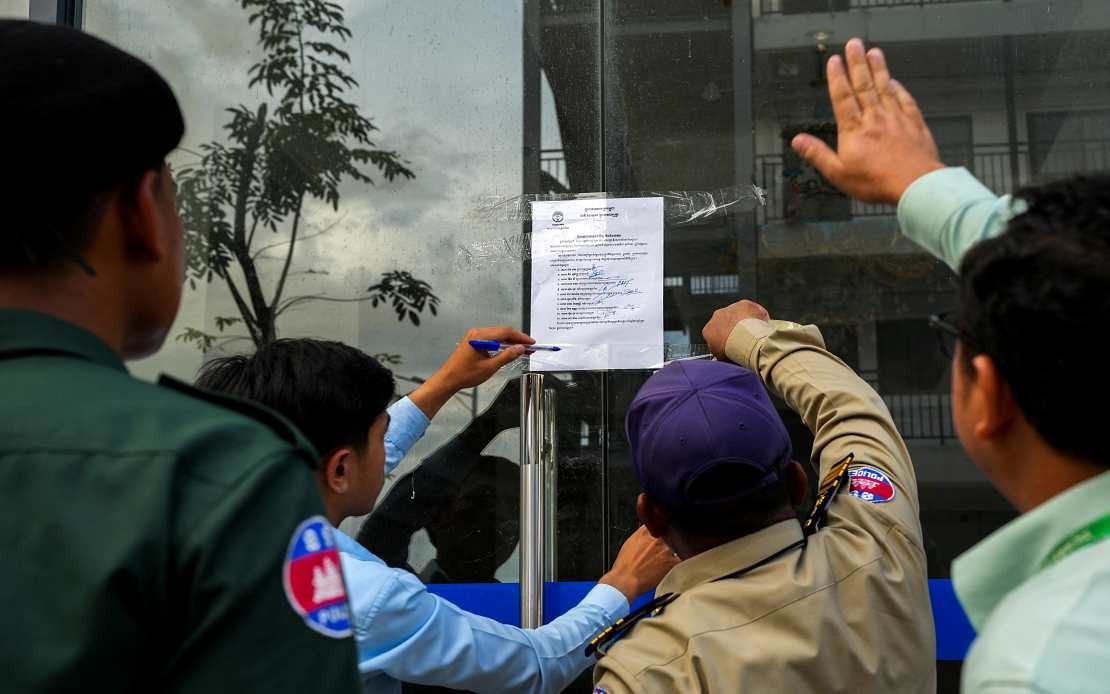
Cambodia has intensified its campaign against transnational cybercrime by expelling over 16,000 foreign nationals suspected of involvement in online fraud schemes during the first half of 2026. The mass deportation, part of an aggressive enforcement push that has seen more than 45,000 foreigners removed from the country since January, signals the government's commitment to dismantling sophisticated scam operations that have proliferated across Southeast Asia and drawn international scrutiny.
Police Lieutenant General Sok Veasna, who heads Cambodia's General Department of Immigration, disclosed the figures at a mid-year review meeting, emphasising that the deportation drive represents a significant escalation in the kingdom's fight against organised cybercrime. The scale of the operation reflects mounting pressure on Cambodian authorities to address a problem that has tarnished the nation's global standing and complicated its diplomatic relationships, particularly with major trading partners and neighbouring countries affected by fraud schemes originating from Cambodian territory.
All individuals deported under this initiative face permanent entry bans to Cambodia, a measure designed to prevent repeat offenders from re-establishing criminal networks. This blanket prohibition underscores the seriousness with which Phnom Penh is treating the issue, though implementation and enforcement of such measures across borders remain challenging in practice. The approach reflects a hardline stance aimed at signalling zero tolerance for foreign criminal elements exploiting Cambodia's relative institutional vulnerabilities.
However, analysts caution that while mass deportations address the visible problem, they constitute only a surface-level response to deeply entrenched criminal infrastructure. Thong Mengdavid, a senior researcher at the China-ASEAN Studies Centre of the Cambodia University of Technology and Science, has characterised the expulsions as a necessary but insufficient intervention. He argues that dismantling the international scam networks requires targeting the senior architects and financial beneficiaries who orchestrate these operations, many of whom maintain protected status through corruption within Cambodia's institutional machinery.
The persistence of human trafficking networks that funnel foreign nationals into scam factories, coupled with endemic corruption within local enforcement and administrative systems, represents the foundational challenge underlying Cambodia's cybercrime epidemic. These systemic vulnerabilities enable criminal syndicates to operate with relative impunity despite heightened official scrutiny. Without addressing the complicity and protection offered by corrupted officials at various government levels, experts contend that displaced scammers will simply relocate to other jurisdictions in the region rather than abandon their lucrative operations entirely.
Cambodia's legislative response has paralleled its enforcement actions. In April 2026, the kingdom enacted the Law on Combating Online Scams, establishing severe penalties for ringleaders and senior operatives involved in online fraud. The legislation represents a pivotal moment in Cambodia's effort to demonstrate to international partners that it possesses adequate legal mechanisms to prosecute cybercriminals and dismantle criminal organisations. Whether such laws will be applied consistently and rigorously, particularly against well-connected individuals, remains an open question within observer communities.
The broader context involves widespread complaints from neighbouring countries, including Malaysia, Thailand, and Vietnam, whose citizens have fallen victim to elaborate romance scams, investment frauds, and impersonation schemes allegedly coordinated from Cambodian territory. These transnational crimes have generated diplomatic friction and demands for stronger Cambodian action. The visible deportations respond directly to such international pressure while attempting to rehabilitate Cambodia's image as a responsible regional actor serious about tackling organised crime.
For Malaysian readers, the significance extends beyond abstract regional cooperation. Malaysian citizens and businesses have suffered considerable financial losses to Cambodian-based scam networks, and Malaysia's own law enforcement agencies have coordinated with Cambodian counterparts on investigation and prosecution efforts. Cambodia's deportation campaign creates opportunities for enhanced bilateral cooperation while also highlighting the importance of domestic vigilance against sophisticated fraud schemes that increasingly target Malaysian consumers and investors through digital channels.
The implementation of Cambodia's crackdown will likely face practical obstacles. Identifying and apprehending suspected scammers, many of whom operate covertly using false documentation and frequently change locations, presents significant investigative challenges. Additionally, the sheer volume of suspects relative to Cambodia's immigration and law enforcement capacity suggests that processing and validating deportation cases requires substantial resources and sustained political commitment. The government's ability to maintain operational momentum beyond the initial enforcement surge will prove crucial in determining whether current policies achieve lasting impact.
Regional implications warrant consideration as well. Successful disruption of Cambodian-based networks may displace criminal operations to other Southeast Asian jurisdictions with weaker border controls or institutional capacity, potentially exacerbating scam problems elsewhere. Coordinated regional approaches involving Malaysia, Thailand, Vietnam, and other ASEAN members may therefore become increasingly necessary. Intelligence sharing, joint task forces, and harmonised legal standards could substantially improve enforcement effectiveness across borders and prevent the simple geographic relocation of criminal enterprises.
Looking ahead, Cambodia's authorities must balance the demonstrated commitment to deportation with genuine structural reforms addressing corruption and human trafficking. The credibility of the crackdown ultimately depends on whether high-level protectors face accountability and whether local officials facilitating scam networks encounter consequences. International observers, including Malaysian authorities engaged in counter-fraud cooperation, will monitor whether the current campaign represents sustained policy change or represents a temporary response to diplomatic pressure that fades once international attention subsides.

