Cambodia's government is making a determined push to transform its manufacturing base, moving beyond its long-standing dependence on labour-intensive garment production toward advanced industries that promise greater economic returns and technological capability. This ambition crystallised during Deputy Prime Minister Sun Chanthol's investment promotion mission to South Korea in June, where he led a high-level delegation through a series of targeted company engagements and an investment roadshow in Incheon aimed at convincing Korean manufacturers to establish operations in the Kingdom.
The timing of Cambodia's push reflects broader regional dynamics shaping Southeast Asia's industrial future. As global automotive companies accelerate their shift toward electric vehicles and digitally integrated production systems, Cambodia recognises that lagging in these sectors risks economic stagnation. By positioning itself as a location for EV component manufacturing and related high-tech industries, Cambodia hopes to participate in supply chains that are fundamentally restructuring global manufacturing rather than remaining locked into lower-margin, labour-dependent sectors that face constant pressure from competing economies.
Chanthol's visit to Daejoo KC Group exemplified this strategy. The South Korean conglomerate already operates in Cambodia through two subsidiaries: Camko Motor, which assembles Hyundai vehicles for the domestic market and manufactures automotive wire harnesses for export while employing nearly 500 workers, and Camko Infracore, which handles vehicle distribution and maintenance services. Rather than view this existing investment as sufficient, Cambodian officials encouraged Daejoo KC to expand further into sectors where the company maintains operations in South Korea, signalling that Cambodia sees established investors as gateways to deeper industrial integration.
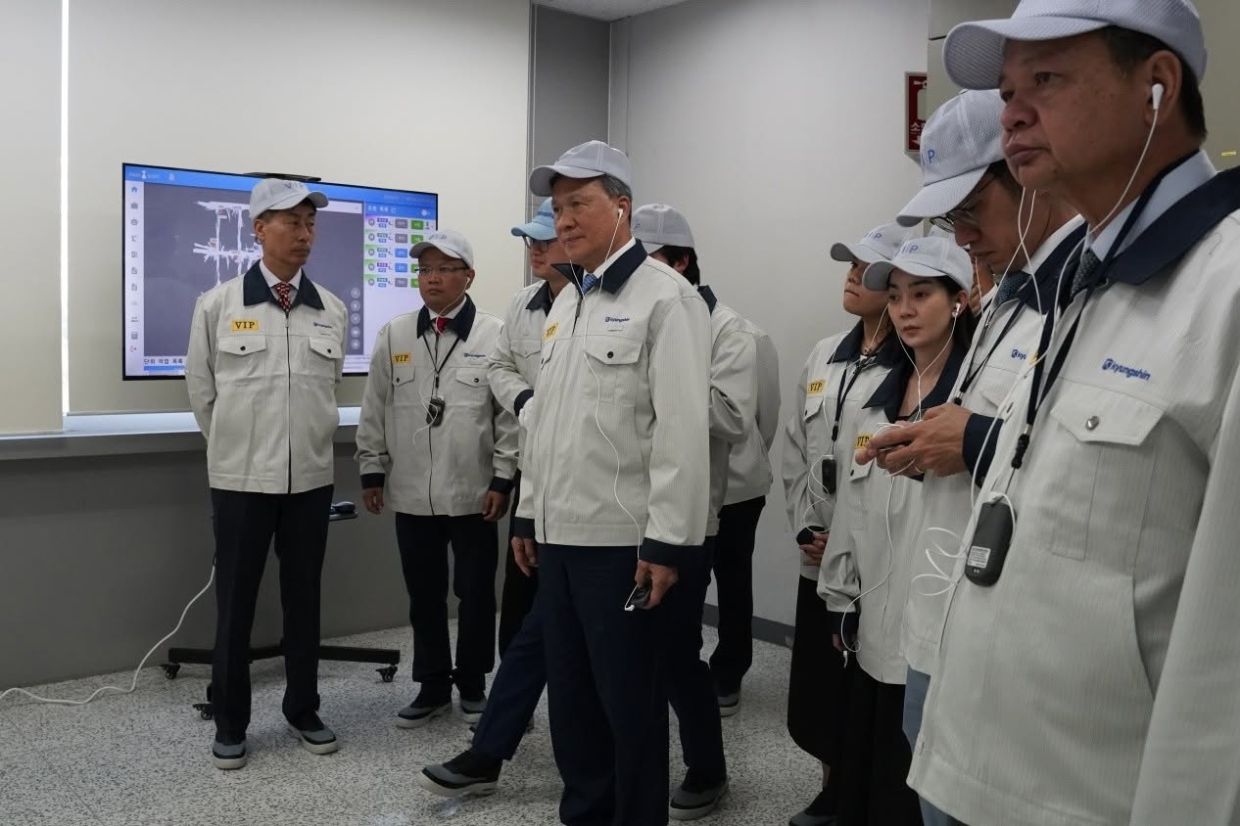
The visit to Kyungshin Co., Ltd. proved even more instructive. Founded in 1974, this leading Korean manufacturer specialises in automotive electronic components and wire harnesses essential for electric vehicles—precisely the type of advanced manufacturing Cambodia aims to cultivate. Kyungshin's existing Cambodian factory, operating since 2012 in Kandal province with approximately US$20 million in capital and 1,467 employees, demonstrates that the Kingdom can sustain complex manufacturing operations. The company's focus on EV-related electrical systems and advanced mobility technologies places it at the frontier of automotive industry transformation, offering Cambodia a tangible model for how traditional component manufacturing can evolve into technology-intensive production.
Beyond individual company visits, the broader Incheon-Cambodia Investment Roadshow, organised by the Council for the Development of Cambodia in cooperation with the Incheon Chamber of Commerce and Industry, showcased Cambodia's revised investment framework. Under Cambodia's recently reformed investment law, the government offers fiscal incentives, macroeconomic guarantees, and investor protection mechanisms designed to compete for Korean capital against neighbouring countries. For Malaysian observers, this represents a significant regional development: Cambodia's explicit ambition to capture a larger share of the automotive and EV supply chain investment that Southeast Asian nations are collectively pursuing as Chinese and developed-country manufacturers regionalise production.
The inclusion of Incheon Baek Hospital in Chanthol's itinerary revealed another dimension of Cambodia's economic diversification strategy. Rather than limiting attention to manufacturing alone, Cambodian officials emphasised healthcare technology, digital hospital systems, and medical training as priority sectors. This reflects a recognition that advanced services—particularly those involving technology transfer and knowledge exchange—can generate sustained economic value beyond factory employment. The request for technical assistance and medical specialist exchanges indicates Cambodia's willingness to develop sectors that require institutional capacity building rather than merely labour availability.
For Cambodia's policymakers, this mission addresses a fundamental challenge facing the Kingdom's economy. The garment industry, which has anchored Cambodia's export growth for decades alongside footwear and travel goods, remains crucial for employment but offers limited pathways to prosperity. Wage pressures, labour standards scrutiny, and competition from lower-cost producers elsewhere in the region have eroded the sector's competitive advantages. By contrast, automotive components, EV systems, logistics, energy, and digital healthcare represent industries where Cambodia can potentially command higher value per worker and participate in supply chains less vulnerable to simple labour-cost competition.
The diplomatic dimension of the mission—involving the Cambodian ambassador to South Korea, officials from multiple government ministries, and representation from business associations—underscores how seriously Phnom Penh treats this pivot. This is not ad hoc commercial promotion but rather coordinated state strategy, aligning diplomatic relationships, regulatory frameworks, and private-sector incentives toward a shared objective. Such alignment matters because attracting substantial Korean investment in capital-intensive sectors like automotive components or EV manufacturing requires sustained government commitment, regulatory clarity, and demonstrable political will.
For regional context, Cambodia's pursuit of South Korean automotive and technology investment mirrors similar efforts across Southeast Asia. Vietnam, Thailand, and Indonesia all compete for the same Korean manufacturing relocations and EV supply chain assignments. Cambodia's advantages rest on lower labour costs than Vietnam and Thailand, geographical proximity to major ASEAN markets, and access to the ASEAN Free Trade Area. However, these advantages are not unique, making the quality of government support and investment protection frameworks critical differentiators. Cambodia's mission thus reflects the reality that post-Covid industrial competition in Southeast Asia increasingly centres on which nations can attract high-value-add manufacturing rather than merely labour-intensive assembly.
The economic implications extend beyond immediate foreign direct investment figures. If Cambodia successfully establishes itself as a hub for EV component manufacturing and automotive electronics, it creates multiplier effects throughout the economy: demand for skilled workers drives education reform, logistics expansion creates infrastructure investments, and international companies' supply chain integration generates broader technology diffusion. These secondary effects ultimately matter more than the immediate factory investments themselves, as they build institutional capacity and human capital essential for sustained economic development.
However, Cambodia faces structural obstacles in realising this ambition. Infrastructure quality lags behind Vietnam and Thailand, electricity reliability remains inconsistent in some regions, and skilled labour availability is limited compared to more industrialised regional neighbours. Addressing these constraints requires substantial domestic investment in vocational education, electricity generation, and port modernisation—investments that depend on both public resources and international development assistance. South Korean companies considering expansion into Cambodia will evaluate these factors carefully, meaning that investment promotion missions alone, however well-orchestrated, cannot substitute for tangible improvements in Cambodia's industrial infrastructure.
The mission also reflects Cambodia's broader strategic pivot toward South Korea and away from traditional dependence on Chinese investment. While Chinese manufacturers have been crucial to Cambodia's industrialisation, Korean companies operate differently: they typically bring more advanced technology, engage more deeply with supply chain integration, and maintain higher standards in labour practices and environmental compliance. By cultivating stronger Korean investment relationships, Cambodia seeks to diversify its industrial partnerships and align itself with supply chains serving developed democracies with stringent labour and environmental standards—markets ultimately more valuable than those served by Chinese-origin manufacturers.
Looking forward, Cambodia's success in transforming its industrial base will depend on whether Phnom Penh can convert diplomatic overtures and roadshow enthusiasm into sustained investment commitments. South Korean companies will require more than promises: they need reliable power supply, skilled workers, stable regulatory environments, and efficient customs procedures. The next phase of Cambodia's strategy must therefore shift from promotional missions toward the unglamorous work of building institutional capacity, training workers, and modernising infrastructure—the foundations upon which industrial transformation ultimately rests.