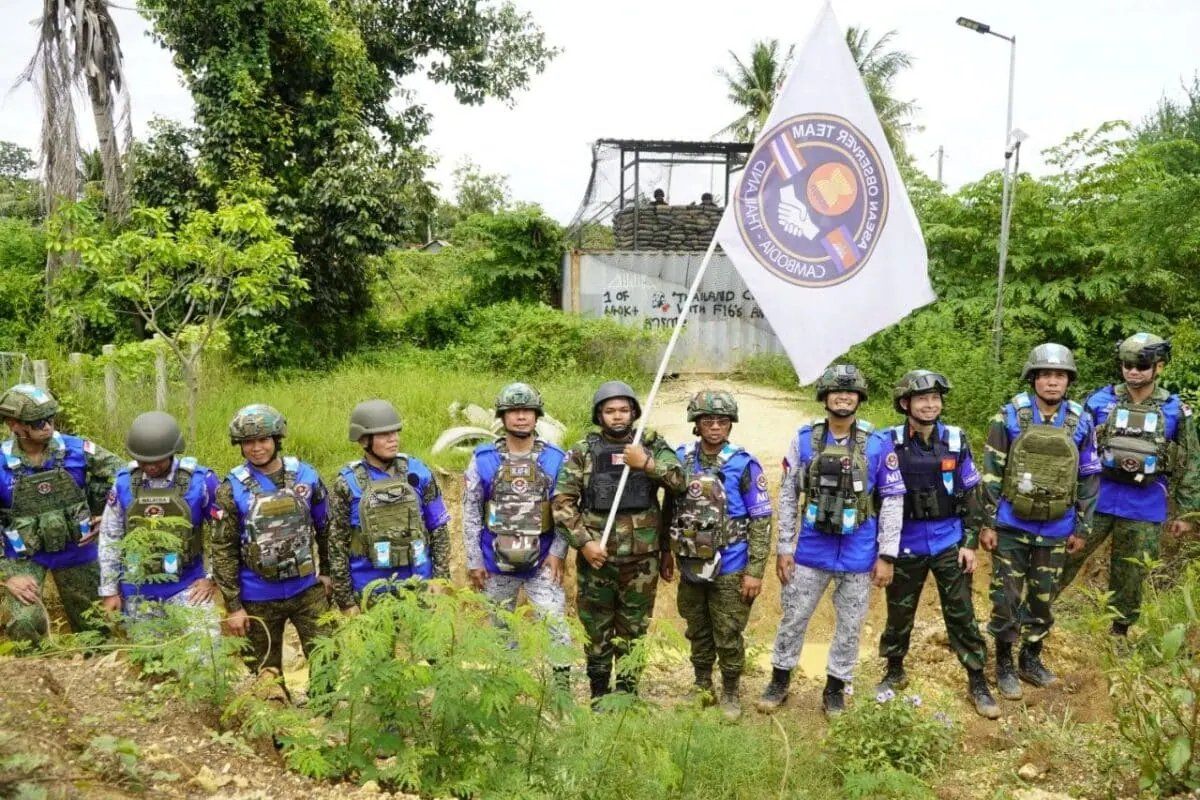
Cambodia's Information Minister Neth Pheaktra has shifted the terms of the border dispute with Thailand by emphasizing that international observers—not just Cambodian authorities—are now documenting evidence of military fortifications and physical infrastructure in contested areas. His response to Thailand's categorical rejection of territorial encroachment allegations represents a strategic pivot toward third-party verification as a way to break the deadlock between competing national narratives that has persisted for decades along one of Southeast Asia's most sensitive frontiers.
Thailand's Joint Information Center, led by Air Chief Marshal Prapas Sornchaidee, had maintained that Bangkok harbours no ambitions to occupy Cambodian territory and that its military activities serve only to protect Thai troops and civilians while securing what Thailand considers legitimate sovereign areas. Prapas acknowledged a principle that Cambodia has long championed: that boundary disputes cannot be resolved through military occupation or the establishment of facts on the ground, but rather through legal instruments including maps, historical documents and the joint boundary commission. Yet this apparent common ground masks a fundamental disagreement about which nation actually controls the disputed zones.
Pheaktra's statement reflects a calculated change in Cambodia's approach to the dispute. Rather than continuing to present allegations that Thai media largely ignores or dismisses, the Cambodian minister is now emphasizing that Asean officials, foreign diplomats and UN representatives have personally witnessed the containers, razor wire, trenches and other structures that Cambodia says constitute unauthorized Thai encroachment. This shift leverages external credibility to overcome the inherent asymmetry whereby unilateral Cambodian claims face systematic Thai denial without independent verification.
The Asean Observer Team in Cambodia, headed by a Philippine official, recently conducted inspections in Banteay Meanchey province that documented the physical situation with specificity. At Boeung Trakuon in Kouk Romiet commune, the team found 44 shipping containers distributed across 14 locations in an area where Cambodia says over 7,800 residents from nearly 1,900 families, including nearly 1,850 children, remain unable to return home. Two additional villages, Chouk Chey and Prey Chan, contained 72 more containers across 10 separate sites. Collectively, 116 containers across 24 locations now mark the frontier, creating physical barriers that Cambodia contends violate its territorial sovereignty and prevent the return of over 13,000 displaced people.
Beyond Asean's role, UN Special Rapporteur on human rights in Cambodia Tom Andrews visited the border region during a July mission and subsequently reported observations that align with Cambodia's humanitarian concerns. Andrews documented that approximately 650,000 Cambodians were displaced during the conflict and that more than 20,000 remain unable to return, with those he met attributing the obstruction to Thai security force presence. For Pheaktra, these testimonies from a UN mandate holder add institutional weight to Cambodia's claims about the humanitarian consequences of the border dispute, even though Andrews' role focuses on human rights rather than territorial sovereignty.
Yet it is crucial to recognize the limits of these third-party observations. The Asean Observer Team's mandate concerns verification of ceasefire conditions under the December 27 agreement, not determination of international boundaries. Similarly, Andrews' assessment addresses human rights and displacement rather than the legal and technical questions of where the border actually lies. Thailand could argue, and likely will, that observation of physical structures does not inherently prove Cambodian sovereignty over the areas where they stand. The fundamental disagreement remains: Cambodia contends these are Thai incursions into Cambodian territory, while Thailand maintains it is fortifying what already belongs to Thailand.
Pheaktra's rhetorical strategy employs vivid language to underscore that military infrastructure cannot substitute for legal title. "Shipping containers are not border markers. Barbed wire is not a treaty. Trenches are not boundary maps. Planting a flag is not a title deed to territory," he stated, articulating Cambodia's long-standing position that territorial disputes must be resolved through agreed frameworks rather than faits accomplis established by armed force. This argument appeals to international law principles that reject unilateral territorial acquisition through military means, particularly relevant in Southeast Asia where multiple border disputes exist.
Cambodia anchors its legal position in the Franco-Siamese treaties and conventions that historically governed Indochina, archived boundary documents, the 2000 Cambodia-Thailand Memorandum of Understanding, the 2003 Terms of Reference for their border dispute, and the Joint Border Committee process. These mechanisms represent the agreed methodology for resolving the dispute through technical analysis rather than military control. Thailand, however, has shown reluctance to advance aggressively through these channels when the status quo involves Thai military presence in contested areas—a reality that explains Cambodia's emphasis on independent observation as a way to create pressure for resolution.
The dispute also intersects with humanitarian concerns embedded in the December 27 ceasefire agreement. Point 4 of that accord explicitly provides for displaced civilians to return to their homes on their respective sides without obstruction and in conditions of safety and dignity. By tying the territorial issue to this humanitarian provision, Cambodia frames the border fortifications not merely as a sovereignty question but as an obstruction to the ceasefire agreement itself. The thousands of Cambodians unable to return home behind containers and barriers represent, in Pheaktra's framing, evidence that the post-war order remains fundamentally unsettled and unresolved.
Thailand's response indicates Prapas will not halt security measures in response to unilateral Cambodian demands, regardless of third-party observation. This stance reflects Bangkok's conviction that it must protect what it considers Thai territory and Thai military personnel, creating a spiral wherein each side's security rationale justifies actions the other side views as provocative encroachment. For Malaysian and Southeast Asian observers, the Cambodia-Thailand border dispute exemplifies how third-party verification and humanitarian concerns can highlight problems without necessarily resolving the underlying territorial disagreement, particularly when both parties maintain incompatible claims to the same land.
The role of Asean observers and UN officials in documenting border conditions may gradually build a comprehensive record that eventually pressures resolution, or it may simply document a stalemate that persists indefinitely. Cambodia's strategy of shifting focus to third-party verification acknowledges that bilateral negotiations have stalled and that external scrutiny might create leverage for progress. Yet without agreement on the legal mechanisms for boundary determination—or political will to activate the existing Cambodia-Thailand border MoU and Joint Border Committee—even clear documentation of containers and trenches may not move the dispute toward settlement. The coming months will reveal whether independent observation genuinely changes the dynamics or merely formalizes the existing impasse.

