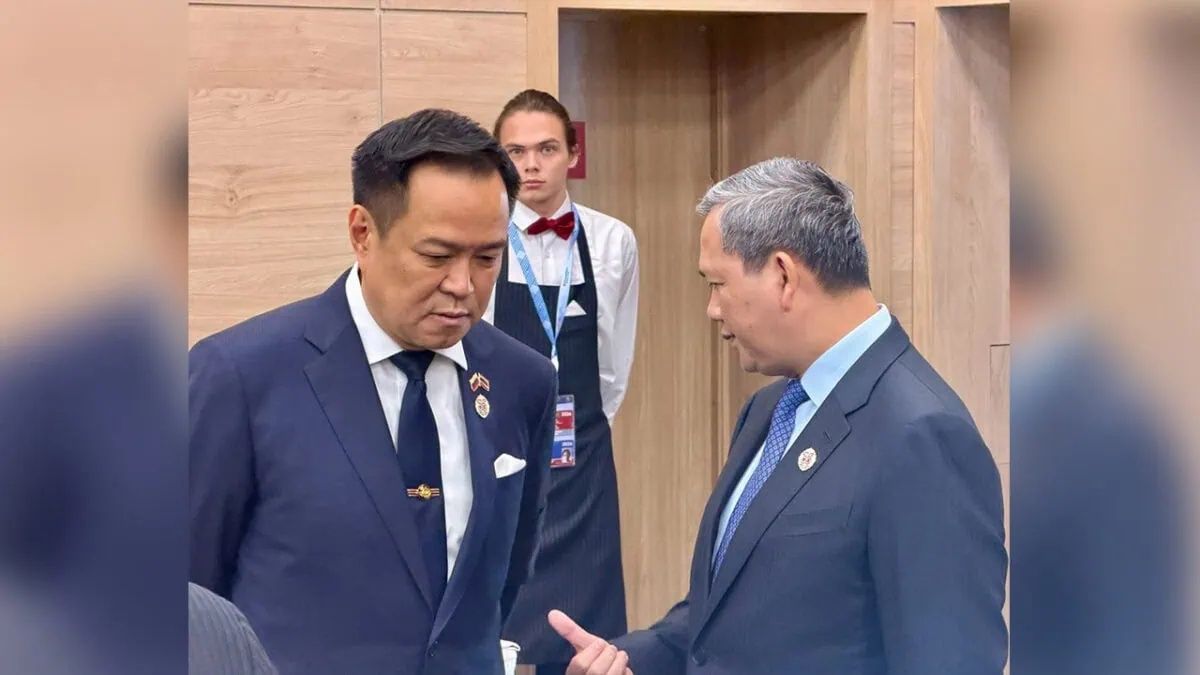
Cambodian Prime Minister Hun Manet has intensified pressure on Thailand to move forward with border demarcation by calling for Bangkok to appoint a head of its Joint Boundary Commission and resume survey work that has languished for years. Speaking after an informal encounter with Thai Prime Minister Anutin Charnvirakul on the margins of an Asean-Russia engagement in Kazan, Russia, Manet reiterated Cambodia's preference for peaceful resolution of boundary disputes while simultaneously signalling impatience with the stalled bilateral mechanism.
The two leaders' back-channel conversation, described by both sides as brief and conducted in the margins of broader diplomatic meetings, offered a window into how Cambodia and Thailand are managing one of Southeast Asia's most sensitive geopolitical issues. Manet's public comments about the exchange emphasised Cambodia's commitment to existing legal and diplomatic frameworks, while simultaneously calling on Thailand to demonstrate similar commitment by filling the vacant JBC leadership position and initiating joint demarcation work in accordance with an agreement signed in December 2025.
Cambodia's dual-track approach to border resolution reflects the complexity of maritime and terrestrial boundary claims with Thailand. For maritime disputes, Phnom Penh has invoked the compulsory conciliation process under the UN Convention on the Law of the Sea, which both nations have already entered. On land boundaries, however, Cambodia has historically preferred bilateral negotiations through the JBC and other established agreements, a position Manet reaffirmed even while expressing frustration with the slow pace of progress.
The Cambodian premier's specific reference to Point Three of the December 2025 Joint Statement indicates that concrete commitments already exist on paper for accelerating demarcation work. By publicly citing this agreement, Manet has effectively placed the onus on Thailand to demonstrate good faith by following through on obligations that both governments have already endorsed. This rhetorical move transforms what might otherwise be a routine diplomatic discussion into a public accountability measure, one that registers in both capitals and among attentive observers throughout the region.
Thai Prime Minister Anutin's account of the encounter, while confirming the substance of the conversation, adopted a more cautious tone that reflected Bangkok's domestic political sensitivities. Describing the meeting as merely "pulling each other aside by the elbow," Anutin emphasised the informal and limited nature of the discussion, suggesting Thailand wishes to avoid the impression of making major concessions or policy shifts. His reported comment that Thai people would be "furious" if border checkpoint reopening were discussed reveals how politically charged these issues remain in Thailand, where public opinion can constrain governmental flexibility.
Both leaders nevertheless publicly reaffirmed their rejection of conflict and commitment to managing border disputes through established mechanisms rather than confrontation. This convergence of messaging, despite differing emphases, suggests a shared understanding that military escalation or nationalist posturing would damage both nations and destabilise the region. For Malaysia and other Southeast Asian countries, this dialogue demonstrates that even the most contentious bilateral disputes can be channelled through legal and diplomatic pathways if both parties exercise restraint and commitment to international norms.
The timing of this exchange in Kazan carries geopolitical significance for the region. As Cambodia and Thailand navigate their boundary issues, they do so within a broader context of Asean engagement with external powers including Russia. The fact that border diplomacy continued even on the sidelines of such multilateral gatherings underscores how integral these issues remain to bilateral relations, yet also how both nations recognise the importance of managing them without allowing them to derail broader regional cooperation or damage Asean solidarity.
Cambodia's invocation of UNCLOS for maritime disputes and the JBC for terrestrial boundaries reflects a pragmatic legal strategy that separates the two categories of boundary disagreement. The maritime conciliation process, which operates under a formal UN framework, provides a structured mechanism with international oversight. The JBC, by contrast, relies on bilateral cooperation and political will to function effectively. By publicly pressing Thailand to appoint a JBC chief, Manet has identified the immediate bottleneck preventing progress on demarcation work and made it difficult for Bangkok to avoid the issue in future discussions.
The differing public statements from Phnom Penh and Bangkok also illustrate how both governments communicate simultaneously to their respective domestic audiences and to the international community. Manet's emphasis on Cambodia's commitment to peaceful resolution and legal mechanisms appeals to those concerned about regional stability, while his explicit call for Thai action addresses domestic constituencies seeking visible progress on border issues. Anutin's more measured response, meanwhile, balances Thailand's commitment to peaceful dialogue with sensitivity to public concerns about national sovereignty and territorial integrity.
For Malaysia and other ASEAN members, the Cambodia-Thailand border situation remains a watched file. These two nations account for significant regional trade and diplomatic influence, and any escalation of their dispute could complicate regional consensus-building on broader issues from the South China Sea to economic integration. The willingness of both governments to pursue peaceful mechanisms, despite historical grievances and periodic tensions, suggests that even the region's most challenging boundary questions need not become destabilising conflicts if political leadership prioritises dialogue.
The road ahead for Cambodia-Thailand border resolution likely depends heavily on Thailand's response to Manet's specific request. Appointing a JBC chief and initiating joint survey work would represent tangible progress that builds momentum toward eventual demarcation. Conversely, further delays would intensify Cambodian frustration and potentially push Phnom Penh toward greater reliance on international mechanisms like UNCLOS conciliation. The Kazan conversation therefore serves as both a reaffirmation of commitment to peaceful resolution and a subtle pressure point marking the limits of Cambodian patience with stalled bilateral processes.
As border disputes continue to occupy diplomatic attention across Southeast Asia, the Cambodia-Thailand engagement offers an instructive case study in how nations can manage profound disagreements through institutional channels. The existence of the JBC, despite its operational challenges, provides a structured framework that keeps disputes from metastasising into broader conflicts. Whether Thailand responds to Cambodia's urging by appointing its chief and resuming demarcation work will significantly influence the trajectory of bilateral relations and regional stability in coming months.