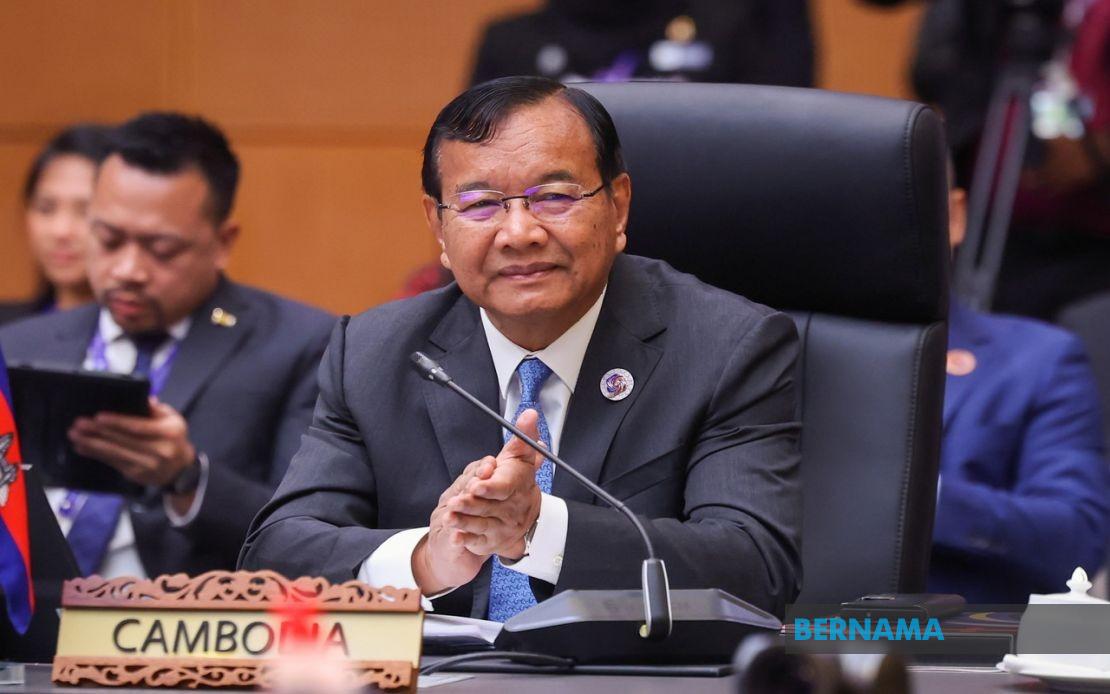
Cambodian Deputy Prime Minister and Foreign Minister Prak Sokhonn touched down at Kuala Lumpur International Airport on Friday, launching a two-day diplomatic mission aimed at revitalising the strategic partnership between Malaysia and Cambodia. The high-level visit, marked by his arrival at KLIA Terminal 1 in the afternoon, underscores both nations' commitment to broadening their engagement across political, economic, and security dimensions. Sokhonn's presence in Kuala Lumpur signals Cambodia's determination to deepen institutional mechanisms for bilateral cooperation at a time when Southeast Asian countries are increasingly prioritising regional integration and intra-regional investment flows.
The Cambodian delegation was received with customary diplomatic protocol, with Cambodian Ambassador to Malaysia Ouk Chandara and Malaysian Government chief ceremony officer Datuk Rozainor Ramli present at the airport to welcome the visiting minister. The ceremonial reception reflects the significance both capitals attach to this engagement, particularly given Cambodia's role within the ASEAN framework and its economic importance to Malaysia's broader regional strategy. Such formal proceedings, while routine in diplomatic practice, carry symbolic weight in affirming the stability and mutual respect characterising the bilateral relationship.
Sokhonn's itinerary prioritises engagement with Malaysia's highest political leadership, with a courtesy call scheduled at Prime Minister Datuk Seri Anwar Ibrahim's office. This meeting provides an opportunity to discuss strategic priorities at the apex level, potentially addressing broader geopolitical developments in Southeast Asia and the region's positioning within global power dynamics. The Prime Minister-level engagement ensures that Cambodia's perspectives on regional security, trade integration, and development challenges are communicated directly to Malaysia's decision-making hierarchy, facilitating high-level problem-solving on contentious or complex issues.
The centrepiece of Sokhonn's visit is the third meeting of the Cambodia-Malaysia Joint Commission for Bilateral Cooperation, a structured institutional forum designed to assess progress on agreed initiatives and chart future directions for bilateral engagement. This meeting will conduct a comprehensive review of implementation outcomes from the second JCBC meeting, examining how previously concluded bilateral agreements have been operationalised and identifying gaps or bottlenecks requiring intervention. Such review mechanisms are crucial for ensuring that diplomatic commitments translate into tangible benefits for both populations and that bureaucratic machinery remains aligned with political intentions.
Beyond the JCBC meeting, bilateral discussions between Sokhonn and Malaysian Foreign Minister Datuk Seri Mohamad Hasan will provide a dedicated platform for detailed policy conversations covering diplomatic, consular, and transnational issues. These talks typically address people-to-people connectivity, labour migration frameworks, cultural exchanges, and coordination on multilateral forums such as ASEAN. Given Malaysia's significant Cambodian diaspora and Cambodia's reliance on Malaysian investment, these conversations carry practical implications for both populations and offer opportunities to address grievances or refine implementation of existing arrangements.
The economic dimension of the bilateral relationship has demonstrated remarkable vitality in recent years. Trade between Malaysia and Cambodia surged 27.4 per cent year-on-year in 2025, reaching RM5 billion, reflecting robust demand and expanded commercial ties across multiple sectors. This growth trajectory outpaces regional average expansion rates and underscores the complementarity of the two economies, with Malaysian companies particularly active in Cambodia's manufacturing, construction, and services sectors. The expansion of bilateral trade contributes to Malaysia's broader economic diversification strategy, reducing dependence on traditional trading partners while building supply chain networks across the Mekong region.
Malaysia's investment footprint in Cambodia further testifies to the depth of economic integration between the nations. With cumulative investments totalling USD3.20 billion across 162 registered projects as of 2024, Malaysia ranks as Cambodia's third-largest foreign investor, behind only China and Vietnam. This investment portfolio spans labour-intensive manufacturing, logistics infrastructure, telecommunications, and financial services, generating employment for thousands of Cambodian workers and contributing substantially to Cambodia's national revenue through taxation and remittances. For Malaysian investors, Cambodia offers lower labour costs, preferential trade access through ASEAN, and proximity to emerging consumer markets in the Mekong region.
The concentration of Malaysian investments in Cambodia reflects long-term confidence in the kingdom's political stability and growth trajectory, despite occasional governance challenges that have preoccupied international observers. Malaysian corporations have developed institutional knowledge of Cambodia's business environment and regulatory systems, positioning them advantageously relative to late-entrant investors. This accumulated presence creates natural constituencies within both countries favouring continued deepening of bilateral ties, as business communities lobby their respective governments for supportive policies and infrastructure investments that facilitate cross-border commerce.
Sokhonn's visit arrives at a moment when both nations navigate complex regional and global developments. Cambodia, as Chair of ASEAN, carries particular diplomatic weight in shaping regional responses to challenges ranging from maritime security to climate change to competition between major powers. Malaysia, with its position as a major Southeast Asian economy and G20 engagement, shares interests in navigating these challenges through multilateral frameworks while protecting its sovereign interests. Bilateral meetings provide opportunities for both nations to coordinate positions on issues affecting their mutual interests and to leverage their respective diplomatic networks for mutual advantage.
The institutional frameworks governing Malaysia-Cambodia relations have evolved significantly over recent decades, reflecting both nations' commitment to systematic engagement rather than ad-hoc diplomacy. The JCBC meeting represents the culmination of this institutional development, providing structured mechanisms for identifying cooperation opportunities and resolving differences through dialogue rather than confrontation. Similar mechanisms exist between Cambodia and other Southeast Asian neighbours, yet each bilateral relationship carries distinct characteristics shaped by historical experiences, economic complementarities, and strategic interests.
Looking forward, the visit carries implications for Malaysia's broader Southeast Asian strategy, which increasingly emphasises deepening ties with regional neighbours across multiple dimensions. As competition between major powers intensifies in the Indo-Pacific region, Malaysia benefits from consolidated relationships with ASEAN partners that enhance regional cohesion and decision-making capacity. Cambodia, despite its strategic alignment with China, maintains diverse international partnerships that include Malaysia, reflecting pragmatic balancing of great-power interests. Sokhonn's presence in Kuala Lumpur reaffirms both nations' commitment to this multifaceted engagement model, ensuring that bilateral relations remain robust regardless of broader geopolitical currents.

