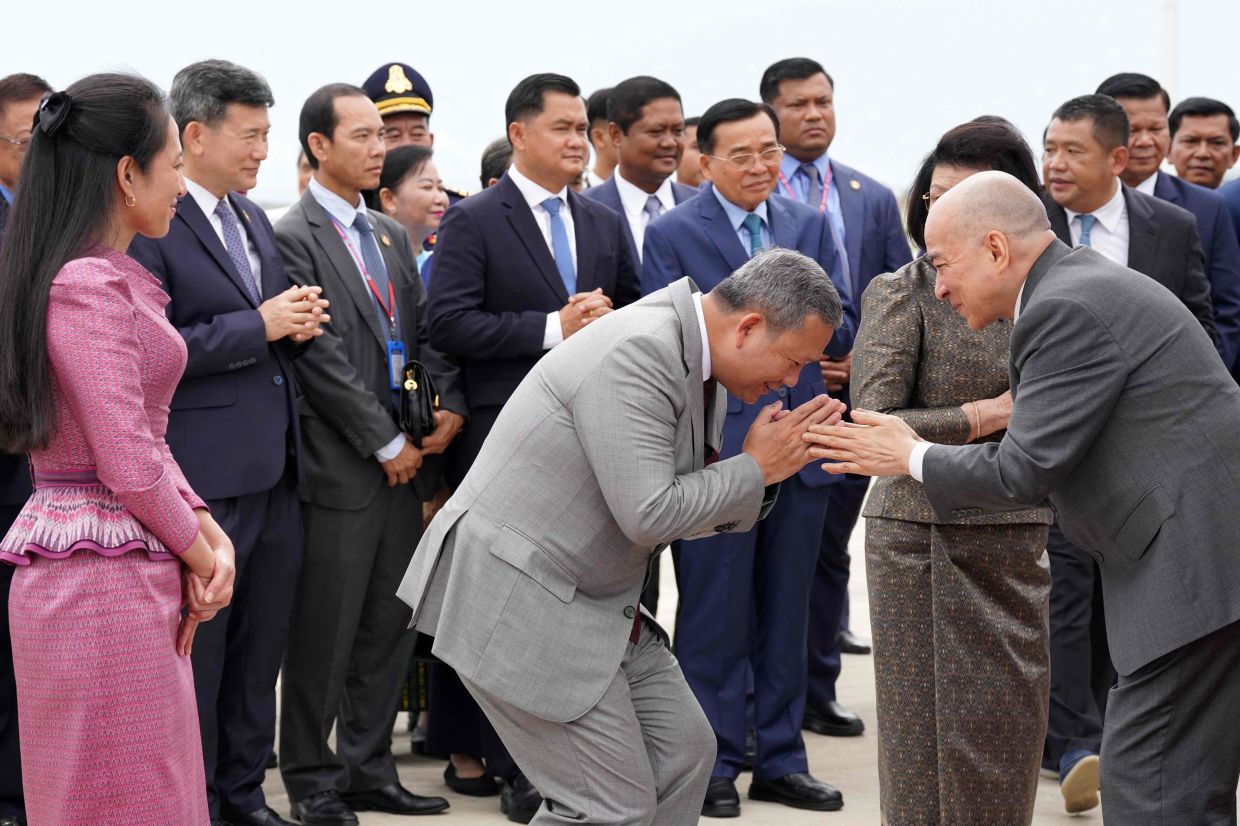
Cambodia's King Norodom Sihamoni arrived back in Phnom Penh on Friday afternoon following an extended medical sojourn in Beijing, marking the conclusion of his cancer treatment in China. The 73-year-old monarch touched down at the airport to a reception that included prominent political figures, underscoring the significance of his return to the Southeast Asian nation. State media confirmed his arrival, with the Royal Palace in Phnom Penh previously indicating that his health trajectory had shown positive signs following intensive medical intervention.
The Cambodian sovereign initially departed for the Chinese capital earlier in the year for routine health evaluations, a visit that ultimately revealed a prostate cancer diagnosis disclosed to the public in April. Rather than seeking treatment domestically, the monarch opted to remain in Beijing, where he underwent surgical intervention described by palace officials as "successful." Chinese medical specialists oversaw his recovery regimen throughout the subsequent months, representing a continuation of Cambodia's established pattern of seeking advanced healthcare services from its powerful neighbour to the north.
Royal Palace statements issued in the days preceding his departure from China detailed encouraging developments in his condition. Officials noted that following more than ninety days of therapeutic care, the king's overall health status had registered measurable improvements. This extended treatment period reflects the comprehensive nature of the medical protocols implemented, moving beyond initial surgical procedures to encompass a complete recuperation phase under professional supervision in one of Asia's most advanced medical centres.
Former Prime Minister Hun Sen, who wielded enormous influence over Cambodian politics for decades, prominently featured in welcoming ceremonies, underscoring the political weight attached to the royal return. However, current Prime Minister Hun Manet, Hun Sen's son who assumed office in August 2023, also participated in the official reception, signifying continuity in Cambodia's institutional hierarchy. The coordinated appearance of both figures highlighted how the monarchy remains a unifying institution across Cambodia's complex political landscape, where generational transitions continue reshaping leadership structures.
King Sihamoni's biography reflects an unusual trajectory to the throne, distinctly different from the typical paths of Southeast Asian monarchs. Before ascending to Cambodia's highest constitutional position in 2004, he devoted most of his adult years to artistic pursuits abroad, cultivating expertise in dance, theatre and cultural studies rather than grooming for royal duties through traditional channels. This background provides him with perspectives shaped by extended residence outside Cambodia and exposure to international cultural traditions. His linguistic capabilities—fluency in Khmer, French, Czech and English—further distinguish him as a cosmopolitan figure within the Cambodian establishment.
The succession circumstances that brought Sihamoni to the throne also merit consideration within the current context. His father, King Norodom Sihanouk, had similarly journeyed to Beijing for cancer treatment before ultimately stepping down from the monarchy, paving the way for his son's ascension nearly two decades ago. The historical parallel between father and son both seeking Chinese medical expertise underscores Cambodia's deep reliance on Beijing for advanced healthcare services unavailable domestically, a dynamic reflecting broader patterns of Sino-Cambodian strategic alignment that extends well beyond medical cooperation.
Cambodia's healthcare infrastructure, while developing, lacks the technological sophistication and specialised oncology capabilities concentrated in major Chinese metropolitan centres. King Sihamoni's decision to pursue treatment in Beijing rather than alternative international medical hubs—such as Singapore or Thailand, both proximate to Cambodia—appears deliberate, reinforcing Cambodia's orientation toward Chinese institutions for matters involving high-stakes medical care. This pattern has become increasingly pronounced during the tenure of Prime Minister Hun Manet, whose administration has accelerated Cambodia's integration with Chinese strategic and economic interests.
The extended nature of the king's Chinese sojourn also illustrates how prostate cancer treatment protocols typically demand sustained engagement rather than episodic intervention. Surgical procedures must be complemented by extended monitoring phases, adjunctive therapies and recuperation schedules that collectively span months rather than weeks. The palace's careful documentation of incremental health improvements suggests a commitment to transparency regarding the monarch's condition, potentially motivated by recognition that public confidence in royal institutions requires candid communication about matters affecting the sovereign's capacity to fulfil constitutional responsibilities.
For Malaysian observers and other Southeast Asian stakeholders, King Sihamoni's medical journey illuminates broader regional patterns regarding healthcare access, medical tourism and the gravitational pull that China's advanced medical infrastructure exerts across Asia. Countries throughout the region grapple with the tension between developing domestic healthcare capacity and leveraging superior foreign facilities for critical interventions. Cambodia's explicit reliance on Beijing for royal-level care simultaneously reflects strategic partnership calculations and pragmatic acknowledgment of capability disparities, a dynamic with implications extending across diplomatic, economic and defence relationships that shape regional geopolitics.
The king's successful recuperation and return also address potential concerns about institutional continuity in a nation where royal stability historically correlates with political equilibrium. Though Cambodia's government functions through a constitutional monarchy framework where the prime minister exercises executive authority, the sovereign's health and presence retain symbolic importance that transcends formal constitutional delineation. Sihamoni's return to active public duties reassures the Cambodian public and international observers that normal institutional functioning has resumed following a period of reduced royal visibility that naturally accompanies serious medical treatment.

