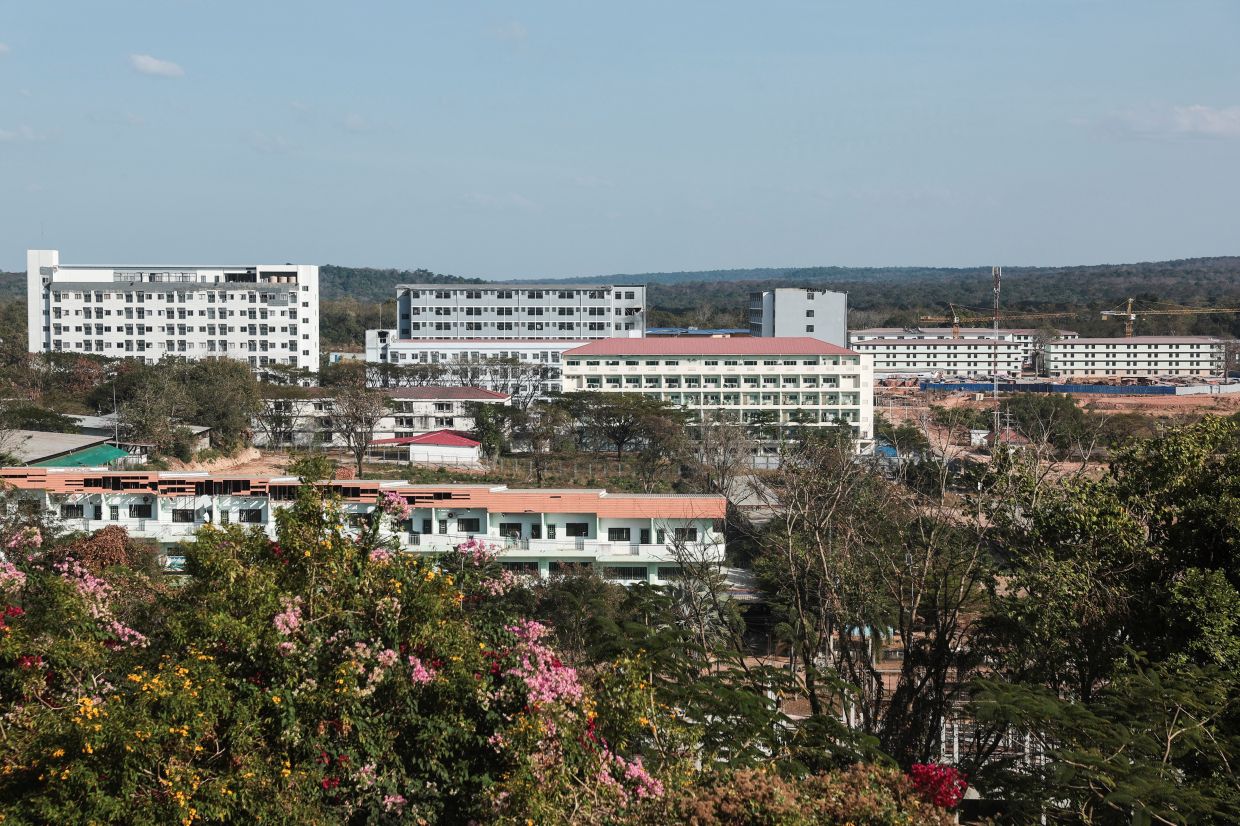
A powerful Cambodian businessman whose gambling empire stretches across the region has come under scrutiny after investigators discovered that his casino complex on the Thai-Cambodian border served as a landlord to one of Southeast Asia's most sophisticated scamming and human trafficking operations. Lim Heng Group, the conglomerate in question, leased multiple buildings within its compound at exceptionally inflated rental rates according to a March 2024 lease agreement reviewed by Reuters, with the structures subsequently converted into elaborate fraud factories complete with fake police stations and bank offices designed to deceive victims across the globe.
The Royal Hill casino, the flagship property of Lim Heng's holdings in O'Smach, sits metres from the Thai frontier and houses the leased buildings where evidence of industrial-scale criminal activity has now emerged. Reuters reporters visited the compound multiple times in 2024 and interviewed Thai military personnel, former workers, and other sources who described how the spaces had been transformed into command centres for romance scams, police-impersonation fraud schemes, and forced labour networks targeting victims in multiple countries. The rental agreement itself shows that three buildings within the compound were leased to a Chinese national for US$200,000 monthly—a sum dramatically exceeding market rates for comparable commercial space in the region.
For context, this rental price far outstrips what similar-sized properties command elsewhere in Cambodia. A mixed-use building of comparable dimensions in Phnom Penh's upscale business districts was advertised at just US$25,000 monthly in May 2024, making the Royal Hill figure roughly eight times higher than what market fundamentals would suggest. Such pricing is consistent with arrangements where landlords either knowingly profit from criminal enterprise or demonstrate such lack of due diligence that they tacitly enable ongoing illegal operations. The disparity raises serious questions about how standard commercial oversight procedures could miss such obvious commercial irregularities.
While Reuters found no direct evidence that Lim Heng Group itself orchestrated the trafficking or fraud schemes, legal experts note that Cambodian prosecutors can bring charges against property owners if investigations establish they knew about criminal activity and allowed it to continue. The company received explicit notice of potential trafficking concerns by September 2024, when representatives filed legal complaints against two Cambodian publishers whose outlets had reported foreign nationals being held within the casino compound. Interestingly, the court summonses did not specify which claims in the published articles prompted the complaint, and one publisher subsequently removed his reporting after legal advice, though the status of the case remains unclear.
Thailand's security establishment has taken a more direct approach to the problem. The Royal Thai Police, conducting investigations into alleged cyberfraud at the compound, attributed the scamming operations to Chinese criminal gangs and have occupied the site following a December 2024 border conflict. Thai security agency reports from 2024 explicitly identify Lim Heng's ownership of the property. The compound itself reveals the scale of operations: at least four fenced-off buildings, surrounded by razor-wire topped perimeter fencing, were used for criminal purposes according to Thai officials and a Thai trafficking survivor who worked at the facility. The fake police stations and bank offices discovered within were designed to impersonate authorities from multiple nations, enabling perpetrators to manipulate victims internationally.
The broader Southeast Asian context makes this revelation particularly significant. The region has become synonymous with organised fraud factories, where predominantly Chinese-led criminal syndicates confine trafficking victims and coerce them into conducting scams targeting vulnerable populations worldwide. American victims alone lost an estimated US$10 billion to regional fraudsters in 2024 according to US government assessments. These operations frequently intersect with casino ownership, as lawful gambling establishments provide convenient mechanisms for money laundering and obscuring illicit proceeds. Jason Tower, an analyst with the Global Initiative against Transnational Organized Crime, notes that casino operations offer traffickers and scammers essential infrastructure for hiding criminal profits within the financial system.
Cambodia's particular vulnerability to this phenomenon reflects deeper governance challenges. An Amnesty International investigation based on gambling regulator records and witness testimony found that casino owners directly controlled at least a dozen scam centres, though Reuters has not independently verified these figures. Cambodian casinos are typically owned by businesspeople with robust political connections, according to Sophal Ear, a professor studying Cambodian politics at Arizona State University. Lim Heng exemplifies this pattern: he has appeared at social gatherings with senior military commanders, holds a royal title equivalent to ducal rank, and donated US$20,000 to Cambodia's armed forces last year according to business association records.
The Cambodian government has publicly committed to eradicating scam centres and has taken some concrete steps, including extraditing casino operator Chen Zhi, an alleged scamming kingpin, to China and enacting legislation specifically targeting fraud perpetrators. However, inconsistencies in official messaging undermine these efforts. Cambodian authorities have repeatedly characterised Royal Hill as merely a hotel despite broadcast evidence worldwide of the fake police stations and banking facilities discovered within the compound. This disconnect between public pronouncements and documented reality suggests either systematic evasion or institutional capture.
Chhay Sinarith, the senior Cambodian minister responsible for combating online fraud, responded to Reuters' inquiries by reaffirming governmental commitment to international cooperation and noting that investigations are proceeding around the Royal Hill area. However, he notably requested that Thai security forces return control of seized locations to facilitate Cambodian probes—a position that effectively seeks to reclaim sites from the neighbouring country's custody. The Cambodian military declined to address questions about its relationship with Lim Heng, maintaining silence on this politically sensitive intersection between business, military ties, and organised crime.
For Malaysian and broader Southeast Asian audiences, this case illuminates a critical vulnerability in regional stability and security architecture. When prominent businesspeople with military patronage operate properties that serve as international crime hubs, it reflects institutional weaknesses that transcend Cambodia's borders. Malaysia, as a region with its own gambling enterprises and cross-border criminal networks, faces similar risks. The case demonstrates how international criminal syndicates exploit the intersection of inadequate oversight, political connections, and the profitability of casino operations. The fact that such elaborate fraud machinery could operate for extended periods within sight of a border—metres from Thai territory—suggests coordination failures and possible complicity at institutional levels.
Further complicating matters is the jurisdictional complexity. Thai military occupation of the site following December's border conflict has created an unusual investigative arrangement where one nation's security forces control evidence related to crimes perpetrated by nationals of third countries against victims worldwide. This structure, while providing some accountability mechanism in the absence of Cambodian action, raises questions about evidence integrity and prosecutorial authority. Regional governments, particularly Malaysia and Thailand, should view this episode as illustrative of how organised crime, political patronage, and weak governance create security vacuums that transnational criminal networks eagerly exploit.
The broader implication for Southeast Asia concerns the sustainability of current governance models in border regions where corruption and organised crime intersect with military and political power structures. Until such intersections are systematically dismantled through genuine accountability mechanisms, the region will continue hosting the world's most sophisticated scamming and human trafficking operations, extracting billions from global victims while destabilising regional security.

