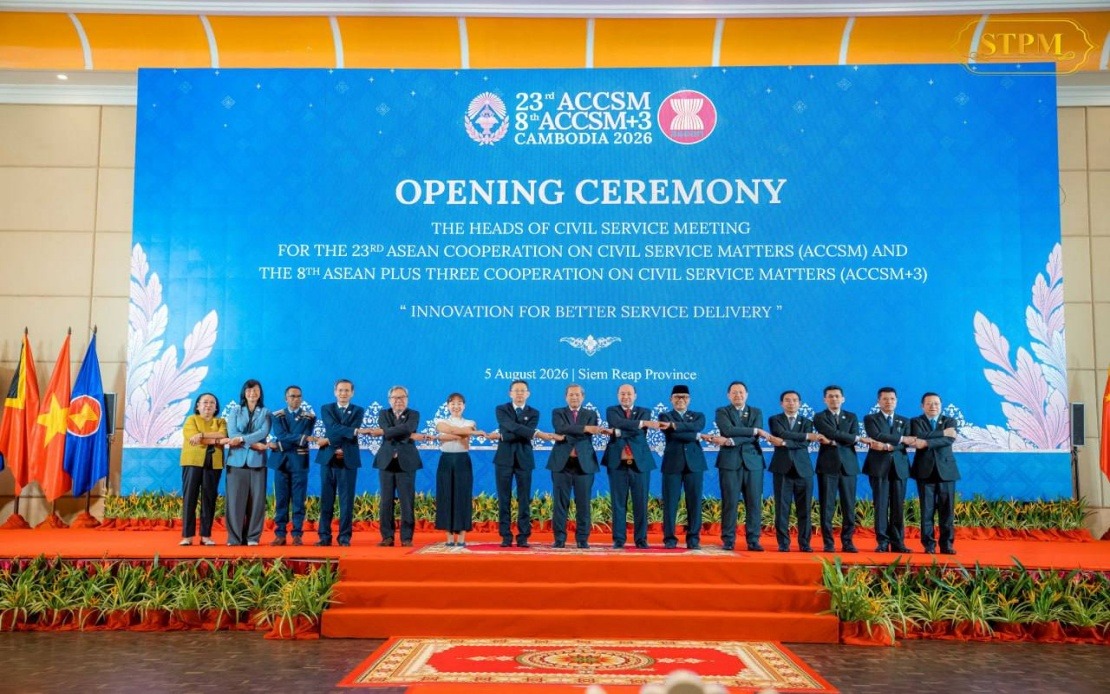
Cambodian Prime Minister Hun Manet has urged ASEAN member states to embrace artificial intelligence and digital transformation as tools for delivering superior public services and reducing development disparities throughout the region. Speaking at a major gathering of regional civil service officials this week, Hun Manet positioned technological innovation not as an end in itself, but as a means to address the concrete needs of ordinary citizens across Southeast Asia's ten nations.
The prime minister's intervention at the 23rd ASEAN Cooperation on Civil Service Matters and the 8th ACCSM+3 conference in Siem Reap reflects growing momentum within the bloc to modernise government administration. However, Hun Manet's framing carries a distinctly cautious note, emphasising that ASEAN's approach to digital transformation must remain grounded in practical considerations rather than becoming a race to implement cutting-edge technology for its own sake.
Hun Manet's core argument centres on the notion that any meaningful innovation programme must rest upon two foundational pillars: institutional capacity and human resources. This emphasis addresses a critical reality for many Southeast Asian governments struggling to develop the skilled workforces necessary to manage sophisticated digital systems. Without investing in training, education, and organisational infrastructure, even the most advanced AI tools risk becoming expensive liabilities rather than transformative assets.
The Cambodian leader explicitly acknowledged ASEAN's heterogeneous composition, with member states ranging from highly developed economies to those still grappling with significant poverty and infrastructure deficits. Rather than impose a uniform technological roadmap, Hun Manet advocated for a calibrated approach allowing each country to adopt new technologies, particularly artificial intelligence, at a sustainable pace suited to its own circumstances. This framework recognises that Cambodia, Myanmar, Laos, and Vietnam face vastly different implementation challenges compared to Singapore or Brunei.
For Malaysian policymakers and business leaders, Hun Manet's remarks carry particular relevance. Malaysia occupies a middle position within ASEAN's development spectrum, having made substantial progress in digital infrastructure yet still identifying efficiency gaps in public service delivery. The emphasis on people-centred innovation aligns with Malaysia's own digital transformation initiatives, which increasingly focus on improving citizen engagement and reducing bureaucratic friction rather than simply automating existing processes.
The conference's overarching theme of "Innovation for Better Service Delivery" reflects a broader regional shift in how governments conceptualise technological modernisation. Rather than viewing digital transformation as primarily a cost-reduction exercise or a way to enhance administrative control, ASEAN's civil service leaders are increasingly framing it as an opportunity to deepen relationships with citizens and solve persistent problems that individual countries cannot address in isolation.
Hun Manet's call for knowledge sharing and collaborative adaptation speaks directly to challenges confronting all Southeast Asian nations simultaneously. Climate-related disasters, uneven economic development, and poverty represent transnational issues that demand coordinated responses. By positioning the ACCSM platform as essential infrastructure for mutual learning and capacity-building, the Cambodian PM emphasised that innovation cannot succeed through isolated national efforts alone.
The broader context involves ASEAN governments simultaneously accelerating AI adoption while navigating legitimate concerns about implementation risks. Questions surrounding data privacy, algorithmic bias, workforce displacement, and equitable access to technological benefits remain largely unresolved across the region. Hun Manet's emphasis on institutional capacity and human resources implicitly acknowledges these tensions, suggesting that sustainable digital transformation requires addressing governance and equity questions alongside technical ones.
For Southeast Asian nations including Malaysia, the challenge lies in translating Hun Manet's principles into concrete policy frameworks. This requires investing heavily in civil service training programmes, establishing robust data governance standards, and ensuring that AI-powered public services actually benefit marginalised populations rather than exacerbating existing inequalities. Several ASEAN members have begun developing national AI strategies, but these remain works in progress, with implementation timelines and resource commitments still uncertain in many cases.
The Siem Reap conference represents a significant moment for ASEAN's collective approach to digital governance. By elevating these discussions to the highest levels of government, the region signals commitment to treating innovation as a strategic priority rather than peripheral technical matter. However, translating conference rhetoric into functioning systems requires sustained political will, adequate funding, and genuine regional cooperation mechanisms that extend beyond periodic gatherings.
Looking ahead, ASEAN's success in building people-centred, AI-ready public services will substantially depend on how effectively member states execute on the principles Hun Manet articulated. This means resisting pressure to adopt technologies prematurely, investing consistently in institutional development, and maintaining focus on citizen outcomes rather than becoming distracted by technological novelty. For Malaysia and other regional economies, the real work begins now in transforming aspirational frameworks into operational reality.

