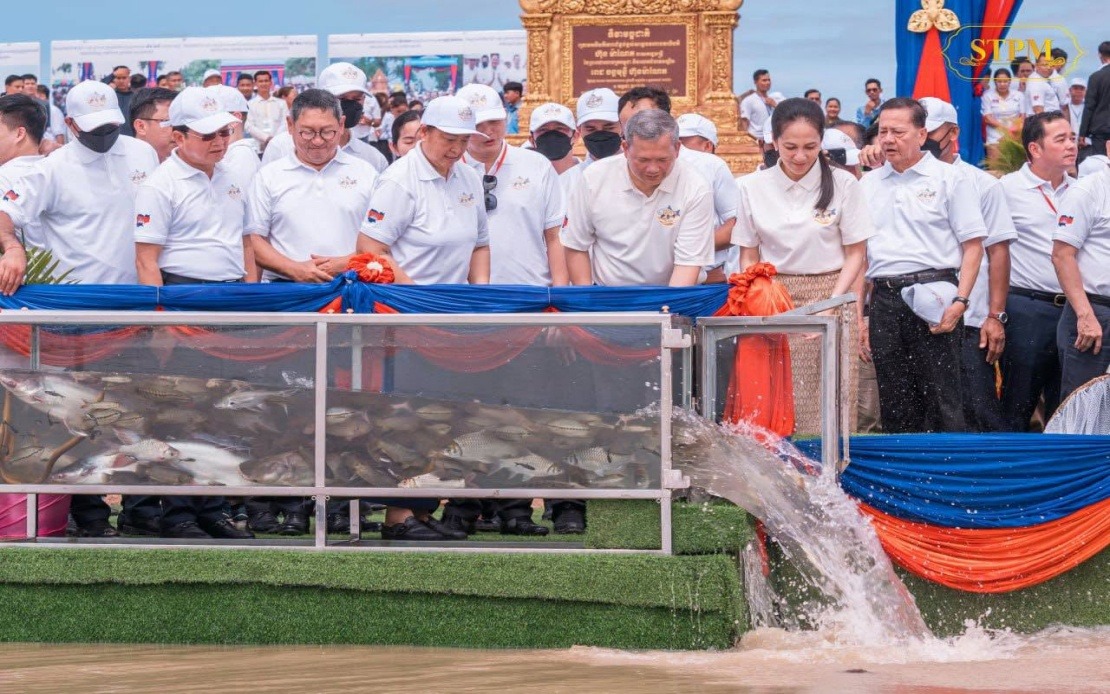
Cambodian Prime Minister Hun Manet has issued direct orders to strengthen enforcement against illegal fishing operations in key spawning regions, underscoring the government's determination to protect the nation's depleting marine and freshwater resources. Speaking at the National Fish Day celebration in Svay Rieng Province on Wednesday, Hun Manet acknowledged that unlicensed fishing activities pose an escalating threat to Cambodia's aquatic ecosystems and the economic survival of thousands of subsistence fishermen who depend on healthy fish populations.
The directive represents a significant escalation in Cambodia's approach to natural resource management, with military units already deployed across regions including the Tonle Sap Lake basin now receiving explicit orders to intensify patrols and enforcement operations. Hun Manet revealed that Cambodia's armed forces have spent the past two years conducting wide-ranging crackdowns on resource-related crimes affecting both terrestrial and marine environments, though the government recognises that this reliance on military intervention remains unsustainable in the long term. The underlying challenge stems from a chronic shortage of specialised civilian law enforcement personnel equipped to handle the technical and investigative demands of environmental crime prosecution.
The Prime Minister's comments expose a critical infrastructure gap within Cambodia's governance framework: the absence of a dedicated fisheries enforcement agency capable of managing the complex legal and operational requirements of marine resource protection. Rather than continuing to divert military resources from border security and other national defence priorities, Hun Manet indicated the government intends to build civilian capacity, though specific timelines and budgetary commitments remain unspecified. This gradual transition from military to civilian oversight reflects international best practice in fisheries management, though such institutional development typically requires years of investment in training, equipment, and legal frameworks.
A particularly damaging practice targeted by the new enforcement orders is large-scale clam dredging, which Hun Manet characterised as directly undermining the livelihoods of fishing communities dependent on coastal and river ecosystems. Mechanical dredging operations destroy seabeds and disrupt breeding habitats, causing cascading ecological damage that extends far beyond the immediate extraction area. By ordering an immediate cessation of such activities, Hun Manet has signalled zero tolerance for industrial-scale extraction that prioritises short-term profit over ecosystem preservation, though enforcement of such prohibitions across Cambodia's extensive waterways will prove logistically challenging.
The Prime Minister's rhetoric positioning fisheries as the nation's "source of protein" alongside agriculture as the "nation's stomach" reflects Cambodia's continued dependence on primary sectors for both food security and rural livelihoods. Approximately 75 percent of Cambodia's rural population relies directly or indirectly on fisheries and aquaculture, making the sector functionally inseparable from poverty reduction strategies and national stability. Any degradation of fish stocks compounds existing vulnerabilities in food security, particularly affecting the poorest households in remote provinces who lack alternative income sources or access to imported protein sources.
The practical demonstration of commitment came through the simultaneous release of 1.5 million fish and other aquatic organisms into the Vai Ko River in Svay Rieng Province, a restocking effort intended to replenish declining populations and restore breeding capacity. Such initiatives, while symbolically important and potentially beneficial if executed scientifically, require complementary habitat protection measures to be genuinely effective. Fish restocking alone cannot succeed if illegal harvesting continues unabated in spawning areas, highlighting why Hun Manet's enforcement orders represent the essential corollary to conservation activities.
Cambodia's struggle against illegal fishing reflects broader Southeast Asian challenges, with neighbouring countries including Vietnam, Thailand, and Myanmar facing comparable pressures from transnational fishing networks operating with sophisticated equipment and minimal regard for conservation regulations. The Tonle Sap Lake, among the world's most biodiverse freshwater ecosystems, faces particular vulnerability given its international significance and the fishing communities that span multiple national jurisdictions. Enhanced bilateral and multilateral cooperation mechanisms remain underdeveloped in the region, allowing sophisticated illegal fishing operations to exploit gaps in enforcement coordination and inconsistent regulatory standards across borders.
For Malaysian stakeholders, Cambodia's fisheries challenges carry indirect implications. Regional fish stocks and trade patterns remain interconnected through the Association of Southeast Asian Nations framework, and deteriorating productivity in Cambodia's waters contributes to increased pressure on Malaysian fishing zones as operators search for replacement catches. Additionally, Malaysian companies engaged in aquaculture and fishing equipment manufacturing maintain significant commercial interests in the Cambodian market, making the regulatory environment consequential for business operations. Southeast Asian fisheries ministers would benefit from intensified dialogue regarding harmonised enforcement approaches and shared commitment to sustainable harvesting practices.
Hun Manet's initiatives also reflect broader governance modernisation within Cambodia, signalling that resource protection and environmental stewardship are emerging as policy priorities alongside traditional security and development concerns. The integration of fisheries management into national strategic planning, evidenced through high-level political engagement and dedicated military resources, suggests growing recognition that environmental degradation constitutes a legitimate threat to state stability and prosperity. However, translating political commitment into sustained institutional change requires years of consistent funding, technical expertise development, and political will across multiple administrative levels.
The sustainability of enforcement efforts depends ultimately on whether Cambodia can transition from temporary military deployments to permanent institutional capacity within the civilian fisheries administration. International donor support for capacity building, technology transfer, and training programmes could accelerate this transition, though such assistance typically arrives with conditions and expectations regarding governance standards. Hun Manet's acknowledgement of this challenge represents a constructive first step, but transformation of enforcement capacity requires multi-year commitment and protection from competing budget pressures that routinely affect resource management initiatives in developing economies.

