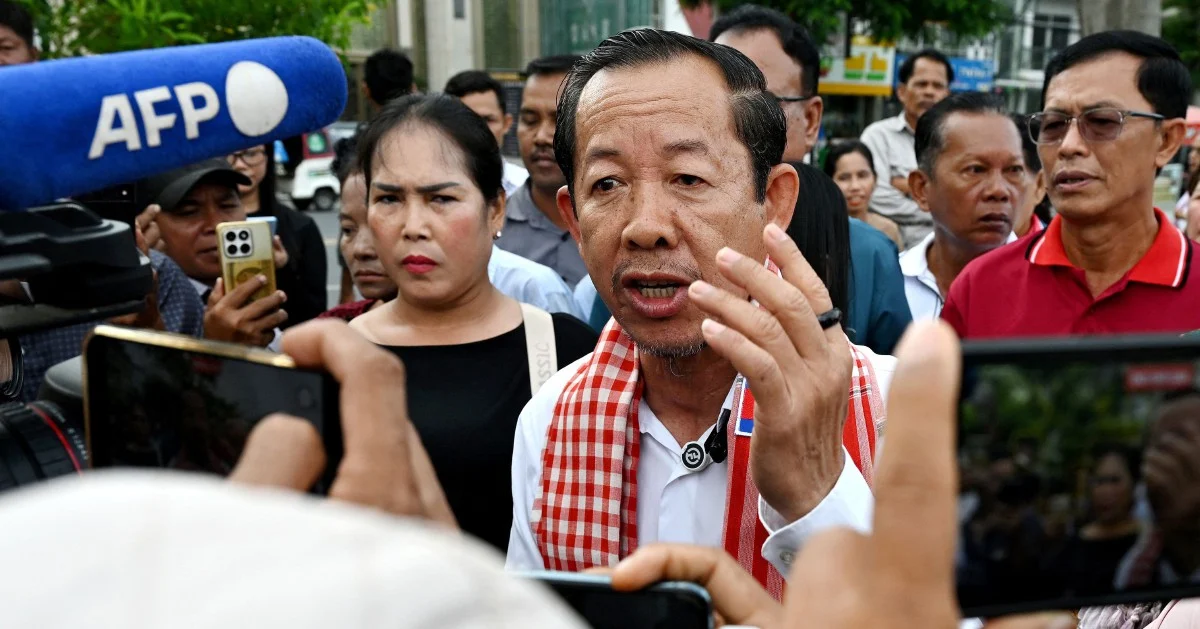
Cambodia's Supreme Court has delivered a mixed verdict on opposition politician Rong Chhun, suspending the prison sentence imposed against him while simultaneously maintaining restrictions that bar him from seeking elected office. The ruling, announced on Friday through his legal team, represents a complex outcome typical of Cambodia's contested political landscape, where court decisions often blend procedural leniency with substantive political limitations that curtail opposition activism.
Rong Chhun, a prominent figure within Cambodia's fragmented opposition movement, had faced a custodial sentence following earlier court proceedings. The Supreme Court's decision to suspend this prison term may be viewed as a procedural concession, potentially reflecting pressure from international observers concerned about the country's democratic governance standards. However, the court's simultaneous reaffirmation of the electoral ban demonstrates that such relief remains circumscribed within boundaries set by Cambodia's ruling authorities.
The election ban represents the more consequential aspect of the judgment, effectively removing Rong Chhun from electoral competition for a prescribed period. This mechanism has become increasingly prevalent in Cambodian politics as a tool for disqualifying opposition candidates without formally imprisoning them, thereby maintaining appearances of judicial process while achieving the same political outcome. For opposition figures, the electoral prohibition effectively suspends their capacity to contest power through democratic channels, rendering their political influence dependent on extraparlimentary activities.
Cambodia's judicial system has faced sustained criticism from human rights organisations and Western governments regarding its independence and impartiality. International observers have documented patterns where court decisions appear aligned with interests of the ruling Cambodia People's Party rather than neutral application of established law. The treatment of opposition politicians through varying combinations of imprisonment and electoral bans suggests a calibrated approach where authorities weigh international scrutiny against domestic political objectives.
Rong Chhun's case reflects broader constraints facing Cambodia's opposition landscape. Following the 2017 dissolution of the Cambodia National Rescue Party, the country's principal opposition organisation, Cambodia's political opposition remains fragmented across multiple smaller parties and civil society organisations. Leaders within these movements face recurring legal challenges ranging from defamation suits to sedition accusations, creating an environment where political participation entails substantial legal risks.
For Malaysian observers, Cambodia's approach to opposition restriction offers instructive comparison with Southeast Asian governance patterns. Several countries in the region employ similar mechanisms combining selective prosecutions with electoral disqualifications to constrain opposition activity whilst maintaining formal democratic institutions. Thailand's multiple constitutions have incorporated analogous provisions, and questions regarding electoral eligibility and legal restrictions on candidates remain contested terrain across Southeast Asia.
The economic and diplomatic implications of Cambodia's governance trajectory extend beyond domestic politics. Western countries condition development assistance and trade benefits partly on democratic performance metrics, creating tension between international standards and Cambodia's strategic alignment with China. Judicial decisions affecting opposition figures inevitably intersect with these broader geopolitical calculations, as international responses affect Cambodia's standing in multilateral forums and bilateral relationships.
Rong Chhun's experience demonstrates how electoral bans function as effective political exclusion mechanisms despite formal judicial processes. Unlike outright imprisonment, which generates international headlines and potential sanctions, electoral disqualification operates through lawful procedures whilst achieving comparable political results. This approach attracts less international criticism whilst substantially limiting opposition capacity to mobilise electoral constituencies.
The Supreme Court's splitting of its decision—suspending prison time whilst maintaining electoral restrictions—may reflect internal calculations within Cambodia's judiciary and ruling establishment. Suspending imprisonment could represent acknowledgment of pressure regarding human rights standards, whilst upholding the electoral ban preserves the substantive political outcome. Such bifurcated verdicts are common in judicial systems where formal independence coexists with political constraint.
For Cambodia's opposition movement, the ruling underscores the precarious position of political leaders operating outside the ruling party's framework. Rong Chhun's situation illustrates how opposition figures navigate a landscape where legal vulnerabilities remain perpetual and court outcomes rarely provide decisive relief. The combination of suspended sentences and electoral bans essentially maintains political marginalisation whilst reducing the visible severity that full imprisonment would entail.
Cambodia's trajectory raises questions about the efficacy of opposition strategies within constrained democratic systems. When electoral participation itself becomes legally hazardous through bans and restrictions, opposition movements must reconsider organisational models and political tactics. Civil society mobilisation, advocacy networks, and regional coordination become alternative pathways when domestic electoral competition becomes administratively restricted.
The regional implications warrant attention as other Southeast Asian governments may observe Cambodia's experience with electoral bans as a mechanism for managing opposition activity. Democratic governance in the region continues evolving in directions that formally preserve institutional structures whilst substantially constraining opposition participation. Rong Chhun's case exemplifies how such constraints operate through ostensibly lawful judicial processes rather than overtly authoritarian suppression.


%22%2F%3E%3C%2Fpattern%3E%3C%2Fdefs%3E%3Crect%20width%3D%22100%25%22%20height%3D%22100%25%22%20fill%3D%22url(%23ph4xn2fg)%22%2F%3E%3Crect%20width%3D%22100%25%22%20height%3D%22100%25%22%20fill%3D%22url(%23ph4xn2fp)%22%2F%3E%3Ctext%20x%3D%2250%25%22%20y%3D%2250%25%22%20text-anchor%3D%22middle%22%20dominant-baseline%3D%22central%22%20fill%3D%22rgba(255%2C255%2C255%2C0.95)%22%20font-family%3D%22Georgia%2C%20'Times%20New%20Roman'%2C%20serif%22%20font-weight%3D%22700%22%20font-size%3D%22272%22%20letter-spacing%3D%22-0.02em%22%3ESeven%3C%2Ftext%3E%3C%2Fsvg%3E)